
Retailers have more data than ever, yet many merchandise plans are still built on historical averages, broad store groupings, static option counts, and manual reconciliation. The result is a familiar gap between financial intent and demand reality.
Planning leaders see the potential of AI, but they are right to be cautious. They do not need black-box plans that override brand strategy, supplier constraints, store realities, or merchant judgment. The real question is not whether AI can generate another forecast. It is whether AI can help planners make better decisions.
AI merchandise planning creates value when it turns demand signals into practical planning choices: which products belong in the assortment, how stores should be clustered, what size curves should look like, how new products should be matched to prior performance, and how much inventory should be bought. The strongest approaches keep planners in control and connect those choices to SKU-store actions across allocation, replenishment, transfers, promotions, in-season purchasing, and lifecycle management.
O que você aprenderá
- What AI merchandise planning means in practical retail terms
- How AI supports clustering, assortment planning, product similarity, size curves, and buy quantities
- Why better forecasting alone does not solve merchandise planning imbalance
- How planners stay in control through assumptions, constraints, approvals, and exception management
- What to evaluate in retail planning AI software
- How demand-based planning connects pre-season plans to in-season execution through the Inventory Intelligence Loop
What is AI merchandise planning?
AI merchandise planning is the use of artificial intelligence and machine learning to translate demand, product, store, size, financial, and constraint signals into better merchandise planning decisions. It helps planners evaluate more variables, identify patterns faster, and make more informed calls without handing over strategic control.
Traditional planning often starts with last year, a top-down financial target, and a set of spreadsheet assumptions. AI in merchandise planning gives teams a richer view of how demand behaves by product attribute, location, size, channel, season, promotion, and lifecycle stage.
The objective is decision support, not autonomous planning. Retail planning AI should help planners build demand-based plans, test tradeoffs, and reconcile bottom-up quantity recommendations to financial targets. In Onebeat’s view, the useful version is Precision Inventory Intelligence for Retail Planning & Execution: intelligence that connects planning intent, live demand, and executable inventory action.
Why AI matters now for merchandise planning
Retail planning has become harder to manage with static planning cycles. Product lifecycles are shorter. Demand is more fragmented by store, channel, size, and local context. Working capital pressure makes overbuying more expensive, while missed demand in the wrong locations damages full-price sell-through.
AI is already on the retail agenda. In a 2025 survey, NVIDIA reported that 89% of retail and CPG respondents were actively using AI in operations or assessing AI projects, and 97% expected AI spending to increase in the next fiscal year. That does not mean every AI project is useful. It means planning leaders need a practical way to separate decision-ready AI from hype.
McKinsey notes that AI can reduce reporting burdens and help merchants spend more time on strategy and decision-making. For planning teams, the opportunity is not faster reporting. It is adaptive merchandise planning that reads changing demand, preserves financial discipline, and still respects constraints such as budgets, lead times, store capacity, and supplier limits.
How AI improves merchandise planning decisions
AI improves merchandise planning by helping planners translate demand signals into better assortment, cluster, product similarity, placeholder, size curve, bottom-up buy, and scenario decisions. The value is not a single answer. The value is clearer tradeoffs, better starting assumptions, and faster movement from planning intent to inventory action.
Demand sensing for planning inputs
Demand sensing gives planners a stronger starting point than broad historical averages. It can read sales patterns, inventory positions, sell-through, channel shifts, promotional activity, seasonality, returns, local events, and recent demand changes. A planner still decides what to do with that signal, but the plan begins closer to reality.
For example, a category may look healthy in aggregate while specific stores are selling through core sizes twice as fast as the chain average. AI can surface that pattern early enough to influence the buy, the first allocation, or the replenishment logic.
Store clustering based on real demand behavior
Store clustering is one of the most practical AI use cases in merchandise planning. Many retailers still cluster stores by geography, format, volume tier, or legacy assumptions. Those groupings can hide meaningful demand differences.
AI can group stores by how products actually sell. A resort location, an urban flagship, and a suburban mall store may all belong to the same region, but they may need different colors, size depth, price points, or replenishment logic. Better clusters help planners localize assortment depth and inventory investment without planning every store from scratch.
The planning-to-execution link matters here. A demand-based cluster should not live only in a planning workbook. It should inform opening allocation, replenishment targets, transfer logic, and in-season exception review at the SKU-store level.
Product similarity and placeholder matching for newness
New products create a planning blind spot because they lack sales history. AI can compare new styles or placeholders against comparable products based on attributes, price, silhouette, color, fabric, brand, channel behavior, and historical demand patterns.
Instead of assigning a new item to a generic average, planners can see which past items are the best analogs, where those analogs sold, which sizes moved fastest, and where markdown exposure appeared. The planner can then adjust for brand intent, trend risk, supplier constraints, and the role of the item in the assortment.
Size curves and bottom-up buy quantities
Size curves are often where planning accuracy breaks down. A chain-level curve may be directionally right, but still wrong for a store cluster, product type, climate, or lifecycle stage. AI can refine size-level demand by product, cluster, season, and channel so planners can place depth where it has a better chance of selling at full price.
This is where demand-based planning becomes concrete. At the assortment-group level, AI can help planners build merchandise pyramids and granular buy quantities from the bottom up. Core basics may need reliable depth, seasonal items may need controlled breadth, and fashion or test items may need smaller buys with faster read-and-react triggers.
The planner still reconciles the recommendation to the financial plan. If the bottom-up quantity exceeds the budget, AI should help show which options to cut, which clusters to protect, which sizes carry the most risk, and where the inventory investment is most likely to support full-price sell-through.
Scenario planning and tradeoff visibility
Merchandise planning is full of tradeoffs. A deeper buy can protect availability but raise markdown exposure. A narrower assortment can reduce complexity but miss local demand. A broader size curve can improve service in some stores but tie up units in others.
AI can compare scenarios across sales potential, margin, inventory investment, sell-through, availability, capacity, and markdown risk. The best output is not a forced answer. It is a clear view of what changes when planners choose one path over another, including what must happen in allocation, replenishment, transfers, or promotions for the scenario to work.
What AI should not do in merchandise planning
AI should not override brand strategy, remove accountability, or create black-box plans that cannot be explained. Retail planning requires context that lives outside the data: brand position, assortment architecture, supplier realities, visual merchandising, customer promise, and leadership appetite for risk.
AI should not turn forecasting into false certainty
One of the most common mistakes is treating a better forecast as the same thing as a better merchandise plan. Forecasts estimate demand. Merchandise planning determines how retailers respond to demand through assortments, quantities, localization, and execution decisions.
A forecast can be accurate in aggregate and still produce the wrong inventory outcome. The plan may overbuy weak clusters, underbuy high-performing sizes, miss newness, or fail to trigger replenishment and transfers quickly enough. Better forecasting helps, but it does not solve inventory imbalance on its own.
AI should not ignore constraints
A recommendation that ignores constraints is not a decision. It is a suggestion the business cannot execute. Retail planning AI should account for budgets, minimum order quantities, lead times, supplier limits, store capacity, pack sizes, presentation minimums, lifecycle stage, and margin requirements.
AI should explain why a recommendation changed. If a planner cannot see which demand signal, constraint, or business rule influenced the answer, the team will struggle to trust it.
AI should not remove planner judgment
Retailers should be skeptical of claims around fully autonomous planning, perfect forecasts, guaranteed outcomes, or planner replacement. Effective AI supports decision-making. It does not eliminate uncertainty, and it does not take ownership of the business tradeoff.
The goal is not another dashboard, generic AI layer, or forecasting tool. The goal is controlled decision support that helps planners decide what to buy, where to place it, how much risk to take, and when to adapt.
How planners stay in control
The strongest AI merchandise planning approaches are built around human-in-the-loop governance. Planners remain responsible for brand strategy, assortment intent, financial targets, supplier realities, and final tradeoffs. AI helps them see the decision more clearly.
In practice, that means using AI to surface opportunities, risks, and exceptions while keeping human expertise at the center of the planning process.
Planner-controlled assumptions and constraints
Planners should be able to define the assumptions the AI is allowed to work within. That includes financial targets, option-count ranges, target weeks of supply, depth by role in the assortment, vendor constraints, presentation minimums, and thresholds for review.
Those controls keep AI aligned with merchandising strategy. A model may see demand for a trend item, but the planner may know the brand should limit exposure. A model may recommend deeper size coverage, but the planner may need to preserve budget for a different assortment group.
Exception management and approval workflows
Planner control does not mean reviewing every product-location-size combination manually. AI should help planners focus on the decisions where intervention is most likely to create value.
Exception management can flag unusual demand shifts, high-risk buys, weak analog matches, size-curve outliers, capacity conflicts, and recommendations that cross a financial or operational threshold. Approval workflows then route high-impact changes to the right people before they affect allocation, replenishment, or in-season purchasing.
Which decisions become faster or better with retail planning AI?
Retail planning AI should be judged by the quality of the decisions it improves. A useful system helps planners move faster on assortment depth, store clusters, placeholder selection, size curves, buy quantities, scenario comparisons, financial reconciliation, allocation handoffs, and in-season adjustment triggers.
Analyst categories for AI-driven assortment planning now include capabilities such as product and variant management, clustering, customer analytics, forecasting, simulations, and scenario planning. For planning leaders, the practical question is whether those capabilities improve the choices teams make each season, each buy, and each in-season review.
- Assortment depth: Which assortment groups deserve more breadth or depth based on demand behavior and financial targets?
- Store cluster definitions: Which stores behave similarly enough to plan together, and where should the cluster change?
- Placeholder and product analog choices: Which past items give the best starting point for newness?
- Size curve estimates: Which sizes should receive more depth by product type, store cluster, and season?
- Bottom-up buy quantities: How much inventory should the retailer commit before reconciling back to the financial plan?
- Scenario comparisons: What happens to margin, sell-through, inventory risk, and availability if the plan changes?
- Financial reconciliation: Where does the demand-based plan fit the target, and where does it conflict with the target?
- Execution handoffs: Which planning decisions should trigger allocation, replenishment, transfer, promotion, in-season purchasing, or lifecycle actions?
What to look for in retail planning AI software
A planning leader should not evaluate AI by the number of models, dashboards, or generic recommendations it can produce. The evaluation should start with decision quality and planner control.
- Does it explain the demand signals behind each recommendation?
- Can planners control assumptions, thresholds, constraints, and approval rules?
- Can it plan at the level where decisions happen: assortment group, SKU, store, size, channel, and lifecycle stage?
- Does it support product similarity, placeholder matching, size curves, bottom-up quantities, and scenario tradeoffs?
- Can it reconcile demand-based recommendations to financial targets?
- Can recommendations become executable actions across allocation, replenishment, transfers, promotions, in-season purchasing, and lifecycle management?
- Does execution feedback improve future planning decisions?
That last question is where many planning tools stop short. If recommendations remain trapped inside a planning process, the business still has to translate them manually into inventory action.
Dica profissional
Do not evaluate AI merchandise planning by forecast accuracy alone. Ask which decisions the AI improves, which assumptions planners can control, and whether recommendations can become executable inventory actions.
AI merchandise planning works best when it connects to execution
A merchandise plan creates value only when it influences what happens next. Many retailers struggle because planning and execution operate in separate processes, systems, and timelines. The plan may be carefully built, but the actual inventory decisions still happen later through allocation rules, replenishment logic, manual transfers, promotion overrides, and end-of-season markdown calls.
Onebeat’s perspective is that planning should connect directly to execution through Precision Inventory Intelligence. Demand signals inform planning decisions, planning decisions inform SKU-store inventory actions, and execution outcomes provide feedback that improves future decisions.
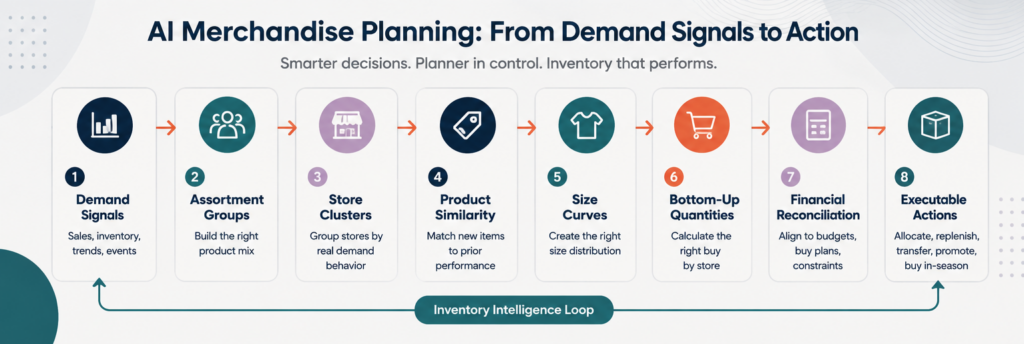
This is the Inventory Intelligence Loop: plan, sense, decide, execute, and learn. The loop turns merchandise planning from a one-time seasonal exercise into an adaptive operating model. Pre-season intent guides the initial plan, live demand changes the priorities, planners review exceptions, and execution data feeds the next decision cycle.
Planning tools plan. Onebeat runs the loop. By connecting merchandise planning with allocation, replenishment, transfers, promotions, in-season purchasing, and lifecycle management, retailers can move from static plans to adaptive execution while keeping planners accountable for the decisions that shape revenue, margin, and inventory productivity.
Key Takeaway
AI improves merchandise planning when it helps planners make better decisions from demand reality: stronger assortments, better clusters, smarter size curves, clearer tradeoffs, and more informed buy quantities. The strongest retail planning AI is explainable, governed, and connected to execution.
Perguntas frequentes
What is AI merchandise planning?
AI merchandise planning uses demand, product, store, size, financial, and constraint data to improve merchandise planning decisions. It supports planners with better signals and recommendations while keeping strategic control with the planning team.
How does AI improve merchandise planning?
AI improves merchandise planning by identifying demand patterns, store clusters, comparable products, size curves, bottom-up quantities, exceptions, and financial tradeoffs faster than manual processes.
Will AI replace merchandise planners?
No. AI should support planners with decision intelligence, scenario visibility, and exception management. Planners still own brand strategy, assortment intent, constraints, approvals, and final tradeoffs.
How is AI in merchandise planning different from forecasting?
Forecasting estimates demand. Merchandise planning decides how to respond through assortments, quantities, clusters, size curves, localization, and execution handoffs.
What should retailers look for in retail planning AI?
Retailers should look for explainable recommendations, planner-controlled assumptions, constraint-aware scenarios, size and store-level granularity, financial reconciliation, and strong planning-to-execution connectivity.
How does adaptive merchandise planning connect pre-season planning to in-season execution?
Adaptive merchandise planning uses pre-season intent as the starting point, then updates priorities as demand, inventory, and sell-through change. Those updates should inform allocation, replenishment, transfers, promotions, in-season purchasing, and lifecycle actions.


