
Most merchandise plans look reasonable in summary. Sales target, margin target, receipt plan, inventory budget. The trouble starts when those numbers are treated as proof that the plan is healthy.
They are not. A plan can hit its top-line targets on paper and still create thin assortments, excess depth, weak store fit, or markdown pressure that only becomes visible once inventory starts moving. By then, planners are no longer testing the plan. They are repairing it.
That is why merchandise planning KPIs matter. They are the merchandise planning metrics that show whether a plan is balanced, productive, and ready for execution. The right metrics help retailers judge whether a plan is executable before allocation begins, while there is still time to reshape the buy, rebalance breadth and depth, or challenge assumptions that look neat in aggregate but weak in practice.
O que você aprenderá
- What plan health means in merchandise planning
- Why top-line sales and margin targets are not enough
- Which merchandise planning KPIs matter most before execution starts
- Why planners need to read KPIs together instead of one by one
- How stronger planning metrics improve allocation and replenishment later
- How Onebeat connects KPI insight to execution decisions
What Plan Health Means in Merchandise Planning
Plan health means more than whether a retailer can explain the financial plan. It means the plan can hold up when real demand, store variation, and product behavior begin to test it.
In practical terms, a healthy plan gives the business a credible path to sell-through, margin, and inventory productivity without relying on constant downstream correction. It does not assume every store behaves the same way. It does not hide weak assortment choices behind a strong chain average. And it does not defer risk discovery until the first markdown conversation.
This is the difference between reporting the plan and testing the plan. Reporting says the category hit its target. Testing asks whether the assortment breadth, buy depth, and coverage assumptions behind that target are strong enough to survive execution.
Deloitte’s retail planning guidance points in the same direction. In assortment and planning decisions, retailers need to account for multiple performance metrics such as sales, margin, and purge rather than treating assortment design as a purely qualitative exercise.
Why Top-Line Targets Are Not Enough
Sales and gross margin targets matter. They create discipline and give planning teams a common financial language. But they are incomplete. They describe what the business wants to achieve, not whether the assortment and buy are built in a way that can achieve it cleanly.
An aggregate target can hide all kinds of problems. One category may look healthy because a few winners carry the total. A cluster may appear on plan while masking weak local fit in several stores. A margin line may look acceptable while building in markdown risk that will only surface later. These are planning problems, not just execution problems.
That is why merchandise planners need earlier warning signals. McKinsey’s markdown research notes that retailers should compare each item’s current-season performance against its sales plan when deciding what needs attention, instead of using blanket markdown thinking late in the cycle. The same logic applies earlier in planning. If the plan cannot be stress-tested below the chain total, it is probably too blunt.
Another risk is that plan weakness gets discovered by the wrong team first. Allocation sees the range is too shallow in fast stores. Replenishment sees the demand pattern is more uneven than expected. Pricing sees markdown candidates building too early. At that point, the business is managing symptoms instead of improving the original plan.
The Core Merchandise Planning KPIs That Matter Most
The best merchandise planning KPI set is short. The goal is not to build a dashboard with dozens of measures. The goal is to track the few signals that reveal whether the plan is balanced, productive, and realistic before allocation begins.
The first KPI is planned sell-through. This is not a post-season score only. It is an early view of how much of the buy the retailer expects to sell within the relevant window, and at what pace. Planned sell-through forces teams to ask whether the assortment depth, price architecture, and coverage assumptions match demand reality.
The second is inventory productivity, often expressed through inventory turns or a related productivity lens. This KPI matters because a plan can produce sales while still tying up too much working capital in slow or misallocated inventory. Strong planning does not just chase revenue. It protects the productivity of every inventory dollar.
The third is margin productivity. That can be framed through gross margin return logic, category margin contribution, or another internal profitability measure. The key is to avoid reading margin as a static target. Margin quality depends on whether the plan can achieve it without later rescue through aggressive markdowns, transfers, or stock cleanup.
The fourth is markdown exposure. This is one of the clearest early warning metrics because it tests whether the current assortment and buy architecture are likely to create price risk later. McKinsey’s research shows that better visibility into sell-through and margin versus plan helps retailers avoid broad, late markdown tactics that leave money on the table.
The fifth is weeks of supply or coverage risk. This KPI matters because it exposes whether the plan is building too much inventory for the likely demand path. It is especially useful when combined with sell-through expectations. Healthy coverage buys flexibility. Excess coverage buys risk.
The sixth is breadth-versus-depth balance. This is not always treated as a formal KPI, but it should be. A retailer can be under-assorted, over-assorted, too shallow in winners, or too deep in marginal product. That balance often explains why a plan that looks good financially still performs poorly operationally.
Why Planners Have to Read KPIs Together
One metric on its own can flatter a weak plan. That is why merchandise planning KPIs only become useful when they are read together.
High planned sell-through can look healthy until planners notice the assortment is too shallow to capture upside demand in priority clusters. Strong margin can look reassuring until markdown exposure reveals that the margin is fragile and depends on perfect sell-through timing. Good inventory turns can look impressive while hiding lost sales from insufficient depth in key products.
The point is not to find one perfect metric. It is to understand tradeoffs. If sell-through is strong but weeks of supply is too low, the business may be underbought. If coverage is comfortable but markdown exposure is rising, the buy may be too deep or too broad. If the plan hits margin goals but inventory productivity is weak, the business may be carrying too much capital for the return it expects.
Dica profissional
If one metric looks strong in isolation, ask which other metric could be hiding the downside. In merchandise planning, clean numbers often mask imbalanced assortments or shallow depth.
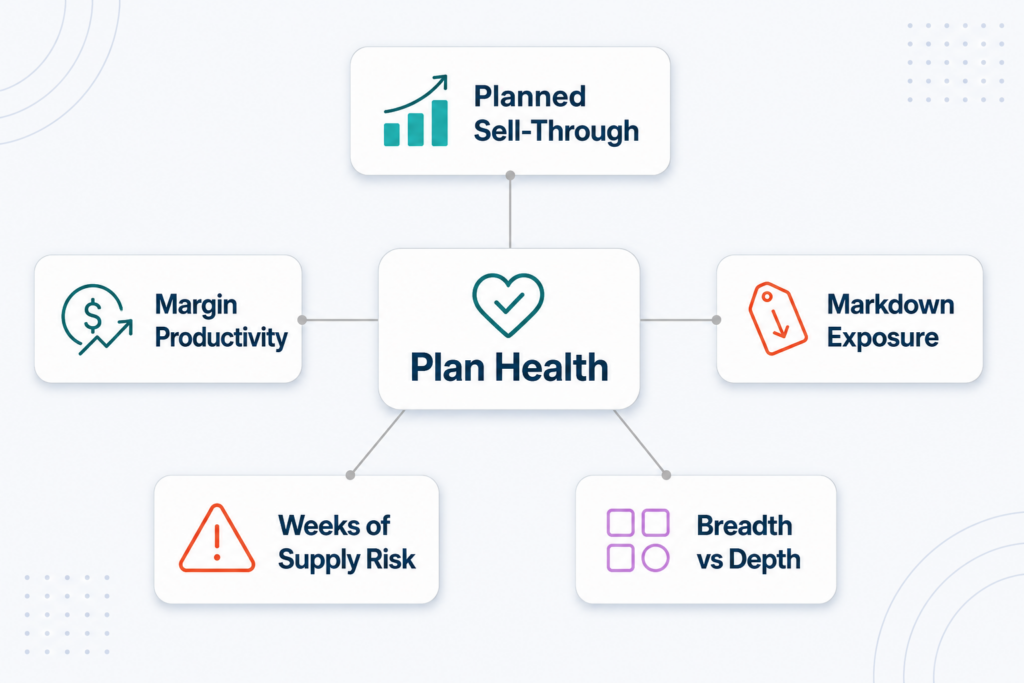
This is where planning teams get real value from KPI design. The conversation shifts from Are we on plan? to What kind of risk is already visible inside the plan? That is a much more useful question while decisions are still adjustable.
How These KPIs Improve Allocation and Replenishment Later
Good planning KPIs do more than help planners. They improve the starting conditions for execution teams.
If the merchandise plan already reflects realistic sell-through expectations, balanced coverage, and manageable markdown risk, allocation begins with a stronger inventory picture. Teams are placing inventory into stores from a better starting point instead of compensating for structural planning issues. The same is true for replenishment. Better initial planning creates cleaner demand signals later.
Onebeat’s sell-through and replenishment article makes this connection clear by treating sell-through, full-price sell-through, stockouts, weeks of supply, and markdown exposure as linked measures rather than isolated outcomes. That is a useful mindset for planners as well. Execution metrics do not start being relevant after allocation. They start being relevant when the plan is built.
When planners use the right KPI mix, downstream teams spend less time repairing imbalance. They can focus more on precision: where inventory should go, how much depth is needed, which stores should be prioritized, and where risk needs to be contained early.
Where Onebeat Fits in the Planning-to-Execution Loop
This is where Onebeat’s point of view matters. Merchandise planning should not stop at a financially aligned plan. It should create a plan that can move into execution with clear demand logic behind it.
Onebeat positions merchandise planning as demand-based planning that starts from real demand at the assortment-group level, then reconciles back to financial targets with visible tradeoffs. That framing fits this KPI discussion well. The best planning metrics are the ones that show whether assortment decisions and merchandise financial planning tradeoffs are healthy before the business commits too early.
This is also where the Inventory Intelligence Loop becomes practical rather than theoretical. Planning metrics shape the first decision set. Allocation and replenishment test those assumptions in the field. Execution outcomes then improve the next round of planning. The loop only works when planners measure what actually predicts plan health.
It also preserves planner control. The objective is not to let software replace judgment. The objective is to give planners better evidence, clearer exceptions, and a tighter connection between financial intent and inventory action.
Key Takeaway
Merchandise planning KPIs matter when they reveal whether the plan is executable before inventory hits stores. The right mix of sell-through, inventory productivity, margin, markdown exposure, and coverage tells planners far more than top-line targets alone ever can.
Perguntas frequentes
What are merchandise planning KPIs?
Merchandise planning KPIs are the performance measures retailers use to judge whether a merchandise plan is balanced, productive, and realistic before and during execution.
Which KPI matters most in merchandise planning?
No single KPI is enough on its own. Planned sell-through is important, but it should be read alongside inventory productivity, margin quality, markdown exposure, and coverage risk.
How does sell-through affect merchandise planning?
Sell-through helps planners judge whether the planned breadth, depth, and price structure are realistic. Weak sell-through expectations often point to overbuying, poor assortment fit, or both.
What does markdown exposure tell planners?
Markdown exposure signals whether the plan is building price risk into the assortment before the season even starts. It helps planners spot where inventory may need to be cleared later to protect margin.
How do planning KPIs connect to allocation?
Allocation inherits the strengths and weaknesses of the plan. Strong planning KPIs improve the quality of the inventory decisions allocation teams make later.


