
Retailers enter the season with a plan, but demand rarely follows it. Some products sell faster than expected. Others slow down. The hardest part is not seeing that demand changed. It is deciding what to buy, where it should land, and whether there is still enough time for that purchase to create full-price sales.
In-season purchasing is the retail process of adjusting purchasing decisions during the selling season based on actual demand, inventory coverage, supplier constraints, and remaining selling time. It includes repeat buys, chase buys, supplier reorders, and other in-season orders that help retailers buy closer to demand without committing capital blindly.
The best in-season purchasing decisions do not start with “this item is selling fast.” They start with a better question: does this demand signal deserve more inventory after the team accounts for coverage gaps, MOQs, supplier lead times, store-level demand, margin, and markdown risk?
Direct answer:
In-season purchasing is the retail process of adjusting buying decisions during the selling season based on actual demand, coverage gaps, supplier constraints, and remaining selling time. It includes repeat buys, chase buys, and supplier reorders. The goal is not simply to buy more of fast sellers. The goal is to commit inventory only when the demand, timing, MOQ, margin, and store-level opportunity support the decision.
What You Will Learn
- What in-season purchasing means in retail and why it matters for seasonal categories.
- How in-season purchasing differs from preseason buying, open-to-buy, replenishment, allocation, and markdown planning.
- How retailers identify true coverage gaps before placing repeat buys or chase buys.
- How supplier lead times, MOQs, remaining selling weeks, and margin risk shape the buying decision.
- Why Onebeat frames in-season purchasing as a demand-driven execution loop, not a static planning review.
What Is In-Season Purchasing?
In-season purchasing is the process of deciding whether to commit new supply during the selling season based on what real demand is showing now. For fashion, footwear, sporting goods, beauty, jewelry, and other seasonal categories, that usually means deciding whether a product should receive a repeat buy, chase buy, vendor reorder, or adjusted purchase order while the season is still active.
The value is timing. Preseason buying commits inventory before demand is fully visible. In-season buying responds after demand appears, but before the full-price selling window closes. That window is narrow. A product may look like a winner in week two, but if supplier lead time is eight weeks and the season has ten weeks left, the buy may not land early enough to protect margin.
A useful definition is this: in-season purchasing turns live demand into a constraint-aware buying decision. It asks whether a product is truly under-covered, whether more supply can arrive in time, and whether the purchase will improve inventory productivity.
For teams searching for repeat buying retail strategies, the real question is not only what sold fast. It is whether the retailer can still buy, receive, allocate, and sell that inventory profitably.
Common examples: repeat buys, chase buys, and supplier reorders
A repeat buy is a new purchase of a product that is already selling. A chase buy is a faster or more opportunistic version of that decision, usually used when an item outperforms expectations and the retailer wants to capture upside before the season moves on. A supplier reorder may be part of either process, depending on vendor capacity, MOQ rules, packaging, shipping windows, and production calendars.
The mistake is treating these terms as simple “buy more” actions. A winning product in one climate zone, store cluster, size curve, or channel does not always justify a chainwide purchase. In-season purchasing should decide where the gap exists and how much demand can still be served at a profitable price.
Why In-Season Purchasing Matters for Retailers Now
Retailers are working in a market where seasonal plans age quickly. McKinsey and The Business of Fashion describe a 2025 fashion market shaped by uncertainty, changing consumer behavior, and pressure on growth, which makes static planning less reliable for categories with short selling windows.
The commercial risk is two-sided. If the retailer does not buy more of a true winner, demand turns into missed full-price sales. If the retailer buys too much, too late, or too broadly, the purchase becomes excess inventory and markdown exposure.
This is why in-season purchasing is not just a buying workflow. It is a margin and working-capital decision. The goal is not to maximize receipts. The goal is to put capital behind inventory that can still meet demand while there is time to sell at full price.
That shift matters for executive teams. Finance wants inventory discipline. Merchandising wants sales upside. Planning wants a controlled process. Stores and operations need decisions they can execute. In-season purchasing sits at the intersection of those needs.
In-Season Purchasing vs. Open-to-Buy, Replenishment, Allocation, and Markdown Planning
In-season purchasing overlaps with other retail planning processes, but it is not the same job. Confusion here creates bad decisions. A budget can be available, a product can be selling fast, and a store can still be the wrong place for a repeat buy.
Open-to-buy governs the financial envelope. Replenishment moves existing or recurring inventory toward demand. Allocation places inventory across stores, channels, or clusters. Markdown planning clears slow or aging inventory. In-season purchasing decides whether the retailer should commit new supply while the season is underway.
| Process | Primary question | How it relates to in-season purchasing |
| Open-to-buy | How much budget and receipt capacity do we have? | A governance input. It does not decide which product, location, or supplier action is worth funding. |
| Replenishment | Where should available or recurring inventory flow? | A flow decision. Repeat buying asks whether the retailer should secure new supply at all. |
| Allocation | Where should inventory land? | A placement decision. A smart buy still needs SKU-store placement to create value. |
| Markdown planning | How should slow or aging inventory be cleared? | A lifecycle decision. Better in-season purchasing reduces the chance that late buys become markdown risk. |
| In-season purchasing | Should we commit new supply during the selling season? | The buying decision that balances demand, coverage, timing, MOQs, supplier constraints, and margin. |
Open-to-buy vs. in-season purchasing
Open-to-buy tells the retailer how much buying capacity exists against the plan. It blends sales, receipts, inventory, markdowns, and planned targets. Oracle frames merchandise financial planning around indicators such as sales, markdowns, receipts, inventory, gross margin, and open-to-buy.
That makes OTB a control mechanism, not a complete buying decision. In-season purchasing still needs to answer which products deserve that budget, where demand exists, what the supplier can deliver, and whether the purchase will arrive in time to protect margin.
Repeat buying vs. replenishment
Replenishment usually manages ongoing flow for products with repeatable demand and available supply. Repeat buying commits new inventory, often under supplier constraints, for a product that has shown stronger demand than expected.
A replenishment decision may ask, “Where should available units go?” A repeat-buy decision asks, “Should we create or secure more units at all?” Both matter, but the risk profile is different. A replenishment error misplaces existing inventory. A repeat-buy error can create new exposure.
Purchasing vs. allocation
Purchasing answers whether to buy. Allocation answers where the inventory should go once it is available. A retailer can make a smart repeat-buy decision and still lose value if the units are spread evenly across stores instead of directed to the SKU-store locations where the coverage gap is real.
This is why in-season purchasing should not stop at category-level demand. A product may look under-covered nationally because one region is selling out. The right action may be a targeted buy, a transfer, an allocation adjustment, or no new purchase at all.
The In-Season Purchasing Decision Framework
A good in-season purchasing process should slow down the wrong decisions and speed up the right ones. The question is not, “Which items are selling fast?” The better question is, “Which repeat-buy candidates can still improve full-price sell-through after timing, coverage, and constraints are considered?”
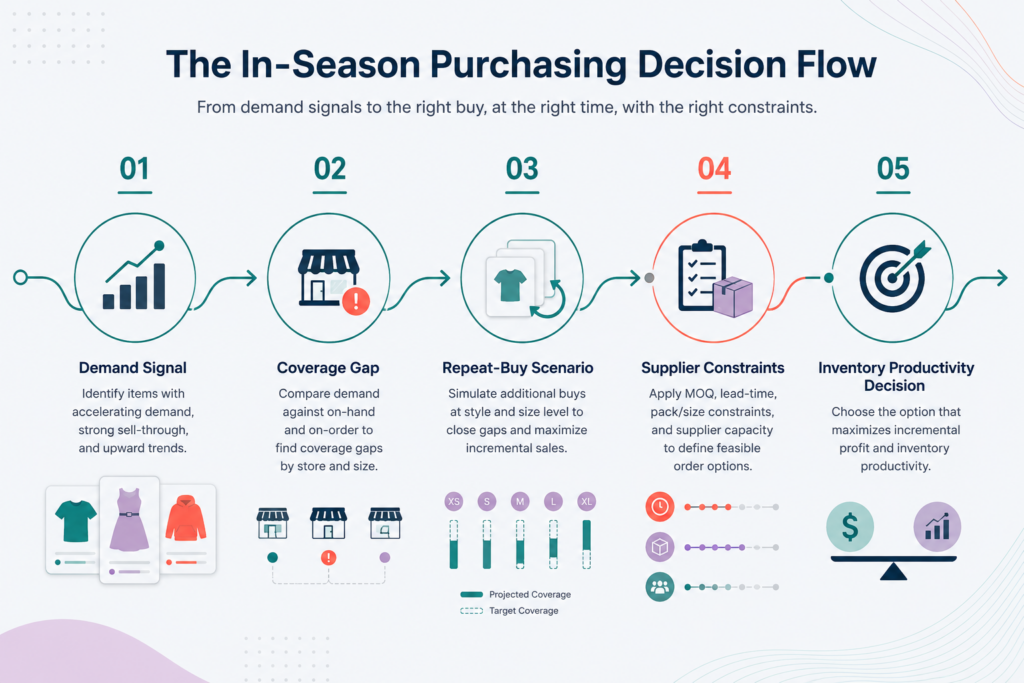
The in-season purchasing decision should answer five questions: Is demand real? Where is the coverage gap? How much selling time remains? What can the supplier deliver? Will the buy improve inventory productivity?
1. Validate the demand signal
High sell-through can be a true signal, but it can also reflect shallow initial allocation, a promotion, a weather event, a regional spike, or a lack of inventory in the wrong stores. Before placing a repeat buy, the team should compare demand across stores, clusters, sizes, colors, channels, and comparable products.
Stockouts can also hide demand. Recent academic work on retail demand data describes stockouts as creating censored sales data, meaning observed sales may understate true demand because demand cannot be seen when inventory is unavailable.
2. Identify SKU-store coverage gaps
A coverage gap appears when projected demand is higher than available inventory for the remaining selling period. The best view is not only category, class, or chain level. It is SKU-store or SKU-location level, because demand may be concentrated in a few clusters.
For example, a sandal may be under-covered in warm-weather stores but over-covered in northern locations. A chainwide repeat buy could create excess, while a targeted order or transfer may protect sales with less risk.
3. Simulate coverage scenarios
A repeat buy should be tested against scenarios. What happens if demand continues at the current rate? What happens if it slows after the promotion ends? What happens if the buy lands two weeks later than expected? Scenario thinking helps planning and buying teams avoid treating the first demand signal as a final answer.
Coverage scenarios should include unit need, receipt timing, sell-through path, store distribution, margin rate, and markdown exposure. The goal is to compare options, not to create a perfect forecast.
4. Check MOQs, lead times, and supplier constraints
Supplier constraints can turn a strong product into a weak purchase decision. MOQs may force the retailer to buy more units than demand supports. Lead times may push arrival past the strongest selling weeks. Shipping capacity, packaging rules, vendor reliability, size availability, and production calendars can all change the decision.
A retailer should not ask only whether the supplier can deliver. It should ask whether the supplier can deliver the right units, in the right size curve, to the right locations, while the product can still sell at full price.
5. Prioritize inventory productivity
The final test is inventory productivity. Will this buy put capital behind demand that can still be served profitably? Or will it increase receipts without improving the outcome?
A strong in-season purchasing decision improves the relationship between inventory, sales, margin, and time. FRED’s retailers inventory-to-sales ratio describes how many months of inventory retailers hold relative to one month of sales, a useful reminder that inventory efficiency is a financial signal, not only an operational metric.
Pro Tip
Do not treat high early sell-through as an automatic repeat-buy signal. First check whether demand is broad, whether the product was under-allocated, whether stockouts are hiding demand, whether the supplier can deliver inside the full-price window, and whether the purchase improves inventory productivity after MOQ and lead-time constraints.
Common In-Season Purchasing Mistakes
The most common mistake is simple: buying more of anything that looks like a winner. That is tempting because speed matters. But speed without decision quality creates another problem. The retailer may prevent one stockout while creating new markdown exposure somewhere else.
Mistaking sell-through for true demand
Early sell-through needs context. If a product sold through quickly because launch quantities were too low, the signal may be real but the size of the repeat buy still needs discipline. If the product sold through because one store cluster was under-allocated, the answer may be redistribution, not new supply.
The right question is not whether the product sold fast. It is whether the retailer has enough evidence to separate true demand from allocation bias, promotion lift, regional concentration, or constrained inventory.
Buying too broadly
A product can be a winner in one channel and a risk in another. Chainwide averages hide that distinction. When teams buy broadly, they may send capital to stores that do not have the same demand pattern.
This is where SKU-store precision matters. In-season purchasing should identify where incremental inventory can still sell, not just which item is trending at the top level.
Ordering after the full-price window has closed
Late buying often looks rational at the moment of approval. The product is selling. OTB is available. The supplier can produce. But if the goods arrive after demand peaks, the retailer may have created a markdown problem rather than solved an availability problem.
The buying decision should include a deadline. If the supplier cannot deliver before the full-price opportunity fades, the better action may be allocation, transfer, substitution, or letting the product sell out.
How Demand-Driven Purchasing Connects Planning to Execution
Preseason planning sets the intent. It defines the assortment, budget, financial targets, and initial inventory strategy. But planning intent does not create outcomes by itself. Outcomes come from the decisions retailers make as demand reveals itself.
Onebeat frames this as an Inventory Intelligence Loop: sense demand, decide which repeat-buy candidates deserve action, act within supplier and operational constraints, then learn from the outcome. Planning tools plan. Onebeat runs the loop.
Operationally, that means demand signals do not stop in a report. They become prioritized decisions across in-season purchasing, allocation, replenishment, transfers, promotions, and lifecycle management. The same product can trigger different actions by location. One store may need a repeat buy. Another may need no action. A third may need inventory transferred out before it becomes excess.
That is the difference between demand visibility and demand-driven purchasing. Visibility shows that reality changed. Execution decides what to do about it while the decision still matters.
Why SKU-store precision matters
Category-level planning is useful for financial control, but customers do not buy at category level. They buy specific products in specific places at specific times. A demand signal is only useful if it can be translated into an action at the level where the inventory decision happens.
For in-season purchasing, that means identifying repeat-buy winners by SKU, size, color, store cluster, channel, and remaining season. It also means knowing when not to buy, because a transfer, allocation adjustment, or lifecycle action may create a better outcome with less capital.
KPIs Retailers Should Track for In-Season Purchasing
In-season purchasing should be measured by decision quality, not only purchase volume. A team can issue more purchase orders and still create poorer outcomes if the buys arrive late, land in the wrong locations, or require markdowns.
Availability and coverage KPIs
Track coverage weeks, projected stockout risk, lost sales exposure, SKU-store availability, and the share of repeat-buy candidates with validated demand. These KPIs show whether the team is finding the right gaps before the sales window closes.
Coverage should be viewed by location and timing. A product with six weeks of inventory at chain level may have two weeks of coverage in high-demand stores and twelve weeks in low-demand stores.
Margin and productivity KPIs
Track full-price sell-through, gross margin rate, markdown exposure, inventory turnover, and inventory productivity. These measures keep the buying conversation tied to financial outcomes instead of only receipts.
Retail returns can also pressure inventory productivity and margin. NRF and Happy Returns projected U.S. retail returns to total $890 billion in 2024, with retailers estimating that 16.9% of annual sales would be returned.
Supplier execution KPIs
Track lead-time adherence, MOQ impact, purchase order conversion, vendor fill rate, and late-receipt risk. These metrics make supplier constraints visible before they turn into inventory problems.
A strong in-season purchasing process should help teams rank decisions. Which buys are urgent? Which are profitable? Which are constrained? Which are no longer worth pursuing? That ranking is often where margin is protected.
Key Takeaway
In-season purchasing helps retailers buy closer to demand when they validate real demand, identify SKU-store coverage gaps, simulate repeat-buy scenarios, and account for supplier constraints before committing capital. The goal is not to chase every fast seller. It is to improve inventory productivity by acting on the right opportunities while there is still time to sell at full price.
FAQs
What is in-season purchasing in retail?
In-season purchasing is the process of adjusting buying decisions during the selling season based on actual demand, inventory coverage, supplier constraints, and remaining selling time. It helps retailers decide whether to place repeat buys, chase buys, supplier reorders, or other in-season orders.
What is a chase buy in retail?
A chase buy is an in-season purchase placed to capture upside from a product that is selling faster than expected. It should only happen when the demand signal is validated, the supplier can deliver in time, and the buy still supports full-price sell-through after MOQ and margin checks.
How is in-season purchasing different from open-to-buy?
Open-to-buy controls how much budget is available for receipts against the merchandise plan. In-season purchasing decides which products deserve new supply, how much to buy, where inventory should land, and whether the supplier can deliver in time.
When should retailers place a repeat buy?
Retailers should consider a repeat buy when demand is validated, a clear coverage gap exists, enough selling time remains, and supplier constraints do not erase the margin opportunity. A fast start alone is not enough.
How do supplier lead times affect in-season purchasing?
Supplier lead times determine whether new inventory can arrive while demand and margin opportunity still exist. If the lead time pushes receipt past the full-price window, a transfer, allocation adjustment, substitution, or no-action decision may be better than a new purchase.
How do MOQs affect in-season purchasing?
MOQs can force retailers to buy more inventory than the demand signal supports. A repeat buy should pass an MOQ test: can the retailer sell the minimum quantity at acceptable margin before the season changes?
How can retailers avoid overbuying during the season?
Retailers can reduce overbuying risk by validating demand, checking SKU-store coverage, simulating multiple demand scenarios, comparing repeat buys with transfers or allocation changes, and setting a cutoff date for full-price arrival.
How does Onebeat support demand-driven purchasing?
Onebeat supports demand-driven purchasing by helping retailers connect live demand signals, coverage gaps, supplier constraints, and execution priorities. That means planners can see which repeat-buy candidates deserve action, which should be handled through allocation, replenishment, or transfers, and which no longer justify new supply. The focus is Precision Inventory Intelligence for Retail Planning & Execution: turning planning intent into daily inventory decisions across purchasing, allocation, replenishment, transfers, promotions, and lifecycle management.


