
Coverage gap purchasing is the repeat-buy decision retailers make when remaining cover is no longer enough to last until fresh inventory can arrive. That is the part of in-season purchasing most teams wrestle with. Spotting a winner is usually the easy part. Knowing when that winner has crossed from healthy cover into real risk is harder.
If the team buys too early, the business can trap cash in units that arrive after the strongest demand window. If it buys too late, a proven winner goes out of stock while margin is still on the table. That tension is why broad advice about buying closer to demand often feels directionally right but operationally incomplete.
Coverage gap purchasing is a better frame because it focuses on timing, not only intent. It asks whether remaining cover, current sales velocity, in-transit stock, and supplier constraints still support patience or whether the repeat-buy decision needs to happen now. In retail, availability decisions carry financial weight. McKinsey notes that a one-percentage-point improvement in presubstitution in-stock rates can lift sales by 20 to 35 basis points.
What You Will Learn
- What coverage gap purchasing means in practice
- Why broad in-season buying advice still leaves teams exposed
- Which signals reveal that a repeat buy deserves review now
- How to time a repeat buy without creating late excess
- How MOQs, lead times, and open-to-buy reshape the decision
- How Onebeat connects coverage risk to better in-season action
What Coverage Gap Purchasing Actually Means
Coverage gap purchasing is the discipline of deciding when a winning SKU’s remaining inventory is no longer enough relative to the time it would take to respond. It is not a synonym for general in-season buying. It is a narrower decision method built around one risk: the gap between how fast demand is consuming cover and how long the business needs to replenish it.
That distinction matters because inventory can look healthy right up until it does not. A SKU may still show units on hand, but those units have to be judged against actual selling pace, store concentration, in-transit receipts, and how much time remains in the demand window. Cover is only useful if it is measured against the time it takes to act.
This is also why a winner can be at risk while total inventory still looks acceptable at chain level. The real problem may be concentrated in a few high-velocity stores, channels, or size runs. Broad totals can hide thin forward cover where the next full-price sale is most likely to happen.
Onebeat describes in-season purchasing in exactly these terms: retailers need to simulate different coverage and buffer levels before committing and weigh coverage gaps against MOQs, supplier rules, lead times, and other limits. That is the operational heart of coverage gap purchasing.
Why Broad In-Season Purchasing Advice Misses the Hard Part
Retail teams hear good advice all the time: buy closer to demand, commit later, and stay flexible. The problem is that none of those ideas tells a merchant when the safe buying window is actually opening or closing. They point in the right direction, but they do not answer the repeat-buy decision.
That gap matters because waiting is not always safer. If lead times are long or variable, the business may need to act while inventory still looks comfortable on paper. Deloitte’s 2025 retail planning POV points to longer supplier lead times, high lead-time variability, and one-size-fits-all inventory planning as common causes of excess and insufficient stock.
The reverse problem is just as expensive. Teams that respond to every fast seller with an immediate reorder can end up buying inventory that arrives after demand has cooled. McKinsey wrote that U.S. retailer inventories rose by $78 billion to around $740 billion, underscoring how quickly late or misaligned buys can become a working-capital and markdown problem.
The hard part, then, is not deciding whether demand matters. It is deciding when demand has become strong enough, persistent enough, and exposed enough to justify the next order before the business slips into either lost sales or late excess.
The Signals That Reveal a Real Coverage Gap
Sales Velocity and Trend Strength
The first signal is not raw sell-through. It is the pace and shape of current demand. Is the SKU still accelerating, stabilizing at a high rate, or fading after a short spike? A repeat-buy decision should be built on sustained evidence, not a single hot week.
Current Cover and Weeks of Supply
Coverage tells the team how many selling weeks remain at the current pace. But weeks of supply only become useful when paired with the expected arrival date of a new order. A healthy-looking four weeks of supply can be thin if lead time is five weeks. A thinner-looking position can still be manageable if supply can land in ten days.
In-Transit Stock and Lead-Time Exposure
A coverage gap is not just about what is on hand. It is about what is already moving through the pipeline and how reliable that pipeline is. Orders in transit, supplier fill confidence, and lead-time variability all change how much urgency is real.
Demand Concentration by Store or Channel
The business should also ask where demand is happening. If a winner is being carried by a small number of high-productivity stores, the apparent network cover may be less reassuring than it looks. The problem may not be total inventory. The problem may be that the right inventory is running out in the right places first.
Inventory Accuracy
Coverage logic gets weaker when system inventory cannot be trusted. An INFORMS study found that low-inventory-focused counting approaches were especially effective at detecting unknown out-of-stocks, a useful reminder that low-cover items deserve close attention before a team assumes it has more time than it really does.
How To Time a Repeat Buy Without Creating Late Excess
The most useful timing question is straightforward: when will this SKU hit a risky level of remaining cover, and can a new order land before that point? If the answer is no, the repeat-buy decision should be reviewed now. If the answer is yes, the team may still have room to watch another cycle of demand.
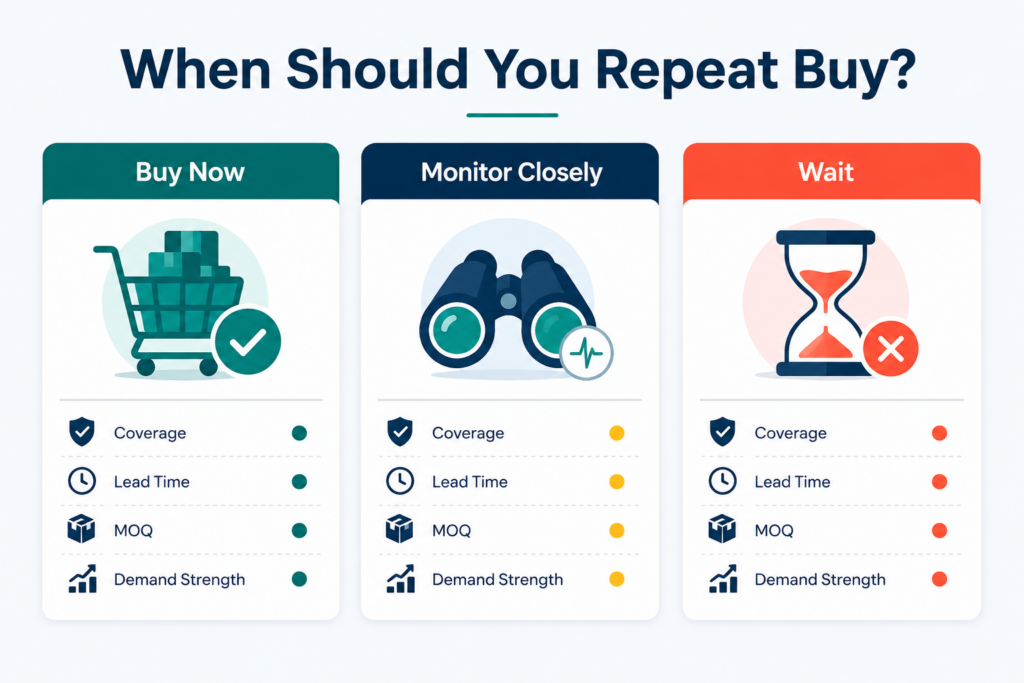
That creates three practical states. The first is buy now: the SKU has strong demand, the cover window is narrowing, and the lead-time clock says the business is close to running out of safe waiting time. The second is monitor closely: demand is good, but enough uncertainty remains that another short read can improve the decision. The third is wait: the demand signal is not yet strong enough, or the business would be forcing a buy that is more likely to arrive as markdown risk than as protected margin.
The point is not to remove judgment. It is to make judgment more disciplined. Teams should compare time-to-stockout against time-to-arrival, look at the expected demand window, and test whether the order still makes sense if demand softens before delivery. That is much stronger than relying on instinct alone.
Pro Tip
Set a latest-safe-order date before the season gets busy. If the expected arrival date lands after the likely full-price demand window, treat the order as a markdown-risk decision, not a growth decision, even if the SKU still looks hot today.
How MOQs, Lead Times, and Open-to-Buy Change the Decision
Constraints are what make repeat-buy timing a real retail decision rather than a math exercise. The same demand signal can justify different actions depending on supplier minimums, lead-time reliability, and the amount of open-to-buy left in the category.
MOQ is often the most visible friction. A sensible top-up can quickly become an overcommitment if the supplier requires a larger order than the risk actually justifies. That does not mean the buy is wrong. It means the decision has to be judged against the likely landing point of that extra inventory, not only against today’s shortage risk.
Open-to-buy matters too, but it should not become the entire decision. A buy can be budget-approved and still be commercially weak if the inventory is likely to land after the strongest demand window has already passed. Shopify’s open-to-buy guide defines OTB as the inventory budget still available after stock on hand and outstanding orders are accounted for, and notes that stronger planning adds lead-time visibility and scenario planning as complexity grows. That is useful. But OTB is a guardrail. It does not tell the team whether the remaining cover on a winner is genuinely safe.
Lead-time variability is the final pressure point. A five-week lead time is one thing. A stated five-week lead time that routinely lands in seven is another. Teams need to buy against the real response window, not the clean version on a vendor sheet.
How Onebeat Connects Coverage Risk to Better In-Season Action
This is where Onebeat’s point of view becomes useful. Coverage gap purchasing sits inside the broader discipline of in-season purchasing, but it brings that discipline down to the exact repeat-buy decision. Planning tools plan. But repeat-buy decisions happen inside a moving retail environment where demand shifts, coverage changes, and constraints do not wait for the next planning cycle.
Onebeat positions itself as Precision Inventory Intelligence for Retail Planning & Execution. In the in-season purchasing context, that means evaluating coverage scenarios before commitment, weighing demand upside against supplier and operational limits, and helping teams decide how much to buy while staying in control of the tradeoff.
That matters because the best repeat-buy decision is rarely the one with the neatest spreadsheet. It is the one that translates planning intent into action before the demand window closes. McKinsey’s store-SKU root-cause framing also supports this wider point: availability problems emerge across functions and handoffs, which is why the link between planning and execution matters so much.
The role of the system should be to sharpen judgment, not replace it. Teams still choose the direction. But they make that choice with better visibility into coverage risk, timing pressure, likely landing outcomes, and feedback that can improve the next repeat-buy decision.
A Better Standard for Repeat-Buy Discipline
Weak in-season buying discipline usually shows up in one of two ways. Some teams wait too long because they want more certainty than retail can realistically provide. Others buy too fast because a hot seller creates urgency before the timing logic is clear.
A better standard is to define the repeat-buy decision around coverage risk, not around emotion. That means reviewing velocity, current cover, lead-time exposure, constraint pressure, and full-price demand window together. It also means accepting that not every winner deserves the same action at the same moment.
Retailers do not need broader advice about agility. They need a cleaner answer to one operational question: has this winner crossed the line where waiting creates more risk than buying? Coverage gap purchasing is a practical way to answer that question with more discipline.
Key Takeaway
Coverage gap purchasing helps retailers time repeat buys by judging remaining cover against the real time and constraints required to respond, so winners stay supported without turning late inventory into future markdown risk.
FAQs
What is coverage gap purchasing?
Coverage gap purchasing is the repeat-buy decision process retailers use when they compare remaining cover against lead time, demand strength, and buying constraints to decide whether a winning SKU needs action now.
How is coverage gap purchasing different from in-season purchasing?
In-season purchasing is the broader discipline of buying closer to live demand during the season. Coverage gap purchasing is a narrower part of that job focused on the timing trigger for repeat buys.
Which signal matters most before a repeat buy?
No single signal is enough. The strongest decisions combine sales velocity, weeks of supply, in-transit inventory, lead-time reliability, and the likely full-price demand window.
How often should repeat-buy decisions be reviewed?
Fast-moving winners should be reviewed on a regular in-season cadence, often weekly or even more frequently when lead times are tight and demand concentration is high.
Should open-to-buy control the whole decision?
No. Open-to-buy is a budget guardrail, not the full buying logic. A team still needs to judge whether the coverage gap is real, whether the order can arrive in time, and whether MOQ will create too much late exposure.


