
Markdowns often begin before the discount decision. They begin when inventory stays in a slow store while the same product can still sell elsewhere.
Markdown effectiveness is not only about choosing the right discount. It is about recognizing that mismatch early enough to transfer, consolidate, hold, or phase a markdown before margin is given away.
A good markdown clears true risk at the right pace while protecting as much full-price opportunity as possible.
What You Will Learn
- What markdown effectiveness actually means in retail
- Why liquidation mistakes usually start before final clearance
- Which signals should trigger phased markdown review
- Which KPIs show whether a markdown is working
- How to phase discounts without giving away more margin than necessary
What Markdown Effectiveness Actually Means
Markdown effectiveness is the measure of whether a discount is achieving the right business outcome for the amount of margin given up. Many teams still treat markdown success as a unit-movement question alone.
That is too narrow. A markdown can create a temporary spike in units and still be a poor decision if the product could have sold later at a better price, if the discount was deeper than necessary, or if the retailer marked down a winner alongside a true under-performer. McKinsey makes this point clearly: many retailers treat markdowns as an afterthought and end up discounting good performers, going deeper than needed, or failing to make reductions compelling enough for true slow movers.
In practice, markdown effectiveness is a margin-and-sell-through question. Did the discount improve exit pace enough to justify the price concession? Did it reduce future liquidation risk? Did it preserve better options for the rest of the assortment?
It is also a store-level question. A product can be a markdown candidate in one location and still deserve protection in another. Aggregate chain averages often hide that difference. A chain can look balanced on paper while some stores are already in liquidation mode and others still have full-price opportunity.
Why Liquidation Mistakes Start Before Final Clearance
The biggest liquidation errors do not begin when the first markdown is taken. They begin earlier, when retailers are slow to identify which items are truly drifting off plan and which items still deserve time, exposure, or redistribution.
This is where macro pressure makes weak decisions more expensive. Deloitte said in its Q2 2025 retail trends report that tariff shifts were creating uncertainty around cost, profit margins, and supply-chain complexity, pushing retailers to make sharper decisions across pricing, promotions, and assortment. Under that kind of pressure, late liquidation becomes even more dangerous because every extra markdown point hurts a margin structure that is already under strain.
Public retailers are living this now. Gap reported in its May 28, 2026 Q1 fiscal 2026 results that ending inventory was flat year over year, while improved inventory management supported underlying merchandise margin expansion even as tariff pressure weighed on merchandise margin. That is a useful reminder that inventory discipline is not theoretical. It is a live operating requirement, especially when end-of-season inventory pressure builds unevenly across stores and categories.
Retailers usually fall into three liquidation traps:
- They wait too long to label an item a true underperformer.
- They use one chainwide markdown action when store performance is clearly uneven.
- They mark down too many items at once, including products that still have stronger full-price potential.
That last mistake is especially costly. McKinsey says markdown optimization can improve margin rates by 400 to 800 basis points when retailers stop using blunt markdown behavior. The implication is clear: liquidation quality matters as much as liquidation speed.
Which Signals Should Trigger Phased Markdown Review
The first good liquidation decision is not the markdown itself. It is the decision to review a product before the season forces a panic move.
Start with inventory age and sell-through against plan. If inventory is aging, sell-through is fading, and demand is not recovering, the item deserves review. But do not stop there. A product should not enter markdown logic just because one location cooled off for a week.
Teams should also look at weeks of supply or coverage by store cluster, size or variant imbalance, recent local demand pattern versus chain average, whether the item is still productive in stronger stores, and whether a transfer or consolidation action still has value.
This is where liquidation becomes a lifecycle decision rather than a pricing task. A true underperformer is a product whose forward selling opportunity is shrinking fast enough that a margin-protecting action is needed now. Sometimes that action is a first-phase markdown. Sometimes it is a transfer to a stronger store. Sometimes it is store consolidation before discount depth increases. This requires AI-native retail infrastructure: a shared decision layer that connects demand, constraints, and execution feedback before a markdown is recommended.
Retailers should ask a simple question before deepening liquidation: is this item genuinely running out of good demand options, or are we just late to making a better one?
Which KPIs Show Whether a Markdown Is Working
The easiest KPI to see is unit movement. It is rarely enough on its own.
Markdown effectiveness should be judged with a tighter group of measures: sell-through improvement after the markdown phase, gross margin recovery or margin sacrifice versus plan, weeks of supply improvement, percentage of inventory cleared in the phase, residual inventory risk after the markdown, and store-level variation in response to the discount.
That last point matters. If one markdown drives strong response in a subset of stores and weak response elsewhere, the answer may not be a deeper discount everywhere. It may be tighter store segmentation, more transfer activity, or a different liquidation path by cluster.
Macro inventory context is useful, but it is not enough to run markdown decisions. The U.S. Census Bureau reported that the total business inventories-to-sales ratio at the end of March 2026 was 1.32, down from 1.38 a year earlier. That says inventory discipline is still a live issue across the market. It does not tell a retailer whether a specific SKU in a specific store is one markdown away from healthy exit or from needless margin damage.
Pro Tip
Do not ask only whether a markdown lifted units. Ask whether it improved sell-through enough to justify the margin given up and whether the product still had a better non-markdown option one week earlier.
KPI feedback is what separates phased liquidation from blanket clearance. Without that review loop, retailers are not managing markdown effectiveness. They are simply repeating discounts.
How to Phase Discounts Without Killing Margin
Phased liquidation works because it treats markdowns as a sequence of measured decisions instead of one late-season surrender.
The core discipline looks like this:
- Identify real markdown candidates early.
- Start with the lightest credible discount phase.
- Measure response quickly by sell-through, residual risk, and local variation.
- Separate items that need a deeper phase from items that should pause, transfer, or consolidate.
- Repeat only where the economics support it.
Static liquidation programs usually skip the middle steps. They assume the same markdown depth should apply broadly, then hope the market absorbs the stock. That is where retailers end up over-discounting winners and under-clearing true laggards.
Demand-driven liquidation is more disciplined. It accepts that some items need faster action, some need more time, and some are better handled through another inventory move before the next discount. Better liquidation does not only clear units. It protects more full-price sell-through before deeper clearance is finally required.
This is also where liquidation should connect to other actions across the network. If a store still has healthy demand for a product, the right answer may be replenishment restraint elsewhere and protection there. If one store is saturated while another can still sell through, transfer logic may save margin before a deeper markdown begins.
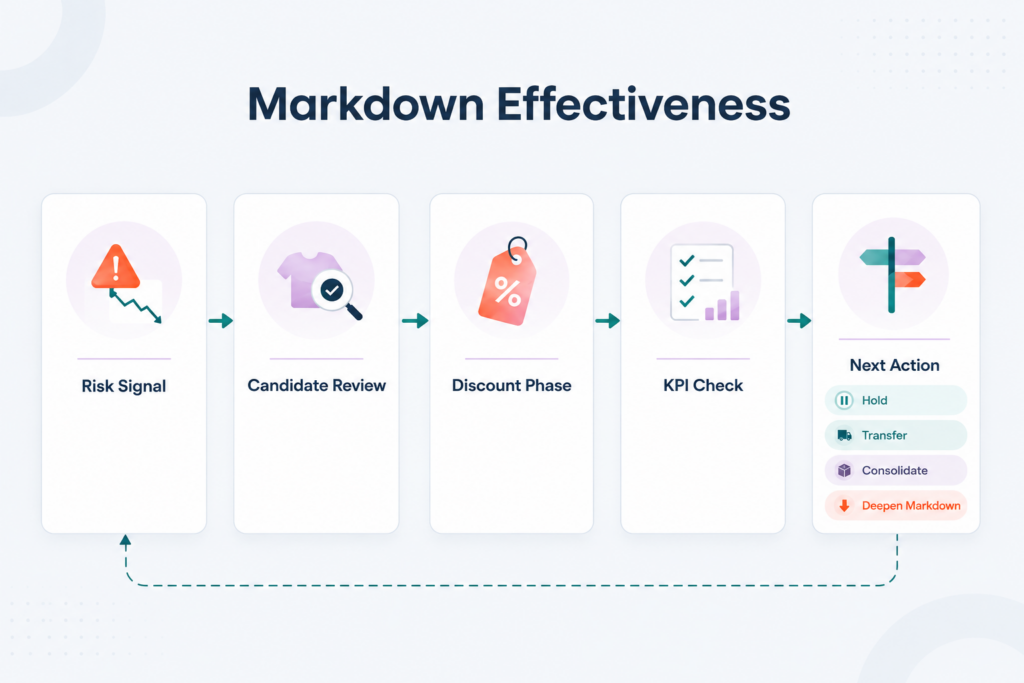
The strongest markdown teams are not the ones that clear fastest at any cost. They are the ones that learn fastest between phases and reduce markdown dependency without giving away margin too early.
Where Onebeat Fits
Onebeat’s liquidation point of view is that markdowns should be part of lifecycle management, not a last-minute emergency. The goal is to spot true underperformers early, track markdown effectiveness in real time, and connect liquidation choices to the wider set of inventory actions that still protect value.
That matters because liquidation is not separate from the rest of retail execution. It sits inside the Inventory Intelligence Loop that connects planning intent to daily SKU-store decisions across replenishment, transfers, promotions, and lifecycle management. Planning tools plan. Onebeat runs the loop.
Onebeat describes this as Precision Inventory Intelligence for Retail Planning & Execution: turning changing demand signals into executable inventory actions before margin disappears. In liquidation terms, that means protecting winners from unnecessary discounts, reducing markdown dependency, and making sure deeper clearance is the last good option, not the first available one.
Key Takeaway
Markdown effectiveness is not about how much inventory moved after a discount. It is about whether the retailer cleared risk at the right pace, in the right places, and with the smallest necessary margin sacrifice. Better liquidation comes from earlier signals, tighter KPI review, and phased decisions that leave room for smarter next actions.
Want to see which markdown candidates still have a better path? Talk to Onebeat about margin-protecting inventory decisions.
FAQs
What is markdown effectiveness in retail?
Markdown effectiveness is the measure of whether a discount improves sell-through and reduces inventory risk enough to justify the margin given up.
When should a retailer mark down inventory?
A retailer should review markdown action when sell-through is fading, inventory is aging, coverage is too high, and the product no longer has a stronger alternative such as transfer, consolidation, or more time at a higher price.
How do you measure whether a markdown worked?
The best measures include sell-through improvement, margin impact, weeks of supply improvement, inventory remaining after the phase, and how response varies by store or cluster.
What is phased liquidation?
Phased liquidation is a staged markdown approach in which retailers start with a lighter discount, measure the result, and then decide whether to pause, deepen, transfer, consolidate, or change the liquidation path.
Why is a blanket markdown strategy risky?
It treats strong and weak stores the same, often discounts products that still have demand, and can give away more margin than the situation actually requires.


