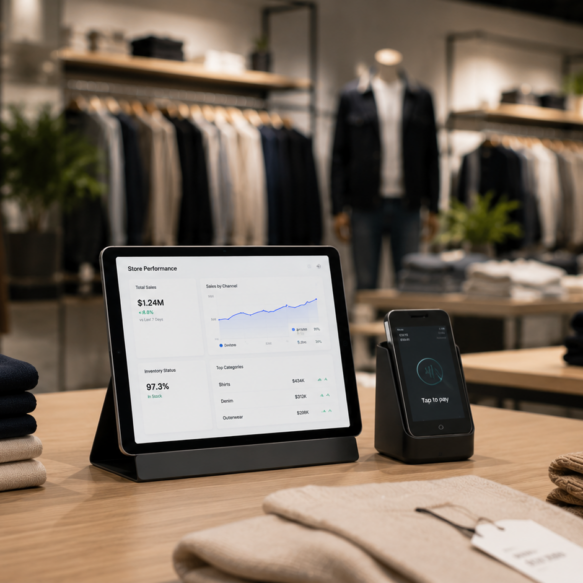
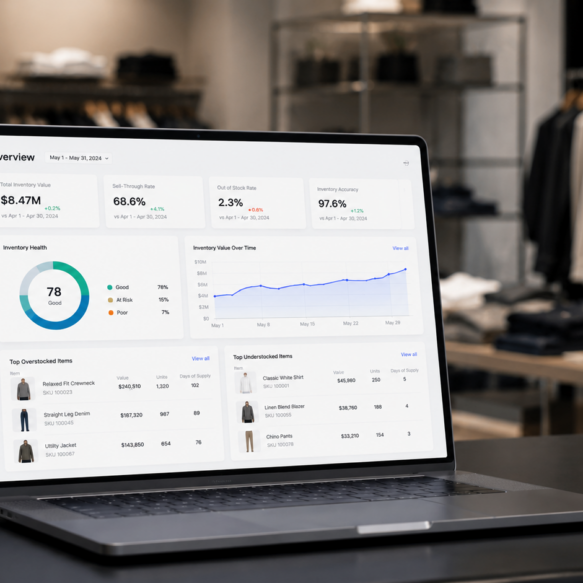
Retailers are being told that AI will transform their business. The harder truth is that most retail systems were never built for AI.
They were built as complex stacks of modules, integrations, reports, spreadsheets, workflows, vendor systems, and patched business rules. Over time, more tools were added. More vendors were acquired. More logic was layered in. Now AI is being introduced as another layer on top.
That can produce useful features. It can make reports easier to query, automate narrow tasks, or summarize what happened last week. But it does not automatically create an AI-native retail operation.
AI-native retail infrastructure is the shared operating layer that connects retail data, business rules, constraints, workflows, and execution feedback so AI can reason through inventory decisions. It is different from adding an AI assistant to a dashboard or module because the intelligence is connected to the process that creates the recommendation.
AI inventory management only becomes operationally useful when AI can understand that full process. It must understand the data before the calculation, the business logic behind the recommendation, the constraints that shaped the result, and the operational context in which the decision will be executed.
That is the shift Onebeat is building: AI-Native Retail Infrastructure, an operating layer above the existing ERP that connects enriched data, customer-specific business logic, retail constraints, proprietary expertise, and AI orchestration into one decision foundation.
What You Will Learn
- Why most retail systems were not designed for AI-native operations.
- The difference between AI-patched software and AI-native infrastructure.
- What AI needs to understand before it can support retail inventory decisions.
- Why the operating layer above the ERP matters.
- How to evaluate whether a retail technology stack is AI-native or only AI-patched.
Retailers are being sold AI transformation, but their systems were not built for AI
Retail technology has accumulated in layers.
An ERP holds core records. A POS captures transactions. A WMS manages warehouse activity. Planning systems hold forecasts and financial intent. BI tools report what happened. Spreadsheets fill gaps. Local teams carry rules that were never fully encoded. Exceptions live in email, meetings, and memory.
This stack can run a business. It can also make intelligence hard to operationalize.
AI works best when it has access to clean context, connected workflows, and a clear path from reasoning to action. Most retail environments were not built that way. They were built for departmental workflows, scheduled reporting, and human interpretation. When AI is added to that environment without changing the operating layer, it often sees only fragments of the truth.
It may see the final report, but not the business rule that created it. It may see the recommendation, but not the constraint that shaped it. It may see a stockout, but not whether the root cause was demand, assortment, replenishment timing, supplier delay, store execution, or bad data.
That is why retail AI cannot be judged only by whether a system has a generative interface. The real question is whether AI is connected to the decision process.
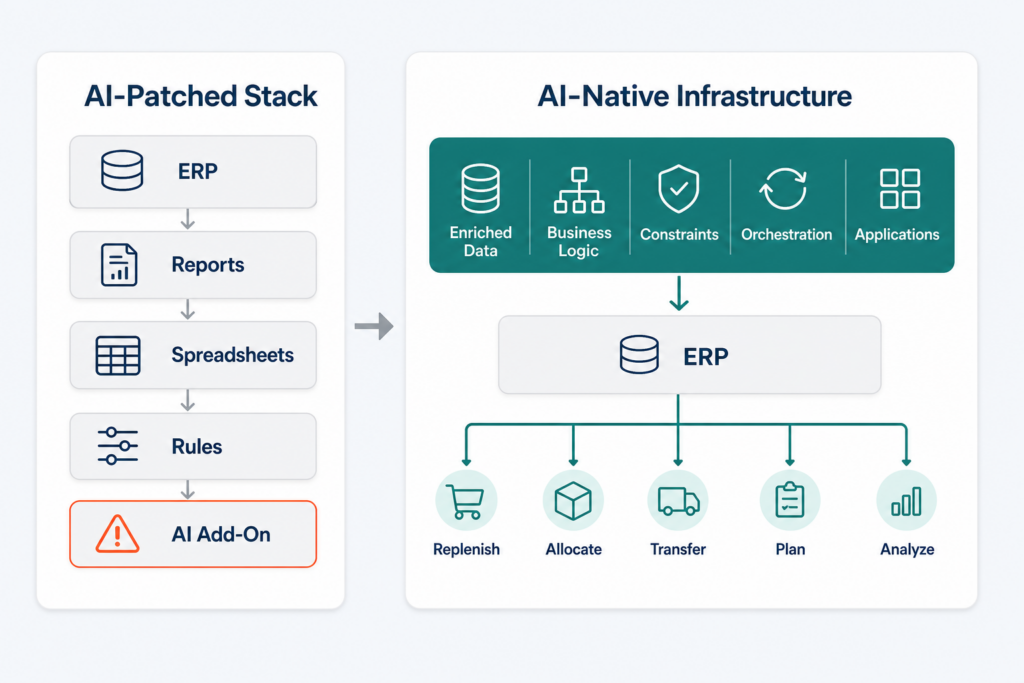
The difference between AI-patched software and AI-native infrastructure
AI-patched software adds intelligence to old workflows.
AI-native infrastructure rebuilds the operating layer so intelligence is present throughout the whole process.
The distinction matters because retail decisions are not isolated questions. A replenishment decision depends on demand, inventory, lead time, service goal, presentation minimum, pack size, store priority, supplier constraint, and lifecycle status. A transfer decision depends on sell-through, size curve, markdown risk, transfer cost, receiving capacity, and store opportunity. A markdown decision depends on remaining weeks of season, price elasticity, inventory position, margin goal, and whether another store can still sell the product at full price.
AI-patched software can answer questions about outputs:
- What happened?
- Which products are out of stock?
- Which stores are underperforming?
- What did the report say?
AI-native infrastructure can reason through decisions:
- Why was this recommendation made?
- Which data, rules, and constraints shaped it?
- What would change under a different policy?
- What is the likely root cause?
- Which action should happen next?
- What did the system learn after execution?
That is the operating difference. AI-patched software sits beside the process. AI-native infrastructure is built into it.
The practical test is simple: can the AI inspect the path from data to decision to execution?
If it can only summarize the final report, it is AI-assisted reporting.
If it can inspect source data, enrichment, business rules, constraints, scenarios, workflow state, and execution feedback, it is closer to AI-native inventory execution.
Why retail AI needs access to the full decision process
Retail inventory decisions are constrained decisions.
A planner may want more inventory in high-demand stores, but supply may be limited. An allocator may want to protect a flagship location, but a smaller store may have the stronger size-level opportunity. A replenishment team may want to fill every gap, but available stock may only support the highest-value stores. A liquidation team may want to reduce excess, but aggressive markdowns may destroy margin on products that could still sell elsewhere.
AI cannot reason through those tradeoffs if it only sees the final output.
It needs the process behind the output:
- The raw and enriched data behind the calculation.
- The retailer-specific business logic behind the recommendation.
- The operational constraints that shaped the answer.
- The scenario alternatives the system considered.
- The workflow state that shows whether the action was approved, rejected, edited, or executed.
- The execution feedback that shows whether the action worked.
This is why AI governance and explainability matter in operational systems. IBM’s AI governance guidance emphasizes that accountable AI depends on practices such as data governance, continuous monitoring, explainability, and transparent decision-making across the AI pipeline. For retail inventory decisions, those ideas become practical. A merchandising leader does not only need a recommendation. They need to know why the recommendation makes sense and when to override it.
Research on agentic AI in supermarket supply chain operations makes a similar point from another angle: retail workflows span demand forecasting, procurement, supplier coordination, and inventory replenishment, and the decision-making layer can remain manual, reactive, and fragmented even when analytics investment is high.
That is the gap AI-native infrastructure must close.
Pro Tip
Before evaluating an AI inventory management platform, ask whether the AI can inspect the recommendation path: source data, enrichment, business rule, constraint, scenario, approval workflow, and execution result.
The operating layer above the ERP
An AI-native retail operation does not require retailers to rip out every existing system.
The ERP still matters. So do POS, WMS, planning systems, BI tools, and local execution workflows. The problem is not that these systems exist. The problem is that none of them alone gives AI the full operating context.
The missing layer is a retail operating layer above the ERP.
This layer connects enriched retail data, customer-specific business logic, retail constraints, proprietary inventory expertise, decision algorithms, workflow state, AI orchestration, and execution feedback.
This is the layer Onebeat is building. It is not a generic dashboard, not a forecasting add-on, and not an ERP replacement. It is an operational brain for retail inventory decisions: not a replacement for retail teams, but a shared layer where data, logic, constraints, workflows, and AI orchestration can be inspected and improved.
This is the infrastructure version of Precision Inventory Intelligence. The point is to support daily SKU-store decisions across replenishment, allocation, transfers, assortment, planning, analytics, and decision support from one shared decision foundation.
That matters because retail decisions are connected. A planning assumption influences allocation. Allocation affects store availability. Availability affects replenishment. Replenishment affects transfer opportunity. Transfer opportunity affects markdown pressure. Markdown pressure affects margin and future buying confidence.
When these decisions are managed in disconnected tools, AI sees fragments. When they are connected through AI-native infrastructure, AI can reason across the loop.
See how this works in daily retail execution: Onebeat turns fragmented retail data into replenishment, allocation, transfer, and markdown decisions teams can act on.
What AI can do when it understands the process
When AI understands the full retail decision process, it can do more than answer questions about what already happened.
It can explain why a recommendation was made. For example, it can show that a replenishment recommendation was driven by recent store-level demand, minimum presentation requirements, available warehouse stock, lead time, and a business rule that prioritizes high-velocity stores when supply is constrained.
It can second-guess the logic. If a store has high demand but poor execution history, AI can flag that the recommendation may depend on a store operations issue, not only inventory availability.
It can simulate alternatives. A merchandising leader could ask what happens if the company prioritizes full-price sell-through over presentation minimums, or if it holds back inventory for a coming promotion.
It can detect root causes across the system. A product may look like a demand problem when the real issue is availability. A store may look like a poor performer when the problem is assortment fit. A replenishment gap may look like a supply issue when the actual failure is timing. A markdown problem may start as an allocation problem weeks earlier.
This is where the phrase operational brain becomes useful. It does not mean AI replaces retail leaders. It means AI can inspect more of the operating context, connect more of the decision chain, and support better human decisions.
Enterprise AI architecture research points in the same direction. A 2025 paper on compound AI systems argues that enterprise AI needs orchestration across agents, proprietary data, models, APIs, and planners rather than relying on a single monolithic model. Retail inventory operations need that orchestration to be retail-specific.
How to evaluate whether your retail stack is AI-native or AI-patched
Retail executives do not need to ask whether a vendor has AI. Almost everyone can say yes now.
The stronger question is what the AI can actually understand.
Use these questions as a practical test:
- Can the AI see only reports, or can it inspect the full decision process?
- Can it trace a recommendation back to source data, enrichment, business rules, constraints, and scenario logic?
- Can it understand retailer-specific policies, such as service goals, presentation minimums, lifecycle stages, store priorities, supplier constraints, and markdown rules?
- Can it reason across multiple applications, or is it trapped inside one module?
- Can it connect recommendations to approval, editing, execution, and feedback workflows?
- Can it explain why the system preferred one action over another?
- Can it identify whether the root cause is demand, availability, assortment, timing, planning, execution, or data quality?
- Can it power multiple retail applications from one shared decision foundation?
If the answer is mostly no, the system may still have useful AI features. But it is likely AI-patched, not AI-native.
That distinction will matter more as retailers move from AI experimentation to AI operations. IBM’s data governance guidance defines data governance around availability, usability, integrity, and security. In retail, those qualities have to be connected to workflow logic and decision execution. Good data is necessary, but it is not the whole operating model.
The next generation of retail technology is an operating foundation
The next generation of retail technology will not be defined by who adds the most AI features to old workflows.
It will be defined by who builds the operating foundation that lets intelligence work through the whole process.
For retailers, that means AI must move beyond summarizing dashboards and answering questions about final outputs. It must understand how decisions are made, why recommendations exist, which constraints matter, and what happens after execution.
That is the difference between AI-patched software and AI-native infrastructure.
AI-patched software adds intelligence to old workflows. AI-native infrastructure creates an operating layer where enriched data, business logic, constraints, expertise, workflows, and AI orchestration work together.
For Onebeat, this is the strategic shift: AI-Native Retail Infrastructure for daily inventory decisions. An operational brain above the ERP, built to help retailers turn fragmented data into actions across planning and execution.
Key Takeaway
Retailers do not need AI that only sees the final output. They need AI that understands the process that produced it.
AI-native retail infrastructure gives AI access to the data, business logic, constraints, workflows, and feedback required to reason across inventory decisions. That is what makes AI useful in rep
FAQs
What is AI-native retail infrastructure?
AI-native retail infrastructure is the operating layer that connects enriched retail data, business logic, constraints, workflows, and AI orchestration so AI can reason across retail decisions. It is different from adding an AI assistant to a reporting tool or existing module.
What is the difference between AI-patched software and AI-native infrastructure?
AI-patched software adds AI features to old workflows. AI-native infrastructure connects intelligence throughout the decision process, from data and logic to recommendations, execution, and feedback.
Why is ERP data alone not enough for AI inventory management?
ERP data is important, but inventory decisions also depend on demand signals, business rules, constraints, lifecycle status, store context, workflow state, and execution feedback. AI needs that broader context to support decisions effectively.
How can AI-native infrastructure improve retail inventory decisions?
It can help explain recommendations, compare scenarios, identify root causes, and support daily SKU-store decisions across replenishment, allocation, transfers, markdowns, planning, and analytics.
Does AI-native infrastructure replace existing ERP systems?
No. The point is to sit above existing ERP and operating systems, connect fragmented context, and power decision workflows without requiring retailers to rip out their core systems.