
Retailers rarely struggle because they lack a plan. They struggle because the plan that looks clean at the top becomes messy the moment it meets store reality.
That usually happens in assortment planning. A chain can hit its top-line sales target, protect its margin rate, and still end up with assortments that do not fit local demand well enough to sell through cleanly. The result is familiar: too much stock in the wrong doors, too little in the right ones, and a wave of downstream fixes that planners, allocators, and replenishment teams all inherit.
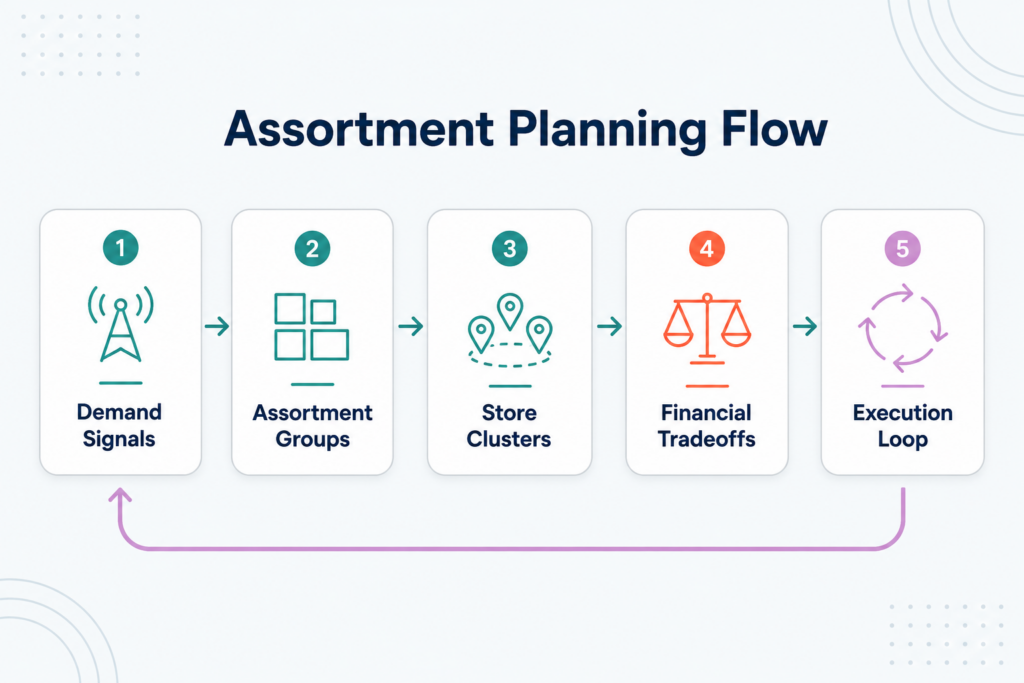
Assortment group planning is where that problem can be fixed early. It gives planners a structure for translating financial intent into assortments that reflect store-level demand patterns without forcing the team to plan every store as a separate business.
What You Will Learn
- What assortment group planning is and why it matters inside the merchandise planning process
- Why top-down plans often break when retailers try to localize assortments
- How to build assortment groups and store clusters without making planning unmanageable
- What data should shape the plan before buys are committed
- How to reconcile bottom-up demand signals with top-down financial targets
- How Onebeat connects planning decisions to later inventory execution
What Assortment Group Planning Actually Does
Assortment group planning is the process of structuring products and store groups so local demand can shape the plan without breaking financial control. It sits between broad merchandise planning and store-level execution.
Assortment planning decides which products a retailer should carry, how broad the range should be, and how much depth each product family needs. Assortment group planning is the operating layer that makes those decisions usable. It breaks a broad merchandise plan into groups that reflect real demand patterns, product roles, and store differences.
In practice, that means planners are not working only with high-level category budgets or a chain-wide sales target. They are deciding how a product family should show up across different kinds of stores, what level of depth each group can support, and where standardization helps more than localization.
An assortment group is not the same thing as a store cluster, though the two should work together. The assortment group defines the product logic. The store cluster defines where that logic belongs. When those two structures are built well, planners can localize with control instead of improvising later.
This matters more now because retail planning is moving toward hyperlocalization, personalized assortments, real-time data, and simulation-led planning, according to Deloitte’s 2025 retail planning POV. The challenge is not whether retailers should get more precise. It is how to do it without creating planning noise.
Why Top-Down Merchandise Plans Break at Store Level
Top-down plans are useful because they align teams around revenue, margin, inventory, and receipt targets. The problem starts when those targets are treated as if they already contain the answer to local assortment questions.
A top-down number can tell a planner how much a category needs to contribute. It cannot tell them which locations need broader size depth, which stores act as discovery destinations, or which cluster should carry the full expression of a trend versus a tighter commercial core. McKinsey’s April 2026 report on the future of stores makes a similar point from a different angle: retailers need to define each location’s mission clearly and align assortment to that role, not assume every store should do the same job.
When teams skip that translation layer, the financial plan looks coherent, but the assortment does not. Buyers end up compensating late. Allocators try to solve structural planning issues with store pushes. Replenishment teams inherit uneven demand patterns they did not create. What looked like a planning problem becomes an execution problem across the network.
This is also why localization efforts fail when they are done halfway. McKinsey notes that localizing assortment without a clear value thesis can add complexity faster than it adds benefit. Retailers do not need more localized exceptions. They need a planning structure that explains where variation matters and where it does not.
How to Build Assortment Groups Without Creating Planning Chaos
The first rule is to group by demand logic, not by org chart, legacy reporting lines, or geography alone. Geography can matter, but only when it reflects a real difference in demand, climate, price sensitivity, or store mission. If planners start by copying the existing hierarchy, they usually preserve complexity instead of reducing it.
The better starting point is to ask which products behave similarly across which types of stores. That leads to a more useful planning model. Some groups need full trend expression. Some need replenishable commercial depth. Some need narrow, high-confidence assortments. Some need a different size curve or a different entry-price balance. Those are planning decisions, not reporting artifacts.
The second rule is to separate product roles from store roles. A retailer may have a fashion-forward assortment group, a commercial core group, and a replenishable essentials group. It may also have flagship stores, convenience-driven stores, tourist stores, and long-tail doors. The planning model works when those roles interact clearly rather than collapsing into one generic A, B, C store shorthand.
The third rule is to keep the structure manageable. More granularity is not always better. The right number of assortment groups is the smallest number that captures meaningful demand differences without making buys, reviews, and downstream execution unworkable. If planners need a separate exception for every door, the model is too detailed. If every store can fit into the same group, the model is too blunt.
Pro Tip
If planners cannot explain why a store belongs to a cluster in one sentence, the cluster is probably too broad to guide assortment decisions or too narrow to scale operationally.
McKinsey describes store-specific assortment as a real source of value, but also notes that fully localized planning requires more complex models and discipline across space allocation, SKU selection, and planogramming. That is exactly why assortment groups matter. They create a middle layer between chain-level strategy and store-level execution.
What Data Should Shape Assortment Decisions Before the Buy
Strong assortment planning starts with demand evidence, but not all evidence deserves the same weight. Historical sales still matter. So do sell-through, velocity, margin contribution, weeks of supply behavior, and product-role performance by store type. For fashion and soft-goods retailers, size and color behavior can be just as important as top-line unit sales because they reveal whether demand is broad, narrow, or distorted by stock gaps.
Planners also need to distinguish between what is stable and what is changing. Stable signals include store role, physical capacity, and long-term customer mission. Changing signals include trend momentum, substitution patterns, local event impact, and the behavior of comparable products. That is especially important for newness, where history is thin and teams need product similarity rather than blind extrapolation.
Academic work on assortment localization reinforces the same idea: retailers serving multiple locations need data-driven ways to reflect heterogeneous demand across communities instead of assuming one standard mix fits all. The operational point is simple. The closer a retailer gets to the buy, the more expensive a bad assumption becomes.
What should planners not over-weight? Single-season outliers, one-off promotional spikes, and averages that blur very different store behaviors. Averages feel safe, but they often hide the fact that one cluster is under-ranged while another is over-bought. That is how clean financial plans turn into messy execution.
How to Reconcile Bottom-Up Demand with Top-Down Financial Targets
This is the step many retailers rush. Once planners build a more realistic bottom-up view, they often discover that it does not map neatly to the original plan. That is not a sign the planning model failed. It is the moment the model becomes useful.
Reconciliation should expose tradeoffs early. If local demand suggests broader assortment in one cluster, where will the retailer simplify elsewhere? If one product family needs more depth, which breadth bets should be trimmed? If the store fleet contains sharply different missions, should the team hold one chain-wide margin target, or should it allow different roles to carry different productivity expectations?
This is where merchandise financial planning has to behave like a guardrail, not a blind constraint. It matters because it keeps the assortment grounded in business reality. But it should be challenged by bottom-up demand logic before buys are locked. Deloitte’s Q2 2025 retail trends make the case that retailers are pairing supply-chain agility with consumer-focused assortment planning to navigate volatility more effectively. In other words, control now comes from better tradeoff management, not from pretending uncertainty is low.
The best reconciliation process usually works through scenarios. One scenario protects margin. Another protects localization depth. Another simplifies the assortment to improve product mix optimization, inventory flow, and risk exposure. The planner’s job is not to produce one mathematically perfect answer. It is to make the tradeoffs visible early enough that the business can commit with clarity.
That matters downstream. A Springer review of integrated retail decision support argues that assortment, shelf-space, and replenishment decisions are too often treated separately, even though they reinforce one another in practice. When reconciliation happens too late, that fragmentation gets worse.
Where Onebeat Fits in the Planning-to-Execution Loop
This is where Onebeat’s point of view becomes useful. Merchandise planning should not end with a slide deck, an approved buy, or a high-level target by category. It should create a plan that can move into SKU-store action with as little distortion as possible.
Onebeat frames this as planning from demand reality upward. On its merchandise planning page, the company describes building assortment plans, merchandise pyramids, and granular buys from real demand at the assortment-group level, then reconciling back to financial plans with visible tradeoffs. That matters because it connects planning intent to the decisions that come next: allocation, replenishment, transfers, promotions, and in-season adjustments.
In practical terms, better assortment group planning reduces downstream rework. Allocators do not need to repair weak depth decisions with broad pushes. Replenishment teams are not forced to compensate for structural range mistakes. Store transfers become a targeted lever, not an everyday workaround for a plan that missed local demand. This is the operating value of the Inventory Intelligence Loop: demand signals shape planning, planning drives action, and execution feedback improves the next decision cycle.
It also keeps planners in control. The goal is not to hand planning over to a black box. The goal is to give planners better visibility into store demand patterns, product similarity, cluster behavior, and tradeoffs before and after the season starts.
Retailers using Onebeat have reported measurable inventory and productivity improvements in public case-study materials. For example, Onebeat’s Aramis case study cites a 20% reduction in in-store inventory, a 30%+ reduction in permanent-item inventory, a 60% increase in inventory turns, and a 6% reduction in markdowns. Those outcomes should not be treated as a promise from one planning tactic. They do show what becomes possible when planning and execution stop operating as separate systems.
Key Takeaway
Assortment planning gets stronger when retailers stop asking only, Did we hit the financial plan? and start asking, Can this plan actually work by store role, product role, and demand pattern? Assortment groups are the bridge between those two questions.
FAQs
What is assortment planning in retail?
Assortment planning is the process of deciding which products a retailer should carry, how broad the range should be, and how much depth each product or category needs across channels or stores.
What is the difference between an assortment group and a store cluster?
An assortment group organizes product-planning logic. A store cluster organizes location demand logic. They should work together, but they solve different planning problems.
How many assortment groups should a retailer have?
There is no universal number. A retailer should use the smallest number of groups that captures meaningful demand differences without making buys and execution too complex to manage.
What data matters most in assortment planning?
Sell-through, velocity, margin, size and color behavior, store role, product similarity, and cluster-level demand patterns all matter. The right mix depends on category and business model.
How does assortment planning connect to allocation?
Allocation inherits the strengths and weaknesses of the plan. If assortment groups and cluster logic are sound, allocation can place inventory more precisely. If the planning model is weak, allocation ends up repairing structural mistakes.


