
Merchandise planning is the process of aligning sales, margin, inventory, and assortment decisions to meet financial targets. In traditional retail planning, that work starts with a financial plan, moves through assortment strategy and demand forecasting, and then flows into allocation, replenishment, pricing, promotions, and KPI tracking.
That process still matters. The issue is what happens after the plan is approved. Demand shifts by channel, region, store cluster, size curve, product role, and promotional response. A plan that looked sound in pre-season can start to drift within weeks of trading. By the time the variance is visible in a monthly review, the margin-saving decision may already be late.
The future of merchandise planning is adaptive execution. Planning creates intent. Execution creates outcomes. Retailers need a planning model that keeps financial targets connected to live demand signals and daily SKU-store inventory actions while the season is still in motion.
Lo que aprenderás
- What merchandise planning means in modern retail and why the definition is changing.
- Why static merchandise plans break once demand, channel mix, promotions, and local store behavior shift.
- What adaptive execution means in a merchandise planning context.
- How financial targets, assortment groups, store clusters, and merchandise pyramids connect to SKU-store actions.
- Which in-season decisions need to adapt before margin is lost.
- How Onebeat’s Inventory Intelligence Loop supports the move from planning handoff to planning-to-execution feedback.
What Is Merchandise Planning in Retail?
Merchandise planning in retail is the discipline of deciding what to sell, where to sell it, how much inventory to carry, when to replenish, and how those choices support sales, margin, and working-capital goals. It connects the commercial ambition of the business to the products and inventory that appear in stores and channels.
The merchandise planning process usually includes merchandise financial planning, demand forecasting, assortment planning, open-to-buy management, allocation, replenishment, promotions, markdown planning, and performance measurement. Each step answers a different question. What sales and margin does the business need? Which categories, price points, product roles, and assortments will support that goal? Where should inventory be placed? What should be repeated, moved, promoted, or cleared as the season develops?
Good retail merchandise planning is not only about buying the right quantity. It is about translating financial intent into choices that customers experience in each location. A category target is useful, but the customer sees a SKU, in a size, in a store, on a day when demand either exists or does not.
How merchandise planning connects to sales, margin, and inventory
Sales, margin, and inventory are connected. A retailer can drive sales with too much stock, but that often creates markdown exposure. It can protect inventory by buying too little, but that can create stockouts and missed full-price demand. It can hold margin targets on paper, but lose them in execution if inventory is trapped in the wrong places.
That is why merchandise planning has to balance commercial ambition with inventory productivity. Inventory is productive when it is in the right location, in the right depth, at the right time, and tied to the role the product is meant to play in the assortment.
Why Static Merchandise Plans Break After Approval
Static merchandise plans are not useless. They create discipline. They set targets. They align merchandising, planning, finance, allocation, and buying teams around a commercial view of the season. But static plans become less useful when demand changes faster than the business can respond.
That gap shows up in familiar ways. One store sells through a product faster than expected while another holds weeks of supply. A promotion pulls demand forward in one region but not another. A size curve behaves differently than the historical pattern. A channel shift changes where inventory should sit. A delayed replenishment action turns a potential winner into a lost sale. A late markdown turns a manageable laggard into margin pressure.
Static merchandise plans usually break in seven places:
- Demand volatility changes the volume or timing of customer need.
- Promotion effects vary by region, channel, product role, or store cluster.
- Channel shifts move demand away from where inventory was originally placed.
- Regional variation changes size, color, style, or price-point performance.
- Stockouts hide real demand and distort future planning signals.
- Excess inventory builds when laggards are not moved, slowed, or cleared early enough.
- Markdown pressure rises when action waits until the end of the season.
IHL Group projected the global cost of inventory distortion at $1.7 trillion in 2024, including $1.2 trillion from out-of-stocks and $554 billion from overstocks. That matters because stockouts and overstocks are often treated as opposite problems. In practice, they can be two symptoms of the same planning-to-execution gap.
McKinsey reported in 2023 that U.S. retailers were sitting on $740 billion in unsold goods and argued that retailers needed to think beyond markdowns to deal with inventory glut. The lesson is not that planning failed on day one. It is that the business needs a faster way to adjust before clearance becomes the main lever.
The planning-to-execution gap
The planning-to-execution gap is the distance between what the plan intended and what the business actually does once demand changes. It is not only a technology gap. It is an operating gap. Teams can see variances, but still lack a clear recommendation for what to do next.
That is where decision latency creates cost. If a retailer knows a product is overperforming in one cluster but does not move inventory, replenish faster, or adjust buying, the plan loses sales. If a retailer knows a product is underperforming but waits for the end-of-season markdown cadence, the plan loses margin.
Planning creates intent. Execution creates outcomes.
— Yishai Ashlag, Cofounder & CEO | Onebeat
Adaptive Execution Is the Future of Merchandise Planning
Adaptive execution in merchandise planning is the ability to adjust inventory, assortment, replenishment, transfers, promotions, in-season purchasing, and lifecycle decisions as demand changes, while keeping actions tied to sales, margin, and inventory targets.
That is where demand-based planning becomes inventory execution, not just a planning principle. Better prediction helps, but prediction alone does not create outcomes. A forecast can identify demand. A dashboard can show variance. The business still needs to decide whether to allocate more, replenish faster, move inventory, protect full-price winners, mark down slow movers, or buy again while demand is still active.
Adaptive execution moves merchandise planning from a static artifact to an operating loop. The plan sets direction. Live demand signals test that direction. Recommended actions translate the signal into SKU-store decisions. Execution changes the inventory position. Results feed the next decision.
This is the shift executive teams should care about. The future of merchandise planning is not a more detailed pre-season plan. It is a planning model that can adjust while there is still time to protect sales, margin, and inventory productivity.
Static merchandise planning vs. adaptive execution
| Dimension | Static merchandise planning | Adaptive execution |
| Planning horizon | Pre-season and periodic reviews | In-season response tied to live demand |
| Primary question | What should the plan be? | What should change now? |
| Demand signal | Forecasts, history, and planned events | Sell-through, availability, store behavior, margin risk, and demand drift |
| Output | Plan, budget, assortment, allocation rules | Recommended SKU-store inventory actions |
| Decision level | Category, channel, cluster, and assortment | SKU-store, with rollup to financial targets |
| Execution mechanism | Handoffs between planning and operations | Allocation, replenishment, transfers, promotions, in-season purchasing, and lifecycle actions |
| Success metric | Plan attainment | Full-price sell-through, inventory productivity, and faster response |
| Failure mode | Stale assumptions | Signals without action if the loop is not operational |
How Financial Targets Become SKU-Store Actions
Financial target reconciliation is where top-down ambition meets bottom-up demand reality. A retailer may start with sales, margin, receipt, and inventory targets by channel, category, or region. The harder work is translating those goals into assortment and inventory decisions that can be executed at store and SKU level.
Assortment groups help planning teams move beyond item-level noise without losing commercial logic. Products can be grouped by role, demand pattern, price tier, seasonality, or similarity. Store clusters help teams recognize that not every store should carry the same depth, size curve, or replenishment logic. Merchandise pyramids help connect the strategic shape of the assortment to the economics of the business, including good, better, best tiers, fashion versus core mix, margin profile, and volume expectations.
These structures create planning logic and stronger assortment optimization. But the logic only matters if it guides action. A store cluster should influence allocation depth. An assortment group should guide how quickly a new item is judged against comparable products. A merchandise pyramid should help decide which products deserve protection from unnecessary discounts and which need earlier lifecycle intervention.
From category targets to store-level decisions
A category may be on plan in total while individual stores are telling a different story. Some stores may be out of sizes on winners. Others may be carrying inventory that no longer has enough local demand. A channel may look healthy because markdown demand is hiding weak full-price sell-through. A promotion may look successful while leaving tail inventory behind.
Retailers connect financial plans to store-level inventory actions by translating targets into decision rules. Margin targets should shape markdown timing. Sales targets should shape replenishment priorities. Inventory targets should shape transfer and allocation choices. Assortment roles should shape which products are protected, expanded, moved, or exited.
The work of modern merchandise planning is to connect those signals back to the financial plan. If the business needs margin, the action may be to move inventory into stronger full-price locations instead of discounting it broadly. If the business needs sales, the action may be to prioritize replenishment to stores with proven demand. If the business needs inventory productivity, the action may be to reduce depth in slow clusters while protecting availability where demand is still real.
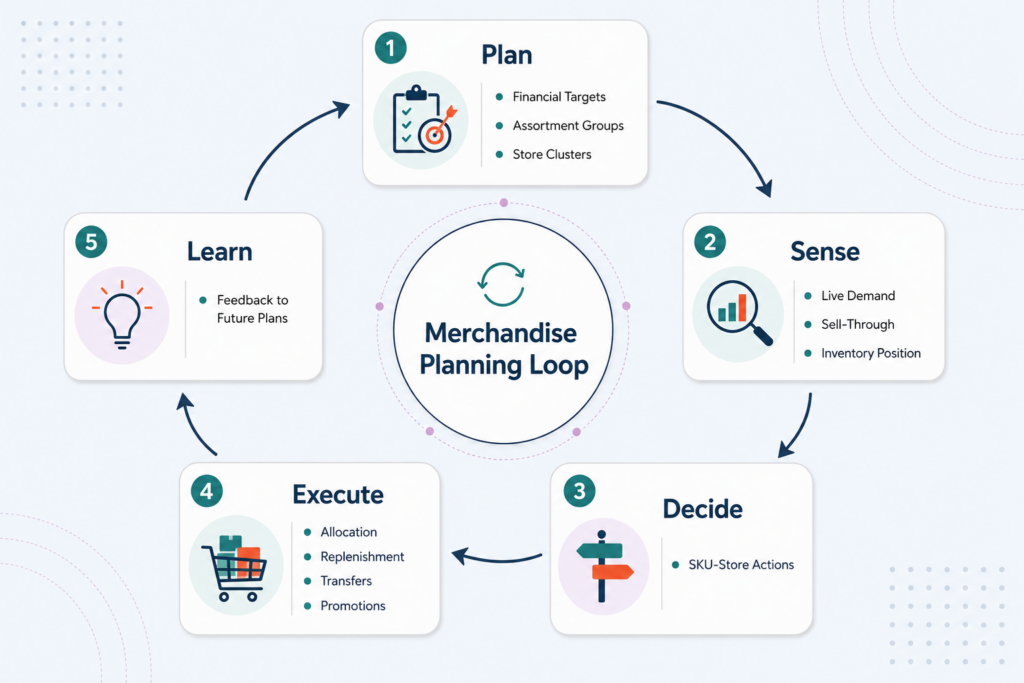
The Merchandise Planning Loop: Plan, Sense, Decide, Execute, Learn
An adaptive merchandise planning process needs a simple operating loop: plan, sense, decide, execute, learn. This loop keeps planning connected to inventory execution rather than treating the approved plan as the end of the planning process.
Plan
Planning defines the financial targets, assortment roles, store clusters, merchandise pyramids, inventory intent, and operating constraints. This is where the business decides what the season is meant to achieve and how inventory should support that ambition.
Sense
Sensing reads what is actually happening. That includes live demand, sell-through, availability, weeks of supply, inventory position, channel movement, margin risk, promotion response, and store behavior. It should separate a true demand issue from an availability, placement, or lifecycle issue.
Decide
Decisioning is where many retailers lose time. A useful loop does not stop at alerts. It recommends the next best action by SKU-store, with the financial and operational tradeoffs visible. The question is not only where the variance is. The question is what to do about it.
Execute
Execution turns the recommendation into action across allocation, replenishment, transfers, promotions, in-season purchasing, and lifecycle management. The action must respect operational constraints such as supply availability, transfer cost, lead time, store capacity, presentation standards, and supplier rules.
Learn
Learning feeds outcomes back into future plans and in-season decision rules. If an assortment group consistently behaves differently in a region, the next plan should reflect it. If a store cluster responds better to a certain depth or size curve, the next allocation should learn from it. The loop becomes smarter because execution results are not left outside the planning process.
Consejo profesional
Do not treat a variance report as a decision. A useful planning loop should show the gap, diagnose whether it is a demand, placement, availability, or lifecycle issue, and recommend the next action before markdowns become the only lever.
What Decisions Need to Adapt During the Season?
Adaptive execution becomes real through specific in-season decisions. The goal is not to make every decision daily for every product. The goal is to recognize which decisions are time-sensitive and which actions can still improve sales, margin, or inventory productivity.
Asignación
Allocation should evolve as early demand reveals store and product behavior. Initial allocation is based on the best available assumptions. Once trading starts, the business should compare actual sell-through, availability, and local demand against those assumptions. A product that deserves more depth in one cluster may need less exposure in another.
Reabastecimiento
Replenishment should respond to live demand and constraints rather than static averages. A fast seller with limited supply needs priority rules. A product with uneven store performance needs demand-based replenishment rather than equal pushes. The decision is not simply how much to send. It is where the next unit creates the best commercial return.
Transfers
Transfers can protect margin when demand exists elsewhere and the move is economical. A slow mover in one store is not always a weak product. It may be under-placed, over-allocated, missing the right local demand, or sitting in a store where another product is absorbing the demand. Cost-aware transfers help retailers move inventory before markdowns become the default answer.
Promotions and markdowns
Promotions and markdowns should be targeted by lifecycle stage and demand reality. Blanket late-season markdowns can clear inventory, but they can also discount products that would have sold at full price in stronger locations. Earlier, more precise intervention gives retailers more choices.
In-season purchasing
In-season purchasing should focus on repeat-buy winners, coverage gaps, supplier lead times, MOQs, and the margin value of acting while demand is active. The best repeat buy is not only the product with high sales. It is the product with enough future demand, available supply, and profitable distribution opportunity.
Lifecycle management
Lifecycle management identifies when products are moving from launch to build, peak, tail, and exit. It helps protect winners from unnecessary discounts, rotate tail inventory into better demand pockets, and phase markdown or liquidation decisions before inventory becomes distressed.
Which KPIs Show Whether Merchandise Planning Is Working?
KPI tracking should do more than report whether the plan was hit. It should show whether the next decision is clear. For adaptive merchandise planning, useful KPIs include full-price sell-through, availability, weeks of supply, inventory productivity, gross margin return on inventory, markdown rate, stockout rate, transfer effectiveness, replenishment responsiveness, and plan variance.
The important shift is from reporting KPIs to decision KPIs. A weeks-of-supply issue should trigger a replenishment, transfer, markdown, or lifecycle question. A full-price sell-through issue should show whether the product needs more availability, better placement, or less exposure. A plan variance should not end in commentary. It should point to the next action.
How Onebeat Runs the Planning-to-Execution Loop
Planning tools plan. Onebeat runs the loop. Onebeat is Precision Inventory Intelligence for Retail Planning & Execution. It is not a generic forecasting tool, dashboard, ERP replacement, or broad AI platform.
The difference is operating focus. Merchandise planning creates the financial and assortment intent. Onebeat helps connect that intent to live demand signals and recommended inventory actions across the planning-to-execution loop. The value is not another view of variance. It is a prioritized action the business can execute while the season is still moving.
In practical terms, the Inventory Intelligence Loop connects signals, decisions, execution, and feedback. It helps retailers understand where demand is real, where inventory is misplaced, where replenishment should be prioritized, where transfers are worth the cost, where promotions or markdowns should be targeted, and where lifecycle decisions should happen sooner.
The point is not to replace planning discipline or core retail systems. The point is to keep planning intent connected to execution as reality changes. Financial targets, assortment groups, store clusters, and merchandise pyramids create planning discipline. The Inventory Intelligence Loop keeps that discipline active.
This matters because inventory productivity is not the same as inventory reduction. A retailer can reduce inventory and still lose sales if the wrong products are cut. A retailer can increase inventory and still lose margin if the stock lands in the wrong places. The better measure is whether inventory is positioned where it can support full-price sell-through and commercial intent.
Key Takeaway
Merchandise planning is moving from a static process to an adaptive operating loop. The plan still matters, but it creates value only when retailers can translate demand reality into timely SKU-store actions that protect full-price sell-through, reduce markdown exposure, and improve inventory productivity.
Preguntas frecuentes
What is merchandise planning?
Merchandise planning is the process of aligning sales, margin, inventory, and assortment decisions to meet financial goals. In modern retail, it should include adaptive execution so the plan can respond when demand changes during the season.
Is merchandise planning the same as demand forecasting?
No. Demand forecasting estimates future demand. Merchandise planning uses demand insight alongside financial targets, assortment strategy, inventory, allocation, replenishment, pricing, and promotions to guide business outcomes.
Why are static merchandise plans risky?
Static plans can become stale once demand, channel mix, store behavior, availability, and promotions shift. The risk is not that the original plan was useless. The risk is that the business cannot adapt fast enough while the season is still in motion.
What is adaptive execution in merchandise planning?
Adaptive execution is the ability to adjust inventory, assortment, replenishment, transfers, promotions, in-season purchasing, and lifecycle decisions as demand changes, while keeping actions tied to sales, margin, and inventory targets.
How do financial plans connect to store-level inventory actions?
Financial plans connect to store-level inventory actions when sales, margin, receipt, and inventory targets are translated into SKU-store decisions. That means allocation, replenishment, transfers, promotions, and lifecycle actions should reflect both the financial target and the local demand signal.
What KPIs show whether merchandise planning is working?
Useful KPIs include full-price sell-through, availability, weeks of supply, inventory productivity, GMROI, markdown rate, stockout rate, transfer effectiveness, replenishment responsiveness, and plan variance. The best KPIs trigger action, not just reporting.
How does Onebeat support adaptive merchandise planning?
Onebeat supports adaptive merchandise planning by connecting planning intent to live demand signals and recommended SKU-store inventory actions through the Inventory Intelligence Loop. It helps retailers move from planning handoff to planning-to-execution feedback.


