
In retail, some of the most expensive decisions are made before customers reveal what they actually want. Buyers often commit inventory months before a season begins, long before local demand patterns, weather shifts, trend changes, or channel performance become visible.
That creates a familiar dilemma. Buy too much and margin is pressured by excess stock and markdowns. Buy too little and winning products disappear from shelves while demand is still strong. The challenge is not achieving a perfect forecast. The challenge is adapting decisions as reality unfolds.
In-season purchasing gives retailers a way to close the gap between planning assumptions and live demand. Instead of treating preseason commitments as fixed, retailers can use demand signals, coverage analysis, supplier constraints, and profitability considerations to make smarter purchasing decisions throughout the season.
Lo que aprenderás
- What in-season purchasing means in retail
- How it differs from preseason planning
- How to identify repeat-buy winners early
- How to evaluate coverage gaps before reordering
- How MOQs, lead times, and supplier constraints affect purchasing decisions
- Which KPIs matter most for demand-driven purchasing
What Is In-Season Purchasing?
In-season purchasing is the practice of making additional buying decisions after a season has started. Retailers use live demand, current inventory positions, projected coverage, lead times, and supplier constraints to determine whether they should reorder products, how much they should buy, and where inventory is most likely to sell at full price.
In practical terms, in-season purchasing answers three questions: which products are still selling strongly, where inventory will run out before demand slows, and whether supplier constraints allow a profitable repeat buy.
It is closely connected to demand-driven purchasing. Rather than relying only on forecasts created months earlier, buying teams incorporate emerging demand signals into purchasing decisions. The objective is not to replace planning. It is to improve execution when reality differs from expectations.
Fashion and specialty retail are particularly challenging because demand is shaped by short product life cycles, seasonality, local preferences, and trend volatility. Academic research highlights the complexity and uncertainty involved in forecasting fashion demand. In-season purchasing helps retailers operate effectively despite that uncertainty.
Demand-driven purchasing vs. forecasting
Forecasting estimates what demand may become. Demand-driven purchasing decides what the business should do once demand starts to show itself. A forecast may say a style should sell evenly across the chain. The season may reveal that the black colorway is selling in urban stores, the extended-size range is stronger online, and a regional weather shift has changed the timing of demand.
That is where in-season buying becomes part of retail purchasing strategy. The question is not whether preseason planning or in-season buying matters more. The question is how both work together without locking the business into assumptions that are already outdated.
Why Traditional Purchasing Models Create Inventory Risk
Traditional purchasing models require large commitments before demand becomes visible. Forecasts provide a starting point, but they cannot fully anticipate changing customer behavior, regional differences, trend acceleration, channel shifts, or unexpected market conditions.
When inventory is committed too early, retailers often experience two costly outcomes at the same time: excess inventory in some products and missed sales opportunities in others. One group of items requires markdowns while another group sells out too quickly. The total inventory position may look acceptable, but the inventory is sitting in the wrong products, locations, colors, or sizes.
This is why inventory risk is not only a volume problem. It is a placement and timing problem. A retailer can be overstocked at chain level and still lose sales at SKU-store level because the right inventory is not available where demand is strongest. Buying more without that visibility can create new exposure. Buying nothing can protect capital but leave full-price sales on the table.
Forecasting remains important, but forecasting alone is not enough. Retailers need a mechanism for adjusting decisions after demand appears. McKinsey has noted that fashion sourcing is increasingly shaped by volatility, disruption, cost pressure, and the need for greater speed and flexibility.
Retailers do not lose margin because demand changes. They lose margin because their decisions do not change with it
-Yishai Ashlag, Cofounder & CEO Onebeat
In-Season Purchasing vs. Preseason Planning
Preseason planning and in-season purchasing serve different purposes. Planning creates intent. It establishes financial targets, assortment strategies, inventory investments, open-to-buy guardrails, and sourcing commitments.
In-season purchasing acts as the execution layer. It evaluates what customers are actually buying and determines how the business should respond. A retailer may discover that one color, size range, store cluster, or region is outperforming expectations while another is underperforming.
The strongest retailers combine both disciplines. Planning provides structure and direction. In-season purchasing provides adaptability. Together, they allow organizations to remain disciplined without becoming rigid.
For a merchandising leader, this distinction matters because the best answer is not always another purchase order. The right action may be a repeat buy, a replenishment change, a transfer, a promotion adjustment, a lifecycle decision, or a decision not to buy more. In-season purchasing should help teams choose the action with the best margin and inventory productivity outcome, not simply react to a fast seller.
Consejo profesional
Treat in-season purchasing as a portfolio of coverage decisions rather than a single reorder decision. Evaluate opportunities collectively so the business can decide where capital, supplier capacity, and operational effort will create the highest full-price return.
How to Identify Repeat-Buy Winners Early
Not every fast-selling product deserves a reorder. A successful repeat-buy process begins with understanding whether demand is sustainable or temporary.
Buying teams should examine sell-through rates, store-level performance, inventory coverage, and the consistency of demand across locations. A product selling strongly in a handful of stores may require a different response than one performing well across an entire network.
For example, a jacket may sell through quickly in northern stores after a cold spell but move slowly in warmer regions. A national repeat buy could create excess inventory risk. A targeted purchase, transfer, or replenishment shift may protect margin while supporting the locations where demand is real.
Avoiding false positives
Teams should test whether demand is being distorted by promotions, temporary events, influencer moments, weather spikes, launch scarcity, or one unusually strong channel. A product can look like a winner because inventory was shallow at launch, not because demand will support a meaningful repeat buy.
Coverage analysis is the safety check. If inventory is projected to run out before demand slows, the retailer may have a genuine repeat-buy opportunity. If inventory remains healthy, a reorder may simply increase risk. The goal is to identify durable demand patterns rather than reacting to every fluctuation.
The strongest repeat-buy process also separates product demand from location demand. A product may be a chain-level winner, but the next decision still needs to happen at SKU-store or SKU-location level. Where will new units sell at full price? Which locations need depth? Which locations should be capped because demand is fading?
How to Evaluate Coverage Gaps Before Reordering
A coverage gap exists when projected inventory will not support expected demand through a future period. Evaluating these gaps allows retailers to focus purchasing attention where it matters most.
Instead of asking whether a product is selling well, buyers should ask a more practical question: where will inventory run out, when will it happen, and what sales opportunities are at risk? This shifts the conversation from product popularity to business impact.
A good coverage view should connect live demand, inventory on hand, inbound units, open purchase orders, expected lead time, warehouse capacity, store capacity, markdown exposure, and open-to-buy limits. The output should not be a generic reorder recommendation. It should be a prioritized SKU-store or SKU-location action that tells the team where additional inventory can still create full-price value.
A practical coverage-gap decision framework
Use this sequence before committing to a repeat buy:
- Confirm the demand signal. Look for sustained sell-through, demand consistency, and performance across relevant store clusters or channels.
- Calculate projected coverage. Identify where inventory will run out before demand slows at SKU-store, SKU-location, or cluster level.
- Test constraints. Check MOQ, lead-time arrival date, supplier capacity, warehouse capacity, store capacity, open-to-buy, and pack or size-curve limits.
- Compare profit and risk. Weigh expected full-price sales against inventory exposure, markdown risk, and working-capital impact.
- Choose the execution path. Decide whether to repeat buy, transfer, replenish differently, adjust promotions, manage lifecycle timing, or make no additional buy.
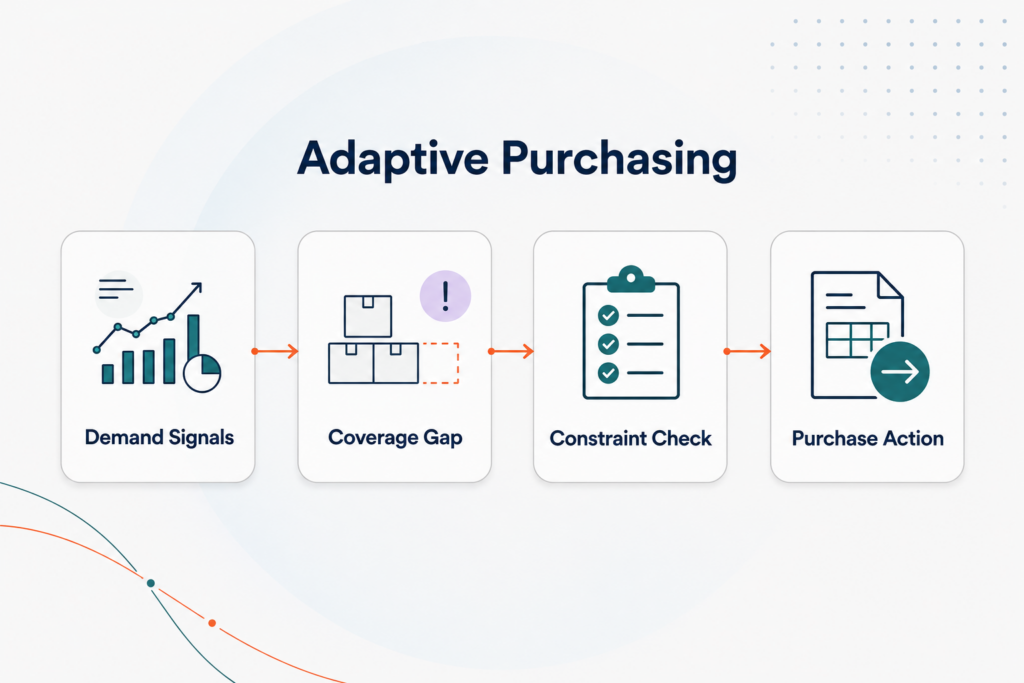
At Onebeat, this approach aligns with Precision Inventory Intelligence. The focus is not on generating more reports. The focus is on turning live demand, coverage gaps, constraints, and profitability signals into executable inventory decisions.
It also connects to the Inventory Intelligence Loop. A repeat-buy decision should not sit apart from allocation, replenishment, transfers, promotions, and lifecycle management. Each action creates new demand feedback, and that feedback should improve the next decision.
How MOQs, Lead Times, and Supplier Constraints Shape Purchasing Decisions
Even when demand supports a reorder, operational constraints determine whether a purchase makes sense. Minimum order quantities, supplier capacity, manufacturing schedules, transportation requirements, pack constraints, and lead times all influence the outcome.
A retailer may identify a winning product but discover that the supplier’s minimum order quantity creates excess inventory risk. Another retailer may find that lead times push delivery beyond the peak selling window. In both cases, the demand signal is useful, but it does not automatically justify a purchase.
Constraint-aware purchasing evaluates feasibility alongside opportunity. Retailers should model multiple scenarios, comparing expected sales upside against inventory exposure, timing, and working-capital implications. The most important scenarios usually include MOQ threshold, expected arrival date, coverage at arrival, selling weeks left, warehouse and store capacity, and likely markdown exposure.
Companies such as Inditex have publicly emphasized flexibility and within-season responsiveness as parts of their operating model. Most retailers cannot replicate that model exactly, but they can build greater flexibility into purchasing decisions by aligning sourcing options, decision cadence, and demand visibility.
KPIs for Demand-Driven Purchasing
Strong purchasing decisions require measurement. The most useful KPIs connect inventory decisions to revenue, margin, and inventory productivity.
Full-price sell-through helps teams understand whether inventory is being converted into revenue without markdown dependency. Inventory turnover measures how effectively capital is being converted into sales. Coverage metrics reveal how long inventory is expected to support demand.
Additional metrics may include stockout risk, repeat-buy success rate, supplier responsiveness, availability levels, lost-sales exposure, and sell-through by store cluster. These indicators give leaders a balanced view of performance across demand, supply, and execution.
The objective is not maximizing a single metric. High availability without margin discipline can create excess stock. High turnover without availability can starve winners. Strong demand-driven purchasing balances availability, margin, risk, and capital efficiency across the portfolio.
Key Takeaway
The purpose of in-season purchasing is not to predict demand perfectly. It is to continuously adapt purchasing decisions as demand becomes visible while balancing inventory productivity, supply constraints, and risk.
Preguntas frecuentes
What is in-season purchasing?
In-season purchasing is the process of making additional buying decisions during a selling season using live demand, inventory coverage, lead times, and supplier constraints.
How does in-season purchasing differ from preseason planning?
Preseason planning sets inventory intentions, financial targets, and sourcing direction. In-season purchasing adjusts execution based on actual demand conditions.
How do retailers identify repeat-buy winners?
They evaluate sell-through, demand consistency, store-level performance, and projected coverage gaps before committing additional inventory.
How do MOQs affect purchasing flexibility?
Minimum order quantities can limit purchasing options by requiring larger commitments than demand may justify. Teams should compare MOQ size with expected full-price demand, lead time, and markdown exposure.
What KPIs should purchasing teams track?
Coverage, inventory turnover, full-price sell-through, availability, stockout risk, supplier responsiveness, and repeat-buy performance are among the most useful metrics.


