
Retail teams rarely fail because they do not care about demand. They fail because the decision to buy again arrives under pressure. A product starts to move. Stores ask for more. Suppliers want commitment. Finance wants control. By the time everyone agrees, the team is either too late to protect sales or too aggressive and creates the next markdown problem.
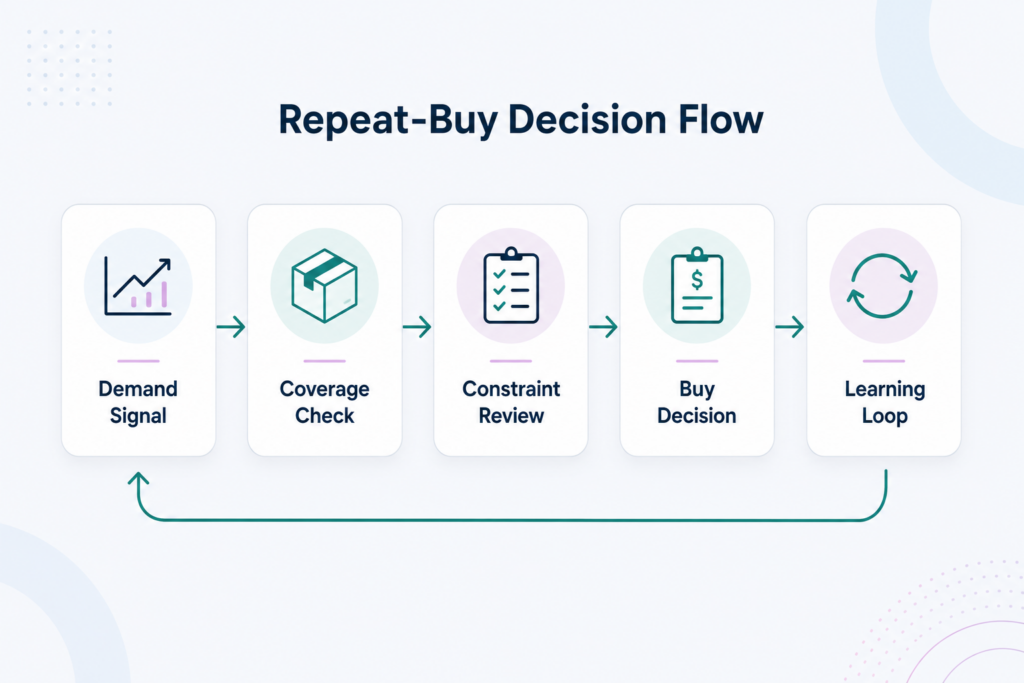
The best in-season buying best practices help retailers decide when to repeat-buy, when to wait, and how to protect full-price demand under real constraints. That means reading demand at the SKU-store level, checking coverage before reacting, and testing each order against timing, margin, and supply-side risk.
That discipline matters more now. Deloitte says retailers are managing more cost pressure, tariff uncertainty, and supply-chain complexity, which is pushing them toward more agile planning, sourcing, and inventory decisions. McKinsey adds that fashion supply chains need to become more agile to reduce excess inventory and minimize the risk of shortfalls, while only 20 percent of fashion executives expected consumer sentiment to improve in 2025 and 39 percent expected conditions to worsen.
Lo que aprenderás
- Why in-season buying still breaks down in strong retail organizations
- The seven rules that improve repeat-buy decisions
- How to use coverage, confidence, and constraints together
- Where open-to-buy helps, and where it does not
- How Onebeat connects planning intent to better in-season execution
Why In-Season Buying Still Goes Wrong
Most teams know the theory. Buy closer to demand. Commit less upfront. Reorder winners in season. The problem is that theory collapses when the decision gets specific.
A merchant is not deciding whether a category is healthy. They are deciding whether one style, in one color family, across a group of stores, deserves another commitment at a specific price and lead time. That mixes signal quality, timing, margin risk, store-level variation, supplier constraints, and working capital into one choice.
This is why capable teams still make weak repeat-buy decisions. They overreact to short bursts of demand. They trust aggregate inventory views that hide local shortages. They use open-to-buy as if it were the decision itself, instead of one financial guardrail inside a larger operating model. Or they wait too long for certainty and miss the moment when a smaller, smarter repeat buy would have protected sales.
In trend-sensitive retail, hesitation has a cost. So does overconfidence. Inditex reported that inventory was 2 percent lower as of January 31, 2026 versus the same date in 2025, which is one sign of how closely large fashion players are managing inventory discipline in a hard market.
7 In-Season Buying Best Practices for Better Repeat-Buy Decisions
Rule 1: Separate Real Demand from Short-Term Noise
The first mistake in repeat buying is treating any strong week like proof of a winner.
Demand signals matter, but not all signals deserve the same weight. A product can spike because a promotion landed, a store was under-inventoried and suddenly refilled, weather shifted for a few days, or one region overperformed while the rest of the chain stayed flat. A smart in-season buying process asks whether demand is broad enough, steady enough, and profitable enough to justify new commitment.
This is where SKU-store visibility matters. Aggregate category strength can hide unstable performance. A retailer may feel good about a style because chain-wide sales are strong, while the reality is that a few stores are carrying the result and the rest are mixed. The opposite can happen too: one weak cluster can hide a real winner elsewhere.
The practical question is simple: are we looking at a repeatable pattern, or are we reacting to heat? A team that cannot answer that clearly should not scale the buy yet.
Rule 2: Check Coverage Before You Check Enthusiasm
Strong sales do not automatically mean you need more inventory. First, you need to know how much demand your current inventory can still cover.
Coverage is one of the most useful filters in in-season buying because it turns the conversation from emotion into timing. Instead of asking, “Do we love this product?” the better question is, “How long can current inventory support actual demand at the stores where it is really moving?”
That shift matters. Many buying errors happen because teams see fast sell-through and jump straight to reorder logic. But if there is still healthy coverage in the highest-opportunity locations, the right move may be to wait, transfer, or stage a smaller follow-up order. On the other hand, if strong stores are heading toward a shortfall while slower stores still hold stock, the decision may be less about buying more and more about acting sooner and more precisely.
Coverage also explains why aggregate inventory can be misleading. Ten weeks of stock at the total level may sound safe. It is not safe if the right stores have three weeks and the wrong stores have fourteen.
Consejo profesional
Treat a repeat buy as a confidence decision, not a popularity contest. A fast seller with weak coverage visibility or long lead-time risk may deserve a smaller staged buy instead of a full chase order.
Rule 3: Use Open-to-Buy as a Checkpoint, Not the Whole Answer
Open-to-buy matters because it protects discipline. It tells teams how much room they have left to commit without breaking the financial plan. But OTB is not a buying strategy on its own. It is a boundary condition.
That distinction matters because many market articles treat OTB as the whole playbook. Those formulas are useful, but they do not answer the harder question: which repeat buy deserves the remaining budget most?
OTB can tell you whether you can spend. It cannot tell you whether you should spend on this style, in this quantity, at this moment, with this level of demand confidence. That requires a different layer of decision-making that connects finance discipline with demand quality, coverage risk, and execution timing.
Rule 4: Stress-Test Every Buy Against Lead Times, MOQs, and Supplier Rules
A product is not a winner just because stores want more of it. It becomes a smart repeat buy only if the supply side still makes sense.
This is the point where many in-season buying frameworks get too clean. They assume a retailer can reorder the exact right quantity at the exact right time. Real life does not work that way. Suppliers have minimum order quantities. Factory calendars are tight. Fabric availability shifts. Lead times move. Some partners will only accept larger commitments, while others can support a staged approach.
Deloitte says retailers are responding to a more unstable trade environment with more frequent vendor negotiations, sourcing shifts, and planning changes to preserve margin and supply continuity (https://www.deloitte.com/us/en/industries/consumer/articles/q2-2025-retail-consumer-trends.html). That means the best buying decision on paper can still be the wrong one in practice if the supply side forces too much risk back into the inventory position.
- Does the MOQ force us past healthy demand coverage?
- Will the lead time still let us capture the demand window?
- Do supplier terms reduce our flexibility if demand cools?
- Would a smaller staged order protect margin better than one large catch-up order?
Rule 5: Prefer Staged Commitment When Demand Confidence Is Still Forming
Retailers often think the only two options are to chase hard or do nothing. That is rarely true.
When a product shows strong movement but demand confidence is still building, staged commitment is usually the better path. A smaller repeat buy can preserve upside while limiting the damage if demand normalizes. It also gives the team one more cycle of learning before making a deeper commitment.
This matters even more in volatile categories. McKinsey notes that low growth, uneven demand, and shifting customer behavior are forcing brands to get more agile about excess inventory and shortfall risk. In that environment, staged buys are not a sign of hesitation. They are a sign of control.
Rule 6: Protect Margin, Not Just Availability
The goal of in-season buying is not to keep shelves full at any cost. The goal is to support profitable demand.
Many teams still judge repeat buys mainly by whether they kept a fast seller in stock. That can produce the wrong behavior. If the reorder arrives too late for the demand window, too deep for real velocity, or too broad across low-opportunity stores, availability may improve on paper while margin gets weaker.
The better test is whether the repeat buy improves inventory productivity. Does it support full-price sell-through? Does it protect the strongest stores first? Does it avoid flooding lower-confidence demand? Does it create a cleaner next decision instead of a bigger liability?
Onebeat frames this well. Inventory is not valuable because it exists. It becomes valuable when it meets real demand with the right timing and depth. Onebeat says retailers need inventory aligned to live demand so teams can act faster, reduce shortages, prevent excess inventory, and keep more sales at full price. Onebeat also cites outcomes such as stronger sell-through, lower inventory holding, faster turnover, and higher full-price sales when inventory is better aligned to demand, though those results should be treated as qualified examples rather than guarantees.
Rule 7: Turn Every Repeat Buy into the Next Planning Advantage
The last best practice is the one many teams skip. They make the buy, review the result quickly, and move on.
That is a missed opportunity. Every repeat buy should teach the business something about demand confidence, timing, store breadth, size balance, supplier responsiveness, and margin tradeoffs. If it does not, the team is forced to relearn the same lessons every season.
This is where in-season buying connects back to the Inventory Intelligence Loop. Pre-season intent gives the team a starting point. In-season demand reveals what the market is actually saying. Repeat-buy outcomes sharpen the next round of planning assumptions, commitments, and constraints.
Where Onebeat Fits
Onebeat fits this problem as a point of view before it fits as a product claim. The core idea is Precision Inventory Intelligence for Retail Planning and Execution: planning intent should not stop at a spreadsheet, and execution should not wait until the season is already drifting.
For in-season purchasing, that means using live demand, coverage scenarios, and operational constraints to make better repeat-buy decisions while there is still time to influence the season. It means understanding which stores and SKUs are truly at risk, how much confidence exists behind the signal, and how supplier rules change the right response. It also means keeping the buying and planning team in control of the tradeoff.
That is why the Onebeat view is useful here. Planning tools plan. Onebeat runs the loop. The value is not another static view of the season. The value is turning planning intent into better in-season actions and turning those actions back into better planning the next time around.
Key Takeaway
The best in-season buying teams do not chase demand blindly and they do not hide behind budgets either. They follow a repeat-buy discipline: validate the signal, check coverage, respect constraints, stage commitment when confidence is still forming, and judge success by margin and learning, not just by units ordered.
Preguntas frecuentes
What is the difference between in-season buying and open-to-buy planning?
Open-to-buy planning is a financial control framework that shows how much room a retailer has left to buy. In-season buying is the operating decision process for whether a specific repeat buy should happen, when it should happen, and how large it should be. OTB is an input. It is not the whole decision.
When should a retailer place a repeat buy?
A retailer should place a repeat buy when demand looks durable, coverage is tightening in the right stores, the margin case still holds, and supply constraints still allow the order to arrive in time to matter.
Which constraints matter most in in-season purchasing?
The biggest constraints are usually lead times, MOQs, supplier rules, open-to-buy limits, and the difference between chain-wide inventory and true store-level coverage.
How do you avoid overbuying a winner?
Avoid overbuying by checking whether demand is broad and durable, measuring real coverage, stress-testing the order against constraints, and using staged commitment when confidence is still building.


