
Inventory can be available in the retail network and still be financially wrong. A size run may be sitting in a slow store while another store is missing sizes that could sell at full price. A seasonal product may be treated as excess in one location while demand is still active two regions away. In that situation, the problem is not only how much inventory the retailer owns. It is where that inventory sits, how long it stays there, and whether the business acts before markdown becomes the only lever.
Store transfers are often treated as a back-office operations task. The process matters, but the margin decision matters more. Moving inventory is only useful when the move improves the probability of sell-through, protects margin, or improves the productivity of stock the retailer already owns.
Retailers do not lose margin only because inventory is wrong. They lose margin because inventory stays wrong for too long. This article explains what store transfers are, why they belong in the margin conversation, and how retailers can evaluate transfer decisions using SKU-store demand, transfer cost, lifecycle timing, and full-price sell-through opportunity.
O que você aprenderá
- What store transfers mean in retail and how they differ from basic stock movement.
- Why store transfers are a margin and inventory productivity lever, not only an operations task.
- When retailers should consider transferring inventory instead of marking it down.
- Which signals matter before approving a transfer: SKU-store demand, inventory depth, size availability, lifecycle stage, transfer cost, and execution capacity.
- How transfer optimization and tail rotation fit into Onebeat’s Inventory Intelligence Loop.
What Are Store Transfers in Retail?
Store transfers are the movement of inventory between retail locations to rebalance stock against demand. In plain language, a retailer moves product from a store where the item has a lower chance of selling to a store where it has a better chance of selling, often before the product is discounted, stranded, or liquidated.
Retail store transfers can happen between stores, from a store back to a distribution center, or from one node in the retail network to another. Store-to-store transfers are the most familiar version: one store sends units, sizes, or colors to another store because the destination has stronger demand, better presentation, or a missing size run.
The point is not movement for its own sake. A transfer should improve inventory position. That may mean filling a broken size grid in a high-demand store, clearing a low-opportunity tail in a weak store, supporting a local event, or delaying a markdown because demand exists elsewhere in the network.
Store transfers vs. replenishment
Replenishment usually moves inventory from a central pool to a store to restore availability against an expected target. Store transfers move inventory that is already placed in the network. The question changes from “How much should this store receive from supply?” to “Where can this owned inventory earn the best return now?”
That distinction matters because transferred inventory already carries cost, exposure, and time pressure. A replenishment decision can support future demand. A transfer decision often tries to rescue or improve the performance of inventory that is already committed.
Store transfers vs. markdown optimization
Markdown optimization decides when and how deeply to reduce price. Transfers decide whether the product still has a better full-price opportunity somewhere else before that price action is taken. These are connected decisions, not competing disciplines.
A retailer should not transfer every slow mover. It also should not mark down every slow mover too early. The better question is whether demand still exists in another location and whether moving the product is economically and operationally sensible.
Why Store Transfers Are a Margin Decision
Store transfers belong in the margin conversation because inventory value depends on position. A product can be excess in one store and a full-price opportunity in another. If the retailer only sees chain-level availability, that mismatch can stay hidden until one store discounts inventory while another loses sales.
The scale of inventory imbalance is large enough to make this an executive issue. That matters because stockouts and overstocks are not separate problems. They often appear at the same time when inventory is not aligned with local demand.
McKinsey’s article on the retail inventory glut reported that U.S. retailers were sitting on $740 billion in unsold goods and argued that clearing inventory requires thinking beyond markdowns. Transfers are one of the actions retailers can evaluate before the product becomes a late-season clearance problem.
The hidden cost is time. Every week inventory remains in the wrong store, the retailer loses selling window, presentation quality, size integrity, and optionality. The margin decision is not simply whether to move the product. It is whether acting now preserves more economic value than waiting.
The cost of inventory is not carrying it. The cost is carrying it in the wrong place.
— Greg Arthur, VP Retail Strategy | Onebeat
Why “available in the chain” is not the same as “available to demand”
Retail leaders often know they have inventory somewhere. The hard part is knowing whether that inventory is reachable by the demand that exists now. A store with a single remaining size may not be able to sell a style at full price because the size grid is broken. Another store may have traffic and demand, but not the right sizes. In chain-level reporting, the inventory exists. In the customer’s reality, it does not.
This is why transfers should be measured against full-price sell-through and inventory productivity, not only units moved. Inventory is productive when it sits where it can sell at the best margin within the remaining selling window.
When Should Retailers Transfer Inventory Instead of Marking It Down?
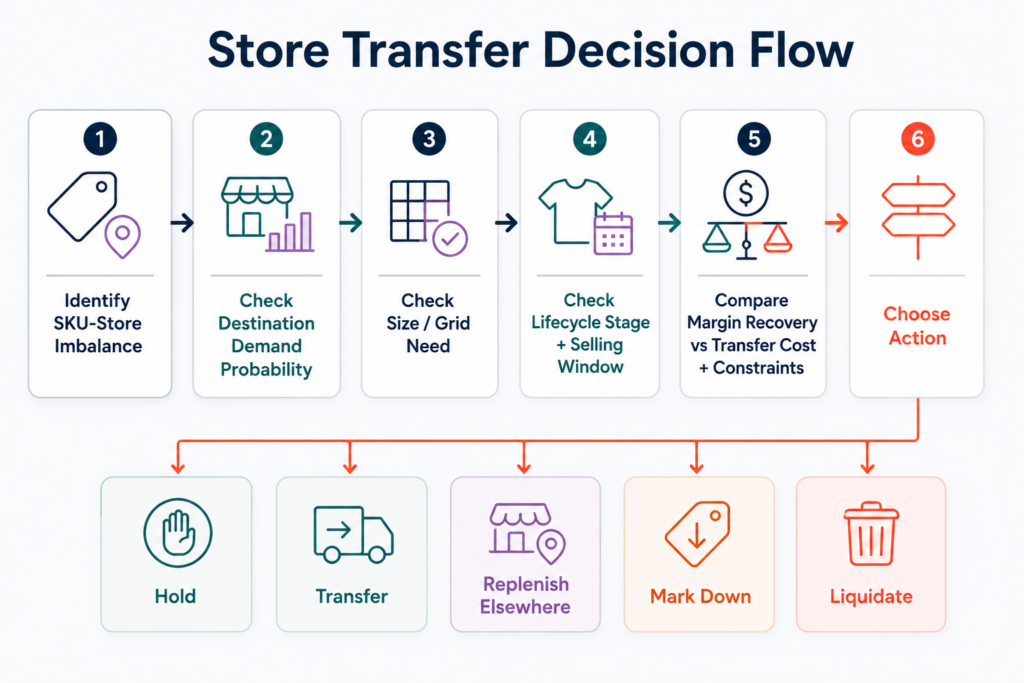
A transfer is worth considering when expected margin recovery and sell-through probability exceed the all-in transfer cost and operational friction. That sentence is the transfer decision equation. It keeps the retailer from treating transfer as a reflex and from treating markdown as the default answer.
What makes a transfer financially worth doing?
A store transfer is financially worth doing when the expected margin recovery, sell-through probability, and strategic value of the destination placement are greater than the all-in transfer cost, store labor, routing friction, and risk of arriving too late in the product lifecycle.
The decision starts with destination demand. Is the receiving store selling the item or comparable products faster? Is there evidence that the missing size, color, or depth would convert? Is the product still early enough in its lifecycle to sell without unnecessary discounting? A transfer only protects margin if the destination has a realistic chance of selling the inventory.
The next test is the remaining selling window. A transfer that arrives too late can simply move the markdown problem from one store to another. Seasonal, fashion, footwear, and specialty categories have short periods when product relevance is strongest. Once that window narrows, the economics may shift toward targeted markdown, outlet, liquidation, or another end-of-life action.
The third test is cost and friction. Freight, handling, store labor, receiving capacity, routing, minimum movement thresholds, and presentation standards all affect the decision. A unit-level margin opportunity can disappear if the move is too expensive or too hard to execute.
When not to transfer
Do not transfer because one store is overstocked and another store is light if the destination lacks demand. Do not transfer broken fragments that will not rebuild a meaningful presentation. Do not transfer late-lifecycle inventory if the product will arrive after the selling window has closed.
A transfer should also be avoided when the operational burden is higher than the expected value. Moving a few units across a long distance may look logical on an exception report, but the cost, store labor, and execution complexity can outweigh the margin recovery.
Dica profissional
Do not approve a transfer just because one store is overstocked and another is light. Approve it when the destination store has enough demand probability, selling window, size/grid need, and margin recovery to justify the all-in transfer cost.
The Data Signals Behind Cost-Effective Store Transfers
Cost-effective store transfers require better signals than a simple overstock-understock match. The retailer needs to understand SKU-store demand, inventory depth, size availability, sell-through rate, weeks of supply, replenishment constraints, distance, transfer cost, and execution feasibility. These signals turn transfer from a manual cleanup task into a margin-aware decision.
Demand signals should be local and current. Chain-level demand can hide the fact that one region, store cluster, size curve, or customer profile is behaving differently from the rest of the business. Deloitte’s 2025 U.S. Retail Industry Outlook describes retail’s shift from mass merchandising toward more data-driven, individualized experiences, which reinforces the need for more localized execution.
Inventory accuracy is equally important. If system inventory says a store has stock that is not physically present, the transfer recommendation will be flawed.
Transfer optimization should also apply business constraints. The right move is not the theoretical best movement of units. It is the best executable movement after considering labor, routing, store capacity, lifecycle timing, presentation standards, and the planner’s commercial judgment.
Signals planners need before approving a transfer
- SKU-store demand probability: Is the destination likely to sell the product at the desired margin?
- Inventory depth and size availability: Will the transfer create a usable size or color grid, or just move fragments?
- Remaining selling window: Is there enough time for the inventory to sell after it arrives?
- Transfer cost and distance: Does expected margin recovery exceed freight, handling, and labor cost?
- Store capacity and execution feasibility: Can the destination receive, present, and sell the product without creating a new problem?
- Markdown trajectory: Will the transfer avoid or reduce a markdown, or is markdown already the more rational action?
How Tail Rotation and Grid Consolidation Improve Full-Price Opportunity
Tail rotation means moving long-tail or slow-moving fragments away from weak-demand locations and toward stores where they have a stronger chance to sell. The goal is not to hide slow inventory. The goal is to reposition it while there is still enough demand and time to improve sell-through.
In fashion, footwear, and specialty retail, fragmented inventory is often the margin problem. A store may have one size left in a shoe, two colors with no depth, or a style that no longer supports a clean presentation. Another store may need those units to complete a size curve or support stronger local demand. Tail rotation makes the transfer decision more precise by asking where fragments can become commercially useful again.
Grid consolidation is related. It means creating more complete size or color runs where the product has a better chance to sell. A style with scattered units across many low-demand stores can become hard to present, hard to replenish, and easy to discount. Consolidating inventory into fewer, stronger locations can support cleaner presentation and a better full-price opportunity.
These actions connect store transfers to lifecycle management. Early in the season, transfers may support winners and protect availability. Mid-season, they may rebalance demand shifts. Late in the season, they may consolidate tail inventory before markdown, outlet, or liquidation decisions. The action should change as the product’s lifecycle changes.
Where Store Transfers Fit in the Inventory Intelligence Loop
Store transfers are one action inside a larger operating loop. The loop detects a demand shift, diagnoses the imbalance, decides whether to hold, move, replenish, mark down, or liquidate, executes the action, measures the result, and feeds that learning back into the next decision.
Planning tools plan. Onebeat runs the loop. That means store transfers are not treated as isolated logistics tickets. They become SKU-store actions connected to demand signals, inventory position, lifecycle stage, and business constraints.
Onebeat is Precision Inventory Intelligence for Retail Planning & Execution. In the context of store transfers, that means helping retailers decide which inventory should move, where it should move, and whether the move is worth executing. The focus is not another dashboard. The focus is a better inventory decision at the point where margin is still recoverable.
Plan, sense, decide, execute, learn
Plan: define the intended inventory position by store, cluster, assortment role, size curve, and lifecycle stage. Sense: read live demand, sell-through, stock position, availability, margin risk, and local store behavior. Decide: recommend the next best action by SKU-store, including whether to transfer, hold, replenish, promote, mark down, or liquidate.
Execute: move inventory through cost-effective store transfers when the economics support the action. Learn: measure whether the inventory sold, whether the receiving store absorbed the product, and whether the movement improved full-price sell-through or reduced surplus exposure.
This is adaptive execution. Demand moves after the plan. Inventory has to move with it when the financial case is clear.
What Changes When Retailers Treat Transfers as Strategic Inventory Redistribution?
The operating shift is simple: transfers move from reactive cleanup to adaptive execution. Instead of waiting until a product becomes a markdown problem, retailers use SKU-store signals to detect imbalance earlier and choose the best action while there are still options.
| Reactive store transfers | Strategic inventory redistribution |
| Moves inventory after the problem is obvious | Uses demand signals to act while margin options remain |
| Starts with overstock in the sending store | Starts with destination demand, sell-through probability, and lifecycle timing |
| Measures activity by units moved | Measures value by full-price sell-through, margin recovery, and inventory productivity |
| Creates long lists of low-value moves | Prioritizes fewer, more executable moves with a clearer economic case |
| Treats transfer as an operations task | Treats transfer as one action in the planning-to-execution loop |
That shift changes how teams discuss inventory. Merchandising sees a margin lever. Allocation sees a placement decision. Replenishment sees an availability and depth decision. Store operations sees a focused execution task, not an endless list of low-value movements. Finance sees better use of inventory already owned.
Retailers also become more selective. Strategic inventory redistribution does not mean moving more inventory. It means moving the right inventory, earlier, with a clearer economic reason. The strongest transfer program may approve fewer moves than a reactive program, but each move has a stronger case.
The broader principle is simple: inventory creates value when it is positioned where demand still exists. Transfers should be judged by whether they improve sell-through probability, protect margin, and make better use of inventory the retailer already owns.
Key Takeaway
Store transfers are not just a way to move excess stock. They are a margin decision. When retailers use SKU-store demand signals, transfer cost, lifecycle timing, and sell-through probability to decide which inventory should move, transfers become part of adaptive execution: moving inventory to where it still has the best chance to sell at full price.
Perguntas frequentes
What is a store transfer in retail?
A store transfer is the movement of inventory between stores or retail locations to rebalance stock against demand, improve availability, or reduce excess in the wrong location.
Are store transfers the same as inventory redistribution?
Store transfers are one form of inventory redistribution. Inventory redistribution is the broader operating discipline of moving owned inventory across stores, channels, or nodes so stock is closer to demand and less dependent on markdowns.
How do store transfers protect margin?
Store transfers can help protect margin when they move inventory from weak-demand locations to stronger-demand locations before markdowns are needed. The move only makes sense when the expected full-price sell-through opportunity is greater than the transfer cost and operational effort.
When should a retailer transfer inventory instead of marking it down?
A retailer should consider a transfer when the destination has enough demand, selling window, product fit, and size or color need to justify the move. If the product is too late in its lifecycle or the transfer cost is too high, markdown or another exit action may be more rational.
What is transfer optimization?
Transfer optimization is the process of deciding which inventory to move, where to move it, and when the move is worth executing based on demand, inventory position, cost, constraints, and lifecycle signals.
What is tail rotation?
Tail rotation moves fragmented or slow-moving inventory away from weak-demand locations and toward stores where demand, presentation, or grid completeness creates a better chance of full-price sell-through.
How does Onebeat support store transfer decisions?
Onebeat supports store transfer decisions by connecting planning intent, live demand signals, inventory position, and business constraints inside the Inventory Intelligence Loop. The goal is to recommend cost-effective SKU-store actions, including transfers, when moving inventory can improve sell-through and inventory productivity.


