
Inventory imbalance is one of retail’s most familiar profit drains. One store runs out of a key size or color while another carries weeks of the same item. On paper, the retailer has enough inventory. In practice, the inventory is sitting in the wrong place.
Store-to-store transfers exist to solve that problem, but they only create value when the move is grounded in demand, margin, and execution reality. Transferring inventory simply because one store has excess can create freight costs, labor burden, and future markdowns somewhere else.
The better question is whether moving a unit creates more value than leaving it where it is. This article explains what store-to-store transfers are, when they create value, when they destroy value, and how retailers can build a repeatable decision process around transfer optimization.
O que você aprenderá
- What store-to-store transfers are
- When transfers create value
- How to choose donor and receiving stores
- How transfers improve sell-through and margin
- What data supports transfer optimization
What Are Store-to-Store Transfers in Retail?
Direct answer: A store-to-store transfer is the movement of inventory from one retail location to another to better match local demand, improve availability, reduce surplus risk, or protect full-price selling.
Operationally, retailers record transfers as inventory transactions that move items between locations. Oracle’s retail documentation describes transfers as transactions used to move items from one location to another, often through shipping and receiving workflows. The transaction matters, but the retail decision behind it matters more.
Store transfers differ from replenishment and allocation. Replenishment usually moves inventory from a distribution center to a store. Allocation decides where inventory should go when products first enter the network. Transfers redistribute inventory that is already in stores.
Retailers may also call these retail store transfers or inter-store transfers. The decision should stay the same: move stock only when the expected value is greater than the cost, timing risk, and store workload required to execute the move.
The goal is not movement for its own sake. The goal is to place each unit where it has the highest probability of selling at the best margin.
Why Retailers Use Store Transfers
Retailers use store transfers because demand rarely develops evenly across a store network. Local events, demographics, weather, store execution, customer preferences, and size curves all shape what sells in each location.
Transfers help address stockouts in one location while reducing excess in another. They can restore broken size grids, improve availability of key items, and increase inventory productivity without placing a new purchase order.
The need is not small. IHL Group has estimated the global cost of inventory distortion in the trillions, driven by the combined impact of out-of-stocks and overstocks. For a retailer, that distortion shows up in practical ways: lost full-price sales in one store, stranded stock in another, and pressure to mark down inventory that still might have sold elsewhere.
The strongest store transfer programs treat inventory redistribution as a margin decision. They ask where each SKU, size, color, or variant can still produce the most value. That is a different mindset from clearing the back room or simply reducing visible excess.
When Are Store Transfers Worth the Cost?
Decision rule: A transfer is worth making when the expected incremental gross margin, markdown avoidance, or sell-through improvement is greater than the full cost of the move and the execution risk.
The cost of inventory is not carrying it. The cost is carrying it in the wrong place.
— Greg Arthur, VP Retail Strategy | Onebeat
Cost-effective store transfers require more than a high-level view of excess and shortage. Retailers need to evaluate freight, store labor, receiving effort, packaging, handling, transfer frequency, and timing. They also need to estimate whether the transferred units can sell before the selling window closes.
McKinsey has reported that U.S. retailers were carrying $740 billion in unsold goods and argued that retailers need actions beyond markdowns to address inventory pressure. Store transfers can be one of those actions, but only when there is real demand at the receiving store.
Transfer cost components
The visible cost is freight. The hidden cost is often store execution. A transfer asks one store to pick, pack, and ship units. It asks another store to receive, process, and place them. If stores are already under labor pressure, a low-value transfer can consume time that would be better spent selling, replenishing the floor, or serving customers.
Retailers should include both direct and operational costs in the transfer threshold. A move that appears profitable on freight alone may fail once handling, receiving, and timing are included.
Value threshold example
Consider a shoe style that is selling at full price in Store A but sitting idle in Store B. If a transfer costs $5 per unit and protects $20 of gross margin, the decision is likely worth making. If the selling window has nearly closed, the same transfer may only move future markdown inventory from one store to another.
The same logic applies to size grids. Moving a few units to rebuild a high-demand size run may improve conversion more than moving a larger quantity of slow sellers. The question is not how many units can be moved. The question is which units can still change the sales and margin outcome.
Dica profissional
Review transfer opportunities before markdown decisions are finalized. Earlier transfers provide more time for inventory to sell at full price and increase the chance that the move creates value.
When Store Transfers Destroy Value
When not to transfer: Transfers destroy value when they move low-demand stock to another low-demand store, arrive after the selling window, break presentation rules, or consume freight and labor without a clear margin upside.
A common mistake is moving stock after customer demand has already faded. Seasonal products, trend-driven fashion, event-related merchandise, and promotional items have limited selling windows. A late transfer may make a report look cleaner while doing little to improve sell-through.
Another mistake is using excess as the only trigger. Excess tells the retailer where inventory is not moving. It does not prove where the inventory should go. Without a destination store with current demand, the transfer is only displacement.
Store constraints also matter. Removing too much inventory from a donor store can break presentation standards or weaken a size grid that still has local demand. Sending units into a receiving store with limited capacity can create stockroom pressure, poor presentation, and store resistance.
Transfers can also compete with better actions. In some cases, replenishment from a distribution center is cleaner. In others, a markdown, promotion, return to vendor, liquidation path, or no action may protect more margin than moving units between stores. A disciplined transfer process compares options rather than assuming every imbalance should become a task.
How to Choose Source and Destination Stores
Effective transfer optimization starts with destination demand, not donor-store excess. The receiving store should show strong current demand signals, healthy sell-through, and a realistic opportunity to sell the units before the end of the lifecycle.
Donor stores should have inventory depth beyond expected demand while still maintaining presentation minimums. The decision should happen at the SKU-store level, not only by category or region. A store can be overstocked in one size, short in another, and balanced overall.
The operating question is simple: where can this specific unit still earn the most margin? That question connects planning intent to executable SKU-store tasks. A planner may want to improve full-price sell-through across a style, but the store team needs a clear instruction: which SKU to send, how many units to send, where to send them, and when the task needs to be completed.
Grid consolidation and tail rotation
Grid consolidation helps rebuild complete size runs in stores where assortment gaps hurt conversion. For example, a footwear store missing core sizes may look stocked in total units but still lose sales because the size curve is broken. A small transfer can restore the selling grid and improve the chance of full-price conversion.
Tail rotation moves slow-selling units toward locations with stronger demand patterns. This works best when the receiving store has evidence of current demand, not just historical similarity. It is especially useful in fashion, footwear, sporting goods, beauty, and specialty retail where local demand can diverge quickly.
What Data Is Needed for Transfer Optimization?
Good transfer decisions require more than inventory visibility. Retailers need live demand signals, inventory depth, sell-through rates, remaining selling window, presentation rules, store capacity, transfer costs, and execution status.
Historical sales matter, but current demand often matters more. A product that sold well six weeks ago may no longer have strong demand today. A product that looks slow at chain level may still be a winner in specific stores, sizes, or colors.
Transfer economics should include all costs. Broader retail network movement is expensive. NRF and Happy Returns projected U.S. retail returns at $890 billion in 2024, which shows how large and costly inventory movement can be across retail operations. The lesson for transfers is direct: movement should be justified by expected value.
Retailers should also track whether transfers are completed correctly. A good recommendation loses value if the donor store does not ship, the receiving store processes the inventory late, or the units arrive after demand has moved on. Transfer optimization is not only a planning exercise. It is an execution discipline.
The strongest data model combines demand, inventory, operational constraints, and margin impact into one decision framework. It should help planners compare transfer, replenishment, markdown, promotion, in-season purchasing, lifecycle management, and no-action options using the same commercial logic.
Turning Transfers into an Inventory Intelligence Loop
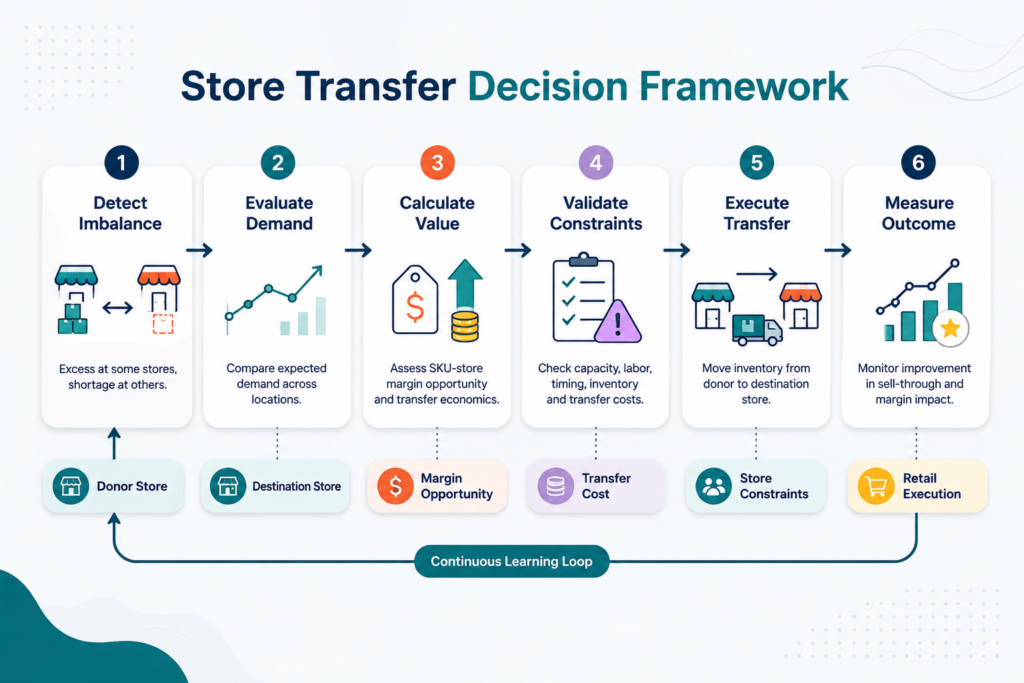
Many retailers can identify inventory imbalance. Fewer can act on it consistently. That is where the Inventory Intelligence Loop becomes useful.
The loop has six steps: detect imbalance, evaluate demand, calculate value, validate constraints, execute the transfer, and measure the outcome. Each step improves the next decision. If a transfer restored a size grid and improved sell-through, that learning should inform future allocation, replenishment, and lifecycle decisions. If it arrived late or failed to sell, that should tighten the next threshold.
This is the Onebeat perspective on store transfers. Precision Inventory Intelligence for Retail Planning & Execution is not about producing another inventory report. It is about turning demand signals into prioritized SKU-store actions across allocation, replenishment, transfers, promotions, in-season purchasing, and lifecycle management.
Planning tools can highlight inventory issues. Retailers need a mechanism that converts those signals into actions store teams can execute and planners can measure. The focus is not on moving inventory more often. It is on moving inventory only when the economics support the decision.
Viewed this way, store transfers become part of a broader demand-driven retail operating model. The retailer is no longer asking, “Where do we have too much?” It is asking, “Where can this unit still produce the best sales, margin, and inventory productivity outcome?”
Key Takeaway
Store transfers create value when they move inventory toward higher sell-through and margin opportunities that exceed transfer costs and execution risk. The objective is not balancing inventory. It is improving inventory productivity.
Perguntas frequentes
What are store-to-store transfers in retail?
Store-to-store transfers are inventory movements between retail locations designed to better align stock with local demand, improve availability, reduce surplus risk, or protect full-price selling.
When are store transfers worth the cost?
Store transfers are worth the cost when expected margin lift, sell-through improvement, or markdown avoidance exceeds the total cost and risk of the move, including freight, labor, handling, and timing.
How do store transfers improve sell-through?
They place inventory in stores with stronger current demand. This can improve availability, rebuild size grids, reduce stranded stock, and give products a better chance to sell before markdown.
How are store transfers different from replenishment?
Replenishment typically sends inventory from a distribution center to stores. Store transfers move inventory between stores that already hold stock, often to correct imbalance after demand patterns have become clearer.
What KPIs should retailers track after a transfer?
Retailers should track sell-through, gross margin, full-price sell-through, transfer completion rates, time to receive, inventory productivity, markdown avoidance, and whether the receiving store sold the units within the expected window.


