
Launching new products can be one of the most exciting yet challenging endeavors for retailers. Without historical data to guide decisions, initial allocation often feels like navigating blindfolded. However, demand signals are changing the game. By using these signals, retailers can make smarter inventory allocation decisions, optimizing product availability and maximizing sales potential. In this blog, we’ll explore how demand signals can help guide smarter product launches, why they’re critical for initial allocation, and how Onebeat leverages this technology to drive success for retailers.
O que você aprenderá
- The importance of demand signals in product allocation and how they help retailers overcome the challenges of launching new products.
- How early demand signals can inform smarter, data-driven inventory decisions.
- The role of store archetypes and regional patterns in refining your allocation strategy.
- How Onebeat’s real-time demand signals help optimize inventory management for both physical stores.
- The benefits of faster learning cycles, higher full-price sell-through, and better inventory balance using demand-driven execution.
Why Initial Allocation Is Crucial for New Product Success
What Is Initial Allocation in Retail and Supply Chain Planning?
Initial allocation refers to the process of distributing inventory to different stores or locations at the start of a product’s lifecycle. It’s crucial to ensure the right products are available in the right quantities at the right time, maximizing the potential for early sales. In retail and supply chain planning, this process helps set the foundation for a product’s success, as it aligns inventory levels with demand forecasts and market conditions, ensuring efficient use of resources and minimizing the risk of stockouts or overstocking.
The Challenges of New Product Launches Without Historical Sales Data
New product launches come with inherent challenges, particularly when there is no historical sales data to guide inventory decisions. Without this data, it’s difficult to accurately predict demand, which increases the risk of both under-allocating high-demand products and over-allocating low-demand ones. These uncertainties can lead to lost sales, excess markdowns, and inefficient use of resources. The lack of historical data means that retailers must rely on other methods, like market research and early consumer feedback, to make their allocation decisions.
The Impact of Attribute Affinity on Initial Allocation
Beyond traditional planning inputs, product attributes can influence how items perform in specific locations. Certain colors, styles, or features may resonate more strongly in particular communities due to local preferences or affiliations. For example, if a nearby high school’s color is orange, orange products may significantly outperform expectations in that store. These types of attribute affinities can be difficult for allocators to anticipate, but they can have a meaningful impact on initial allocation success.
How Demand Signals Address Allocation Uncertainty
Demand signals provide real-time insights into consumer intent and market trends, helping to address the uncertainty faced during new product launches. These signals, such as POS data, online engagement, and regional demand patterns, enable retailers to make more informed, dynamic decisions on inventory allocation. By responding to these signals early on, retailers can adjust stock levels more accurately, ensuring that products are allocated where demand is strongest, reducing both stockouts and excess inventory, and ultimately improving sales and profitability.
Dica profissional
Leverage early demand signals, such as real-time POS data and social media trends, to guide your initial allocation. These signals help you adapt quickly, ensuring your product is in the right places at the right time, before traditional forecasting systems can catch up.
Understanding Demand Signals in Retail Demand Planning
What Are Demand Signals and How Do They Work?
Demand signals are real-time indicators that reflect customer intent and demand for products, providing retailers with actionable insights to make smarter decisions. Unlike traditional demand forecasting, which relies on historical sales data and assumptions about future trends, demand signals offer immediate, short-term feedback. These signals can come from various sources, such as point-of-sale (POS) systems, customer behavior, or online interactions, and are essential in guiding inventory allocation, especially for new products with no historical data. By monitoring these signals, retailers can dynamically adjust their stock levels, improving inventory optimization and reducing the risk of overstocking or stockouts.
The Limitations of Relying on Historical Demand Signals
Many traditional demand planning approaches rely heavily on historical sales data, often looking at the same period from the previous year to guide decisions. While this method can provide useful context, it may not accurately reflect current consumer behavior. Trends, preferences, and market conditions can shift quickly, making last year’s demand signals less reliable for today’s products. As a result, retailers that rely too heavily on historical comparisons risk basing allocation decisions on outdated patterns rather than current demand dynamics.
The Role of Demand Signals in Modern Demand Planning
In modern demand planning, demand signals play a pivotal role in enhancing accuracy and responsiveness. Traditional demand forecasting methods, which rely on historical sales patterns, are often insufficient, particularly for new products or in rapidly changing markets. Demand signals bridge this gap by providing up-to-the-minute data that helps retailers adapt quickly to shifts in consumer behavior. By leveraging demand signals, retailers can anticipate market trends, align their inventory with real-time consumer preferences, and make informed allocation decisions. This enables a more agile and adaptive approach to inventory planning, ultimately leading to improved sales performance and a reduction in excess stock.
Examples of Demand Signals: POS Data, Sell-Through, and More
Demand signals can come from a variety of sources, each offering valuable insights into consumer behavior and product demand. POS data, which tracks real-time sales at the checkout, is one of the most reliable demand signals, helping retailers gauge how well a product is performing across different locations. Sell-through rates provide insight into how quickly products are being sold compared to stock levels, which is crucial for adjusting inventory allocations. Other examples of demand signals include online engagement metrics like product views, clicks, and social media interactions, which can indicate rising interest in specific items. Additionally, regional demand patterns can provide context for local preferences and seasonal fluctuations, helping retailers optimize their allocation strategies across diverse markets.
The Initial Allocation Challenge for New Products
Allocating new products is inherently more complex without historical data, as there are no previous sales trends to rely on for making informed decisions. This lack of data makes it difficult to predict how a product will perform across different stores, regions, or channels. Additionally, high SKU volatility (the rapid fluctuations in demand for new products) adds another layer of uncertainty. Retailers must contend with the risks of customer adoption not meeting expectations, which can lead to either overstocking of slow-moving products or understocking of potential bestsellers. The cost of getting initial allocation wrong is significant, as inaccurate stock levels can result in lost sales, excess markdowns, and poor store performance. Misallocations not only hurt profit margins but also delay learning cycles, making it harder for retailers to quickly adjust and optimize their inventory planning for future product launches. By leveraging demand signals, retailers can navigate these complexities more effectively, ensuring better alignment between product availability and actual consumer demand.
Dica profissional
Onebeat’s Product Similarity model helps you extract key attributes from past products to identify commonalities and predict how new products will perform. By going several layers deeper than standard Excel analysis or manual comparisons, it delivers data-driven performance predictions based on your current and historical data.
How Demand Signals Improve Initial Allocation Accuracy
Leveraging Early Demand Signals for Smarter Allocation
Leveraging early demand signals allows retailers to make smarter allocation decisions by tapping into real-time data like POS, social media engagement, and early sales trends. These signals help identify rising demand for new products, allowing for more accurate and agile inventory placement. By using tools like AI to analyze early signals, retailers can proactively allocate stock to meet demand without waiting for historical sales data, minimizing the risk of stockouts or excess inventory.
There is a big transformation in the demand planning space. Companies are starting to use multiple sources of data to better understand and predict future demand
– David Simchi‑Levi, Professor of Engineering Systems, MIT & Director of the MIT Data Science Lab
Key factors for Allocation Store Archetypes and Regional Patterns
- Store Archetypes:
- Different store types (e.g., flagship vs. smaller locations) require tailored stock strategies.
- Customer demographics and preferences vary by store type, influencing allocation decisions.
- Regional Demand Patterns:
- Local factors such as climate, culture, and events influence demand for specific products.
- Geographic regions may have unique buying behaviors that need to be considered for effective inventory allocation.
- Optimizing Allocation:
- Analyzing store and regional characteristics helps ensure the right products are allocated to the right locations at the right time.
Adjusting Allocations Based on Product Attributes
Adjusting allocations based on product attributes like price, category, seasonality, and life cycle helps optimize inventory management. High-priced items or seasonal products often need smaller, targeted allocations, while fast-moving categories require larger stock. By considering these attributes, retailers can ensure products are available in the right quantities, reducing overstock and markdowns while meeting consumer demand efficiently.
Demand Signals in Action: Smarter Allocation Across Stores
Demand signals turn initial allocation from a “best guess” into a store-by-store decision grounded in what shoppers are actually doing. Instead of spreading inventory evenly or relying on last season’s averages, retailers can use early sales patterns, size/variant pickup, full-price sell-through, footfall indicators, and store-level velocity to see where demand is building, and shift allocation accordingly. That means sending depth to the locations that are proving they can sell it now, while keeping tighter buys in stores where the product is moving slower.
In practice, demand signals help merchants answer the questions that matter most in an in-store environment: which stores need more units, which stores need a different size curve, and which locations should receive fewer (or none) of a specific SKU to avoid slow stock and future markdowns. The result is a more precise initial allocation that improves availability where it counts, reduces stranded inventory, and protects margin.
From Demand Planning to Execution: Turning Signals Into Action
Real-time execution is crucial in initial allocation to ensure that inventory decisions align with actual consumer demand as it unfolds. By continuously monitoring demand signals, retailers can make automated adjustments to stock levels, reallocating inventory across stores or channels as needed. This approach helps minimize stockouts and excess inventory, ensuring products are always available where they’re most needed. Closing the gap between demand planning and inventory execution involves integrating real-time data with inventory systems, allowing for seamless, adaptive decision-making that keeps supply and demand in sync at all times.
Onebeat’s Approach to Demand-Driven Initial Allocation
How Onebeat Uses Real-Time Demand Signals for Optimization
Onebeat leverages real-time demand signals to optimize inventory allocation by continuously monitoring data from multiple sources, including point-of-sale (POS), e-commerce platforms, and social media. This dynamic approach enables Onebeat to respond immediately to shifts in consumer behavior, ensuring that stock levels are adjusted in real-time across different stores and channels. By integrating these signals into its inventory management system, Onebeat helps retailers align their stock with actual demand, reducing excess inventory and minimizing stockouts, ultimately driving higher sales and profitability.
Benefits for Retailers: Faster Learning and Higher Sell-Through
For retailers, using real-time demand signals leads to several key benefits. First, it accelerates learning cycles, enabling retailers to adapt to market changes and customer preferences quickly. This agility improves the ability to forecast demand more accurately, reducing reliance on traditional forecasting methods. Additionally, real-time demand signals drive higher full-price sell-through by ensuring that the right products are available in the right locations at the right time, minimizing markdowns. Overall, retailers can achieve better inventory balance, optimize stock levels, and reduce operational complexity, thereby enhancing profitability and streamlining operations.
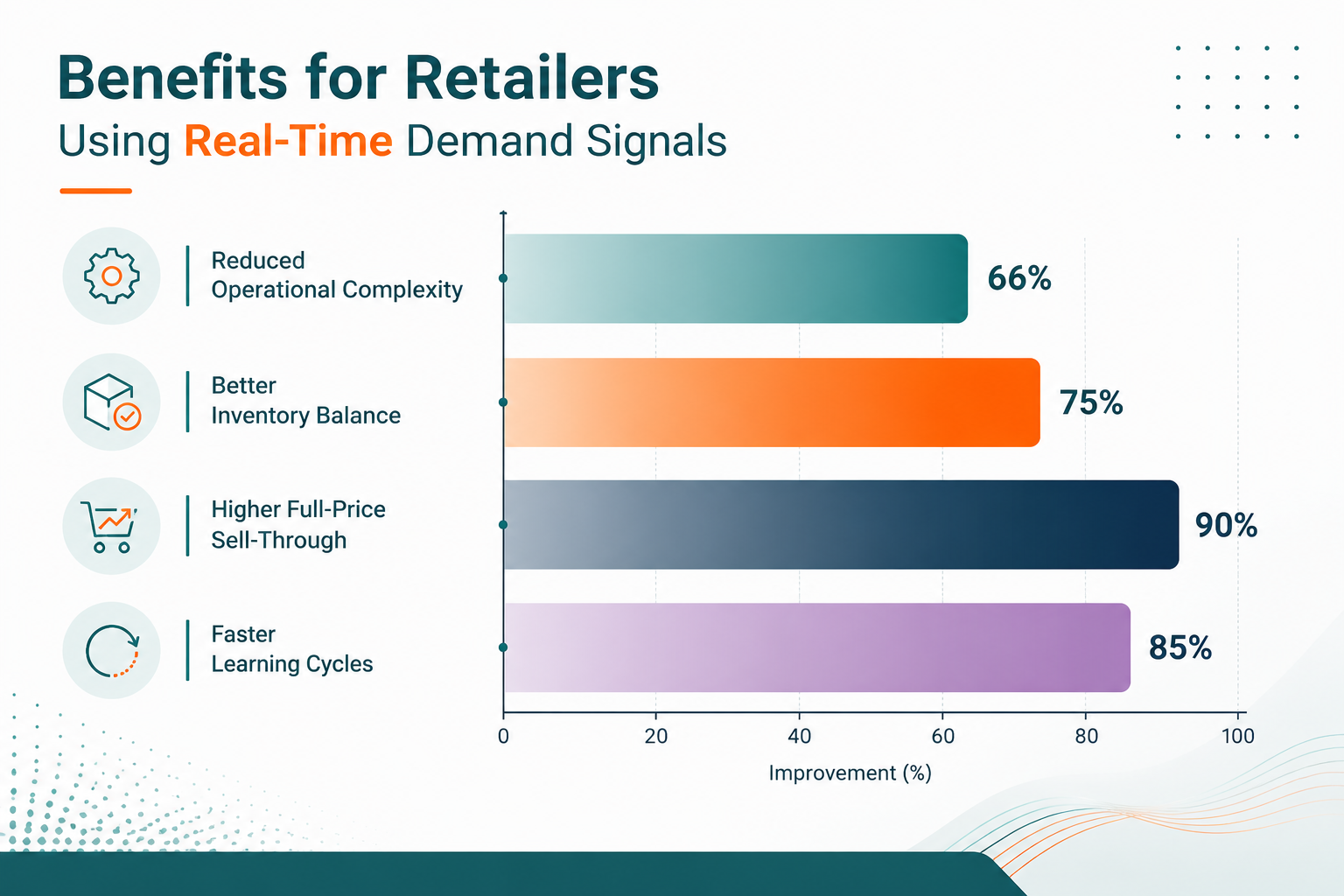
Key Benefits of Demand-Signal-Driven Initial Allocation
Onebeat optimizes inventory allocation by leveraging real-time demand signals, helping retailers make faster, more informed decisions. This approach allows retailers to adapt quickly to shifts in consumer behavior, ensuring products are always available where they’re needed. The key benefits of using real-time demand signals for optimization include:
- Faster Learning Cycles: Retailers can adjust to new information quickly, improving their understanding of customer demand patterns and refining forecasts.
- Higher Full-Price Sell-Through: By aligning inventory with real-time demand, retailers can reduce markdowns and maximize sell-through at full price.
- Better Inventory Balance: Continuous reallocation ensures that the right amount of stock is available in the right locations, minimizing overstock or stockouts.
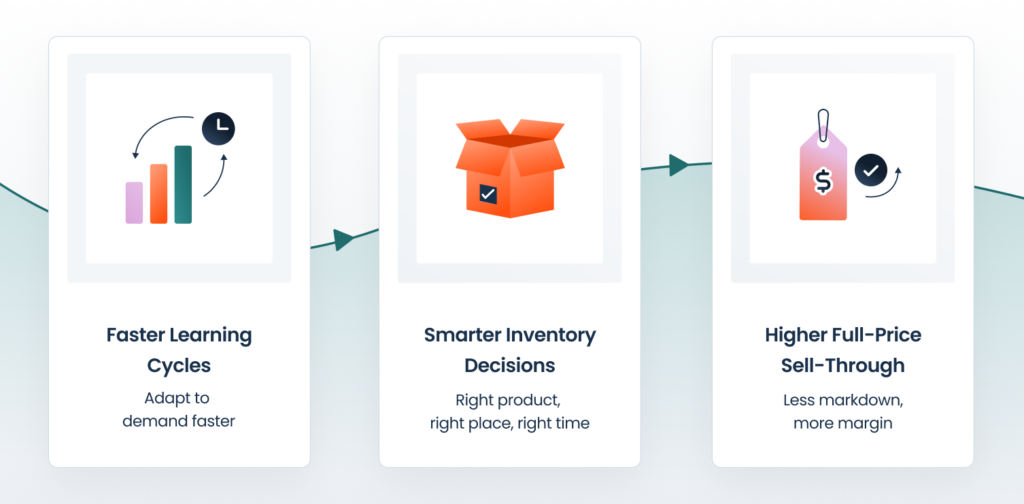
Incorporating these real-time insights into inventory management systems allows retailers to continuously optimize their stock levels, leading to reduced operational complexity and better overall profitability.
Conclusion: Demand Signals Are the Foundation for Smarter Product Launches
In conclusion, demand signals are essential for smarter product launches, enabling retailers to act faster and more efficiently. Retailers who leverage real-time demand signals can make quicker, data-driven decisions, optimizing inventory allocation and ensuring products meet customer demand across all channels. Onebeat empowers retailers by providing demand-driven execution, allowing them to refine allocations in real-time, reduce excess inventory, and maximize full-price sell-through. By integrating these insights into their operations, retailers can win faster, leaner, and more profitably in today’s competitive market.
Key Takeaway
Demand signals give retailers real-time insight into where products are gaining traction, helping them make smarter allocation decisions and avoid costly stockouts or excess inventory. By using early signals from POS, social media, regional demand patterns, and store archetypes, retailers can dynamically adjust stock levels so inventory moves to the right places at the right time. Onebeat supports faster learning cycles and stronger sell-through by continuously reallocating inventory based on real-time data, helping retailers stay agile, respond to shifting consumer behavior, and improve overall profitability.
Perguntas frequentes
What is AI-powered inventory management, and how can it benefit retailers?
AI-powered inventory management uses real-time data, machine learning, and advanced algorithms to forecast demand, optimize stock levels, and prevent stockouts or overstocking. Retailers can enhance their inventory planning and make smarter allocation decisions, leading to higher sales and lower operational costs.
How does demand forecasting software improve product allocation for retailers?
Demand forecasting software uses historical data, market trends, and real-time demand signals to predict future product demand accurately. This helps retailers allocate inventory more efficiently, ensuring the right products are available at the right time, reducing both stockouts and markdowns.
What makes Onebeat’s inventory management solution stand out from competitors?
Onebeat stands out with its AI-powered demand sensing capabilities, which allow retailers to make real-time adjustments to inventory levels based on live market signals. This ensures smarter product allocation, better demand forecasting, and faster response times compared to traditional inventory management systems.
How do omnichannel demand signals improve retail allocation strategies?
Omnichannel demand signals integrate data from both physical stores and e-commerce platforms, giving retailers a unified view of product demand across all sales channels. This allows for more accurate allocation of inventory, ensuring that stock levels are balanced and optimized across both online and offline locations.


