
Phased liquidation starts with a simple truth: not every slow-moving SKU should be treated like a lost cause, and not every markdown should begin with panic. Some products are only experiencing a temporary slowdown. Others are signaling a real lifecycle problem. The retailer’s job is to tell the difference early enough to act without throwing away margin.
In practice, phased liquidation is the discipline of moving a slow-moving SKU through measured markdown decisions based on live SKU-store evidence instead of waiting for a chainwide end-of-season clearance. It is a markdown optimization method built around timing, pacing, and effectiveness. Rather than asking, “How much do we need to discount to clear this later?” it asks, “What is the lightest action that clears risk now without damaging a product that can still earn margin?”
That matters because the cost of waiting has gone up. Deloitte wrote that retail has faced stagnant growth of 1.5% to 3.5 percent depending on sector, with margins squeezed by competition and omnichannel expectations.
Bain added that shifting consumer behavior, economic volatility, regulatory changes, and trade complexities still define the retail environment. In that setting, late markdown mistakes are harder to absorb.
O que você aprenderá
- What phased liquidation actually means
- Why end-of-season panic markdowns hurt sell-through quality and margin
- Which signals show a slow-moving SKU needs action
- How to pace markdowns without over-discounting winners
- Which KPIs show whether liquidation is working
- How Onebeat connects lifecycle management to daily execution
What Phased Liquidation Actually Means
Phased liquidation is not a clearance event. It is a decision method for managing lifecycle risk before the final weeks force a broad response. The goal is to identify a true underperformer early, apply the smallest effective action first, and increase intervention only if the data says the SKU is still losing ground.
That is different from the old liquidation pattern. In many retail businesses, a product gets left alone for too long because teams hope demand will recover. Then the season gets short, aging stock builds, and the answer becomes a large, simple markdown pushed across too many stores at once. That approach is easy to execute, but it treats a timing problem as a pricing event.
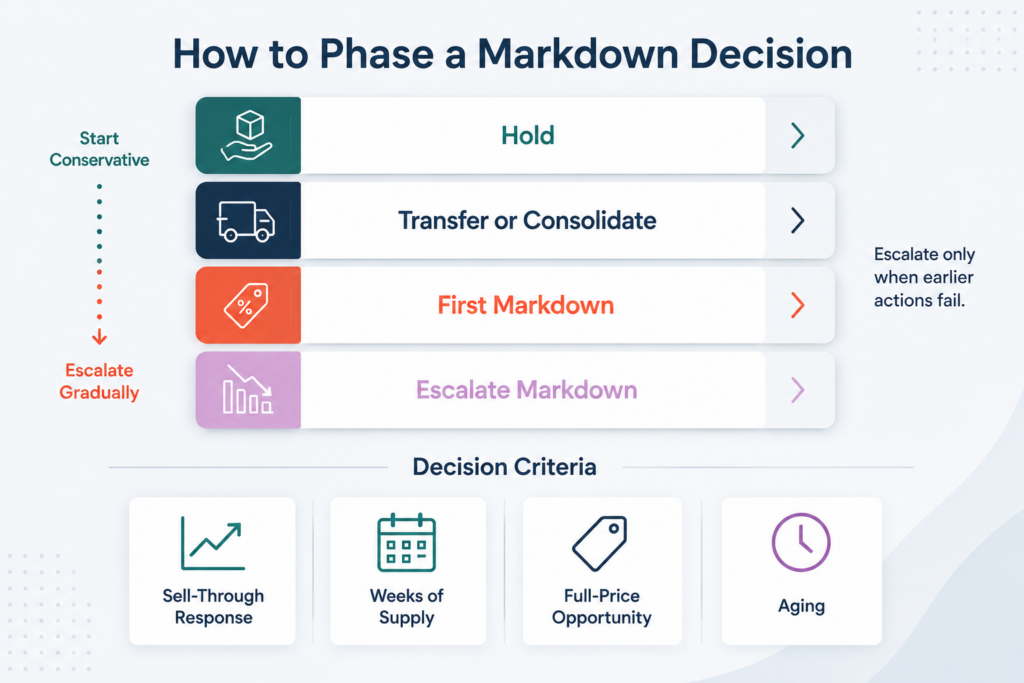
Phased liquidation works the other way around. First, it asks whether the SKU still has real full-price opportunity in some stores. Second, it checks whether transfers, consolidation, or a modest markdown can reduce risk without damaging the whole network. Third, it measures the response and decides whether the next markdown phase is justified. That makes liquidation part of lifecycle management, not a last-minute rescue mission.
Onebeat’s liquidation messaging captures this operating model clearly. The company says it helps retailers spot true underperformers early so markdowns can start gradually instead of waiting until the final weeks, while tracking markdown effectiveness in real time and supporting consolidation and tail rotation when needed. That is the lens this article is using.
Why End-of-Season Panic Markdowns Destroy Margin
Late markdown panic creates three problems at once. First, it compresses the decision window. Teams lose the ability to test a lighter action because there is no time left to learn. Second, it collapses good and bad inventory into one event, which means winners often get discounted alongside true laggards. Third, it increases the operational burden of repricing, retagging, and clearing inventory when the business is already under pressure.
McKinsey wrote that US retailers were sitting on $740 billion in unsold goods, and it noted that rising store labor costs mean the work of changing prices and executing markdowns squeezes margins further. That is a useful reminder that markdown damage is not only about selling units for less. It is also about the cost of waiting until the only remaining option is heavy discounting at scale.
Late blanket markdowns are especially risky because they hide store-level reality. One cluster of stores may still have clean demand and decent full-price conversion. Another cluster may already be carrying aging stock with weak sell-through. If both get the same markdown at the same time, the first group loses margin it could have kept, while the second group still may not clear fast enough.
This is why simple is not always smart. Broad markdowns reduce decision effort, but they usually reduce margin quality too. A better approach is to identify where demand has already broken, where inventory is merely imbalanced, and where a product still has enough life to justify a lighter action.
The Five Signals That Show a SKU Has Become a Markdown Candidate
Retailers do not need a huge scorecard to decide when a SKU has crossed into liquidation risk. They need a short signal set that reveals whether the item is slowing temporarily or structurally.
1. Sell-Through Has Slowed Beyond Normal Variation
The first signal is not that sales have softened. That happens all the time. The real question is whether sell-through has broken below the pattern that item should still be producing at this point in its life. A modest slowdown may justify patience. A persistent miss across similar weeks or similar stores may justify intervention.
2. Weeks of Supply and Aging Are Building in the Wrong Stores
A product becomes a markdown candidate when the inventory position is stretching beyond the remaining demand window. Weeks of supply matters because it shows whether the stock still has time to sell without help. Aging matters because a slow mover with too much time on floor usually becomes more expensive to rescue later. Onebeat’s replenishment guidance highlights weeks of supply and aged inventory exposure as practical indicators of overstock and markdown risk at SKU-store level.
3. Full-Price Pull Is Weakening
Some SKUs still move, but not cleanly. A product may be selling units while full-price conversion deteriorates, which is a warning that remaining demand is weakening. If the item now needs more promotional help to move than it did earlier, the retailer should stop treating it like a healthy seller.
4. Store-Level Demand Variation Is Widening
Chain averages can hide a bad liquidation decision. Some stores may still justify patience because the SKU is fresh there, while others have already lost their selling window. If weak stores keep accumulating cover while stronger stores continue to sell, the business may need a transfer or consolidation step before a markdown step. If weak demand is broad and persistent, that is a stronger liquidation signal.
5. Non-Price Actions No Longer Have Enough Upside
Markdown should not be the first reflex for every laggard. Sometimes the better move is to hold for a short period, rebalance inventory, or consolidate the tail. But when those options no longer offer enough upside, the product has likely become a markdown candidate. This is one reason phased liquidation is better than broad end-of-season inventory management. It checks whether the next action should still be operational before it becomes purely price-led.
How To Pace Markdowns Without Over-Discounting Winners
Once the signals are clear, the liquidation decision is no longer “markdown or not.” It becomes “what action should happen next, in which stores, and how strong should it be?”
The first step is to separate stores with residual full-price opportunity from stores where the selling window has already weakened. If the SKU is still moving well in some locations, do not punish those stores with the same discount used for lagging ones. Protect the winners. Move the pressure toward the stores where aging, low sell-through, and weak full-price pull have already made action necessary.
The second step is to use a phased response. A first markdown should test whether the product still has recoverable demand at a lighter discount. It is not there to surrender the margin immediately. If that action improves sell-through enough to normalize the inventory position, the retailer may not need a second phase. If response stays weak, then the next markdown phase is justified because the business has evidence, not only anxiety.
The third step is to judge markdown depth by response quality, not habit. If a SKU only moves when discounts become steep, the team should stop pretending a shallow price cut solved the problem. If a modest markdown quickly improves sell-through and relieves weeks of supply, deeper discounting may be unnecessary. The purpose of the phase is to learn how much help demand really needs.
The fourth step is to keep planner control. Good phased liquidation does not replace business judgment with a rigid rule. It gives planners better evidence about which stores are already compromised, which products still deserve time, and which actions are no longer worth delaying.
Dica profissional
Treat the first markdown as a test, not a surrender. If a SKU gets a modest price cut but still shows weak sell-through, low full-price pull, and high weeks of supply in the same stores, escalate quickly instead of repeating shallow discounts that only waste time.
The KPIs That Show Whether Liquidation Is Working
The best test of markdown effectiveness is whether a markdown changes sell-through and reduces aged inventory without unnecessary margin damage. Unit movement alone is a weak liquidation KPI. A deep discount can always move units. The real question is whether the markdown improved inventory health with acceptable margin damage.
The first KPI is sell-through lift after markdown. Did the action materially change the rate at which the SKU is moving, or did it only create noise? If there is no meaningful change, the markdown may have been too late, too shallow, or applied in the wrong stores.
The second KPI is full-price mix. This matters because a retailer can clear stock and still damage the category by teaching the customer to wait for discounts. A healthy phased liquidation program reduces risk while protecting as much regular-price demand as possible in the stores that still have it.
The third KPI is markdown penetration. Onebeat’s replenishment article calls markdown penetration a measure of how dependent sales are on markdowns to move inventory. That makes it useful here too. If markdown penetration keeps rising without fixing aged stock, the business may be using price to hide a deeper lifecycle problem.
The fourth KPI is margin recovery. Not every laggard will clear gracefully. But a disciplined phased path should still recover more margin than a late blanket discount because it gives the business a chance to act earlier and more selectively.
The fifth KPI is aged inventory exposure and weeks of supply after each phase. If both stay elevated even after markdown action, the team should question whether the SKU, the store mix, or the timing was wrong. Liquidation is working when risk declines in a visible way, not only when units leave the building.
How Onebeat Connects Lifecycle Management to Daily Execution
This is where Onebeat’s point of view matters. Planning tools plan. But once a SKU starts separating into winners and underperformers across stores, the business needs an execution layer that can translate that signal into action before the season is lost.
Onebeat positions this as Precision Inventory Intelligence for Retail Planning & Execution. In liquidation terms, that means spotting true underperformers early, tracking markdown effectiveness in real time, and using consolidation and tail rotation when those actions are stronger than a broad discount. The goal is not to mark down faster for its own sake. The goal is to clear risk with more control.
The public customer proof is consistent with that logic. On Onebeat’s Being Human case-study page, the company says the retailer reduced overstock and global slow-moving inventory by 30 percent while selling 10 percent more at full price. On the Crystal case-study page, Onebeat says surplus stock had been forcing substantial markdowns, and that store profitability doubled after using the platform. Those examples do not prove that every retailer should take the same action. They do show why earlier lifecycle control matters.
When Onebeat is working well, liquidation becomes part of an Inventory Intelligence Loop: detect the underperformer, compare non-price and price actions, measure the response, and tighten the next decision. That is the operational meaning of lifecycle management. It is also why phased liquidation is more useful than a single end-of-season markdown event.
A Better Standard for Retail Liquidation
The old standard was simple: wait, hope, then clear. It survives because it is easy to explain and easy to execute. But it is a weak standard for a retail environment where demand varies by store, margin pressure is high, and every late decision is more expensive than it looks.
A better standard is to ask four questions early and often. Is this SKU truly underperforming, or only temporarily slow? Is the problem broad or store-specific? Is there still non-price upside through transfer or consolidation? If markdown is required, what is the lightest phase that gives us real evidence about response?
That is what disciplined phased liquidation looks like. It does not eliminate markdowns. It helps reduce markdown dependency by making liquidation a controlled lifecycle decision instead of a panic event. If a team cannot explain why a SKU is in phase one instead of phase two, the process is probably still reacting too late. Precision Inventory Intelligence gives retailers a better standard for making that call sooner.
Key Takeaway
Phased liquidation means acting on slow-moving SKUs early enough to test, learn, and clear risk in steps, so retailers protect more margin than they would with late blanket markdowns.
Perguntas frequentes
What is phased liquidation in retail?
Phased liquidation is a retail lifecycle method that uses measured markdown steps, guided by SKU-store demand signals, to clear slow-moving inventory without jumping straight to broad end-of-season clearance.
When should a slow-moving SKU become a markdown candidate?
A SKU becomes a markdown candidate when sell-through remains weak, weeks of supply and aging are building, full-price pull is fading, and non-price actions such as transfer or consolidation no longer offer enough upside.
How is phased liquidation different from end-of-season inventory management?
End-of-season inventory management often relies on broad clearance moves late in the cycle. Phased liquidation starts earlier, uses store-level evidence, and increases markdown pressure only when lighter actions fail.
Which KPI matters most for markdown effectiveness?
There is no single KPI, but the best combination is sell-through lift after markdown, markdown penetration, margin recovery, weeks of supply, and aged inventory exposure.
Can retailers reduce markdown dependency without delaying action too long?
Yes. The key is earlier identification of true underperformers, selective use of transfer or consolidation, and measured markdown steps that are judged by response instead of waiting for a broad late-season event.


