
Excess inventory management is the process of detecting surplus risk, deciding the best action for each product-location, and clearing or repositioning inventory before it becomes margin-eroding dead stock. In retail, that work should not begin when a product lands on a clearance rack. It should begin as soon as inventory starts drifting away from real demand.
Most excess inventory is noticed when it becomes aging stock. It is usually created much earlier through buy quantities, initial allocation, replenishment lag, missed demand shifts, weak size curves, promotion misses, and slow lifecycle decisions. Finance sees working capital trapped in the wrong products. Merchandising wants full-price sell-through. Store and allocation teams need action, not another report showing what is aging.
The better model is a continuous planning-to-execution feedback loop. Retailers need to detect surplus risk early, diagnose whether demand exists somewhere else, then choose the right SKU-store action: hold, transfer, replenish elsewhere, mark down, return to vendor, liquidate, donate, or dispose. This is lifecycle control, and it is how excess inventory management moves from reactive clearance to stronger inventory productivity.
O que você aprenderá
- What excess inventory management means in retail and how it differs from liquidation.
- Why excess stock is often the result of decision latency, not only forecast error.
- How to distinguish true underperformers from inventory that is under-placed, under-exposed, or trapped in the wrong store.
- Which KPIs signal surplus risk early, including sell-through, weeks of supply, inventory aging, inventory turnover, GMROI, markdown rate, and full-price sell-through.
- How retailers can choose between hold, transfer, replenish elsewhere, mark down, return to vendor, liquidate, donate, or dispose.
- How Onebeat’s Inventory Intelligence Loop supports lifecycle management and SKU-store decisions.
What Is Excess Inventory Management?
Excess inventory management is the retail discipline of identifying surplus risk, deciding what to do by product-location, and acting before excess stock becomes obsolete or liquidation-only inventory. The important phrase is product-location. A SKU can be excess in one store, healthy in another, and under-supplied in a third.
That is why retail excess cannot be managed only at the warehouse, banner, or category level. A national view may show enough inventory. A local view may show that inventory is sitting in the wrong store, wrong size curve, wrong channel, or wrong lifecycle stage. The operating question is not just, “How much do we own?” It is, “Where can this inventory still sell at the best margin, and what action is worth taking now?”
Excess inventory vs. overstock vs. obsolete inventory
Excess inventory is inventory that exceeds realistic demand at a product, location, time, or lifecycle stage. Overstock is stock held above the level needed to meet expected demand. Obsolete inventory is inventory that is unlikely to sell at normal price because demand, season, utility, or product relevance has passed.
Liquidation is different. It is one exit action for inventory that the retailer no longer wants to carry through normal selling channels. Excess inventory can become liquidation inventory if action is delayed, but it does not always start there.
Why liquidation is only one possible action
A retailer that treats every slow mover as a liquidation candidate gives up too early. Some items should be marked down. Some should be transferred. Some should be held because the next demand window is near. Some should stop receiving replenishment while stronger stores continue to be fed. Some should be returned to the vendor if terms allow it.
This is why excess inventory management needs decision logic, not just visibility. The value comes from matching the action to the product’s lifecycle stage, local demand signal, margin exposure, and operational constraints.
Why Excess Stock Forms Before Clearance
Excess inventory is not created at liquidation. It accumulates through the lifecycle.
The first layer is buying. A retailer may buy too much depth because the financial plan requires growth, because last year’s demand is overweighted, or because supplier minimums force more units than the market can absorb. The second layer is allocation. Even when the total buy is reasonable, inventory can be spread too evenly, placed in weak stores, or launched with a size curve that does not match local demand.
The third layer is execution lag. Demand changes, but store targets, replenishment rules, promotion plans, and transfer actions do not change fast enough. A product that was planned as a winner can become a local slow mover. A style that looks weak in one area may still be selling at full price elsewhere. If the system only reports the problem after the item ages, markdowns become the default response.
The hidden cost of slow inventory decisions
Forecast error matters, but it is not the whole issue. Retailers will always face uncertainty, especially in fashion, footwear, specialty, and premium categories where product relevance decays quickly. The larger risk is decision latency after reality changes.
Decision latency shows up as weeks of supply rising in one store while another store sells through, replenishment continuing into weak locations, transfers waiting for manual review, and markdowns arriving only after the margin window has narrowed. The product may not have been wrong. The timing, location, or action may have been wrong.
Where planning assumptions break down in stores
Plans are built from assumptions: store clusters, assortment roles, size curves, financial targets, promotional calendars, and expected demand patterns. Stores expose where those assumptions are right and where they are too broad. Weather, local events, store presentation, foot traffic, competing assortments, and regional taste can change the shape of demand.
Planning creates intent; lifecycle control keeps inventory aligned with demand as reality changes. Without that control, retailers often discover excess stock only when the action set has narrowed.
The Financial Cost of Carrying Excess Inventory
Excess stock is not neutral. IHL Group estimates that global inventory distortion, including out-of-stocks and overstocks, will cost retailers $1.77 trillion in 2025. That matters because stockouts and overstocks are connected symptoms of the same problem: inventory is not aligned with demand.
McKinsey reported in 2023 that U.S. retailers were sitting on $740 billion in unsold goods, a historical reminder of how quickly inventory imbalance can become a board-level working capital and markdown issue. The number should not be treated as a current 2026 figure. Its value is the lesson: once inventory piles up, the retailer’s choices become more expensive.
Carrying cost is more than storage
APQC defines inventory carrying cost to include opportunity cost or cost of capital, storage, insurance, taxes, handling and administration, shrinkage, and obsolescence. Investopedia describes carrying cost as commonly falling between 20% and 30% of total inventory value, though the actual number varies by business model and category.
For a retail executive, the bigger point is that excess inventory consumes optionality. It ties up cash that could fund winners, blocks open-to-buy, crowds store capacity, raises handling work, and increases the chance that a future markdown will be deeper than it needed to be.
Why excess inventory and stockouts are connected symptoms
A chain can have too much inventory and still lose sales. That happens when units sit in weak demand locations while stronger locations are short. Cutting inventory across the board may reduce working capital, but it can also create avoidable stockouts. The better target is productive inventory: inventory positioned where it can sell at the best margin.
This is why excess inventory management should not be measured only by inventory reduction. It should be measured by whether inventory is flowing to demand, protecting full-price sell-through, and reducing late-stage distress.
How Retailers Manage Excess Stock: The Action Menu
Retailers manage excess stock by choosing from a set of actions. The right action depends on lifecycle stage, local demand, network demand, price elasticity, transfer cost, store capacity, presentation standards, supplier terms, and timing.
- Hold when demand is delayed but still likely, such as before a local event, weather shift, campaign, or known selling window.
- Reallocate or transfer when one store is heavy and another store can still sell the item at a better margin.
- Stop or slow replenishment when the location no longer deserves more units, while continuing to feed stores with real demand.
- Bundle or promote when the item still has demand, but needs a stronger selling context or basket logic.
- Mark down when price is the right lever to accelerate sell-through without waiting too long.
- Return to vendor when commercial terms make that path available and better than internal clearance.
- Liquidate when the item has low normal-channel demand and the retailer needs to convert inventory into cash or space.
- Donate or dispose when selling options are limited, the brand risk is high, or handling cost outweighs recovery value.
The critical distinction is that a slow mover in one store may be a full-price opportunity elsewhere. If the retailer looks only at chain-level sales or aging inventory, that opportunity is easy to miss. SKU-store decisions protect margin because they test whether demand is absent or simply in the wrong place.
“The cost of inventory is not carrying it. The cost is carrying it in the wrong place.”
— Greg Arthur, VP Retail Strategy | Onebeat
When to hold inventory
Holding is not inaction when it is based on a real demand signal. A retailer may hold inventory if the item is early in its lifecycle, selling slowly but not abnormally, or entering a known demand window. Holding can also make sense when transfer cost, markdown cost, or presentation disruption would be higher than the likely benefit.
The risk is using “hold” as a default because no one owns the next decision. Holding should have a review date, a target, and a trigger for the next action.
When to transfer instead of mark down
Retailers should transfer excess inventory instead of marking it down when demand is weak in the current location but stronger elsewhere, and when the expected margin lift is higher than the transfer cost and execution effort. The receiving store should have enough demand, space, presentation capacity, and size curve fit to sell the item without creating another pocket of overstock.
Transfer decisions need more than a list of stores with high inventory and low sales. The retailer needs to know where the item can still sell, whether the receiving store can absorb it, and whether the move preserves more margin than a markdown. If the product is already late in the lifecycle or demand has faded across the network, markdown or liquidation may be the cleaner move.
Dica profissional
Before marking down an item, ask whether the product is truly excess or simply in the wrong store, size curve, channel, or presentation. If demand exists elsewhere and the move is operationally economical, transfer may protect more margin than an immediate discount.
When liquidation is the right move
Liquidation is the right move when the remaining normal-channel opportunity is low, the product’s relevance is fading, and the cost of holding exceeds the likely recovery from continued selling. It can also be appropriate when the retailer needs to clear space, protect brand presentation, or simplify stores before the next assortment arrives.
The point is not to avoid liquidation at all costs. The point is to reach that decision through lifecycle evidence rather than panic. Good excess inventory management makes liquidation a planned exit path, not a last-minute reaction.
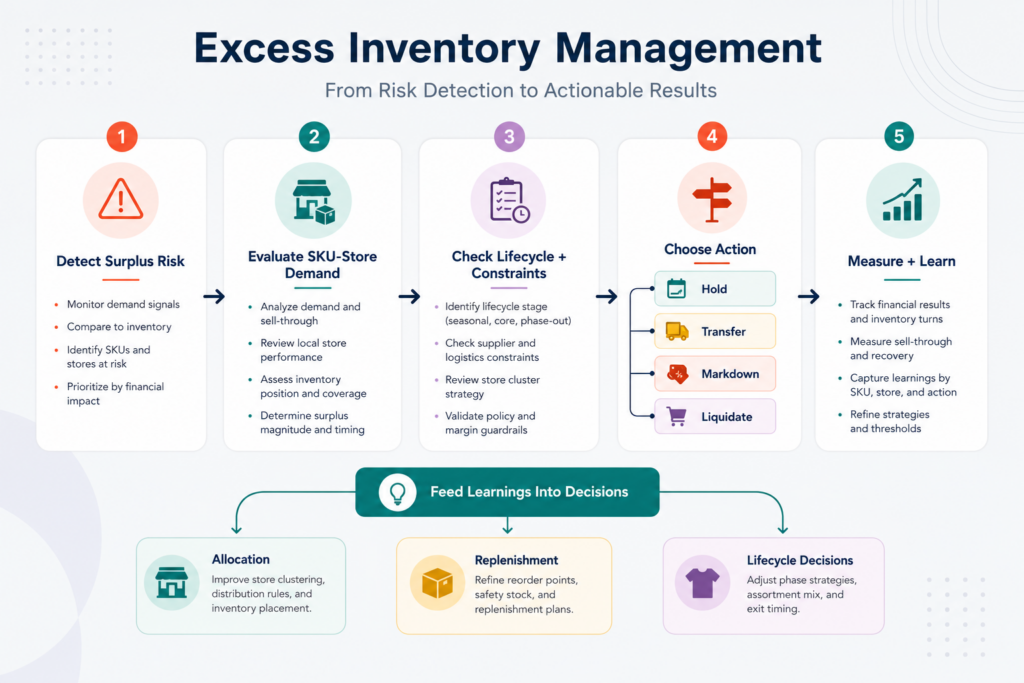
Lifecycle Management: Catch Surplus Risk Earlier
Lifecycle management means managing each product from launch to end-of-life with demand-based actions across allocation, replenishment, transfers, markdowns, and liquidation. It treats excess inventory as a signal to investigate, not only a balance to clear.
In seasonal and discretionary categories, the timing of action matters. The longer a product waits in the wrong location, the more margin the retailer gives up. The same style may need adaptive allocation at launch, smart replenishment during early selling, tail rotation in mid-season, phased markdowns late in the season, and liquidation at end-of-life.
Precision Inventory Intelligence supports this shift by connecting planning intent to daily execution decisions. Instead of waiting for the next planning cycle, teams can use demand feedback to decide which SKU-store actions still have time to protect margin.
Launch, in-season, late-season, and end-of-life actions
At launch, the goal is to place inventory where the product has the best chance to prove demand. In season, the goal is to adjust quickly as sales patterns emerge. Late in the season, the goal is to separate items that deserve continued support from items that need price action. At end-of-life, the goal is to exit cleanly without dragging the rest of the assortment down.
This is where Onebeat’s Inventory Intelligence Loop fits the retail operating model. The loop detects surplus risk at SKU-store level, diagnoses the likely cause, recommends an action, accounts for constraints, measures the result, and feeds the learning back into future allocation, replenishment, transfers, and lifecycle decisions.
How tail rotation reduces markdown dependency
Tail rotation is the practice of moving small pockets of slow inventory to locations where they still have demand, or consolidating scattered sizes so stores can present a cleaner offer. It helps retailers avoid marking down products simply because the inventory is fragmented or misplaced.
For example, three stores may each hold a broken size run that looks weak on its own. A transfer or consolidation move may create a sellable size curve in one better demand location. That does not remove the need for markdowns in every case, but it can delay or reduce unnecessary discounting when demand still exists.
The BoF and McKinsey State of Fashion 2025 report found that only 20% of surveyed fashion executives expected consumer sentiment to improve in 2025, while 39% expected industry conditions to worsen. In that environment, frequent lifecycle updates become a margin discipline, not a reporting preference.
KPIs That Show Inventory Is Becoming Excess
Aging reports are useful, but they often identify the problem late. By the time inventory is old enough to appear on a standard aging report, the retailer may already have lost the chance to protect full-price sell-through. Excess inventory management needs early warning KPIs that trigger action before the only lever left is clearance.
The core KPIs include weeks of supply, sell-through, aging inventory, inventory turnover, GMROI, markdown rate, stock-to-sales, inventory carrying cost, full-price sell-through, and transfer effectiveness. NetSuite’s inventory KPI guide describes measures such as inventory turnover, sell-through, carrying cost, and GMROI as core ways to understand inventory performance and financial return.
Early warning KPIs
The KPIs that show inventory is becoming excess are the measures that compare inventory depth with realistic demand and margin opportunity. Weeks of supply shows whether inventory is outrunning demand. Sell-through shows whether the product is moving at the expected pace. Stock-to-sales shows whether inventory depth is aligned with selling rate. Full-price sell-through shows whether units are still moving without discount pressure.
A single KPI can mislead. High weeks of supply may be acceptable for a basic item before a demand window. Low sell-through may be normal early in a product’s lifecycle. A high markdown rate may be planned in one category and a warning sign in another. The better diagnostic combines KPI movement with lifecycle stage, location, size availability, and future demand signals.
Decision KPIs vs. reporting KPIs
Reporting KPIs explain what happened. Decision KPIs trigger the next move. For excess inventory management, the better question is: what should the planner, allocator, or replenishment team do today?
Transfer effectiveness is a good example. It measures whether moved inventory sold better after the transfer and whether the move justified the operational cost. Markdown effectiveness measures whether price action produced the desired sell-through without discounting too deeply. These KPIs help teams learn which actions worked, not just which products aged.
From Reactive Clearance to Continuous Inventory Control
The old model is familiar: wait, report, discount, liquidate. It is simple, but it gives retailers too few options too late. By the time excess stock is obvious, stores are crowded, open-to-buy is constrained, finance is pushing for cash recovery, and the margin window has narrowed.
The better model is detect, decide, act, learn. Detect surplus risk early. Decide whether the item is truly weak or merely misplaced. Act with the right lever: hold, transfer, replenish elsewhere, mark down, return to vendor, liquidate, donate, or dispose. Learn from the result so future buying, allocation, replenishment, and lifecycle decisions improve.
The Inventory Intelligence Loop in excess inventory management
Onebeat is Precision Inventory Intelligence for Retail Planning & Execution. In excess inventory management, that means planning intent is connected to daily SKU-store decisions. Planning tools plan. Onebeat runs the loop.
The loop matters because surplus risk does not wait for the next planning cycle. Demand moves by store, size, product, channel, and week. A retailer that only reviews excess inventory at the end of a season is managing the aftermath. A retailer that runs a feedback loop can spot the risk earlier, evaluate constraints, and choose an action while there is still margin to protect.
Why planning tools are not enough
Planning tools define targets, budgets, assortment roles, and expected demand. They are necessary, but they do not always run the daily execution decisions that keep inventory aligned after launch. Excess inventory management needs that bridge between financial intent and store reality.
That bridge is especially important as retail becomes more local. Deloitte’s 2025 U.S. Retail Industry Outlook points to a shift away from mass retailing toward more targeted, data-informed retail models. For inventory teams, that means more decisions need to happen at a finer level of detail.
The retail goal is not simply less inventory. It is better inventory: the right units, in the right places, at the right point in the lifecycle, with the right action attached. That is how retailers protect working capital, reduce markdown pressure, and keep more inventory productive.
Key Takeaway
Excess inventory management is not just clearance at the end of the season. It is continuous lifecycle control. Retailers reduce working capital exposure and markdown pressure when they detect surplus risk early, understand whether demand exists elsewhere, and act at the SKU-store level before inventory becomes distressed.
Perguntas frequentes
What is excess inventory management?
Excess inventory management is the process of detecting surplus risk, choosing the best action by product-location, and preventing excess stock from becoming obsolete or liquidation-only inventory. In retail, it should cover buying, allocation, replenishment, transfers, markdowns, and liquidation.
What causes excess inventory in retail?
Common causes include overbuying, inaccurate demand assumptions, allocation mistakes, replenishment lag, promotion misses, assortment-store mismatch, missed local demand shifts, size curve errors, and slow markdown or transfer action.
How do retailers reduce excess inventory?
Retailers reduce excess inventory by transferring units to stronger demand locations, slowing or stopping replenishment, adjusting presentation or promotion, phasing markdowns, returning goods to vendors, liquidating, donating, or disposing. The earlier the risk is detected, the more margin-preserving options the retailer has.
When should retailers transfer excess inventory instead of marking it down?
Retailers should transfer excess inventory when another location can sell the item at a better margin and the expected benefit is higher than the transfer cost. If demand is weak everywhere, the item is late in its lifecycle, or the move would create new overstock, markdown or liquidation may be the better action.
Which KPIs show inventory is becoming excess?
The most useful early signals are weeks of supply, sell-through, stock-to-sales, full-price sell-through, aging inventory, inventory turnover, GMROI, markdown rate, carrying cost, and transfer effectiveness. These KPIs should be reviewed at SKU-store level and tied to action triggers, not only reports.
Is excess inventory the same as obsolete inventory?
No. Excess inventory exceeds realistic demand now. Obsolete inventory is unlikely to sell at normal price because demand, season, utility, or product relevance has passed. Excess inventory can become obsolete when action is delayed.
How does lifecycle management reduce liquidation risk?
Lifecycle management monitors products from launch through end-of-life and triggers demand-based actions early. Those actions can include adaptive allocation, smart replenishment, tail rotation, phased markdowns, or liquidation when the evidence supports that decision.
How can AI help with excess inventory management?
AI can help by detecting SKU-store exceptions faster, comparing local demand signals, and recommending action options such as hold, transfer, slow replenishment, markdown, or liquidate. It should support planner judgment with clearer decisions and constraints, not pretend to create perfect forecasts or replace retail teams.


