
Static min/max replenishment assumes the right answer is to refill a store when it crosses a fixed threshold. That approach breaks when demand, size needs, delivery timing, and inventory risk differ by store.
Replenishment planning is the daily decision about where limited inventory should go next and when it should not move. The goal is not to send more stock. It is to protect availability where demand is strongest without creating more excess elsewhere.
What You Will Learn
- What replenishment planning means in retail
- Why static min/max rules break down in volatile store networks
- What signals modern replenishment should use instead
- How to prioritize replenishment when inventory is limited
- What to look for in replenishment planning software
What Is Replenishment Planning in Retail?
Replenishment planning is the process retailers use to decide when, where, and how much stock should flow back into stores or channels after products begin selling. In plain terms, it is the operating logic behind keeping the right products available without sending too much inventory into the wrong places.
That sounds close to restocking, but the scope is wider. Restocking is the physical act of refilling inventory. Replenishment planning is the decision process that determines which stores need units first, which SKUs should wait, and whether the next move should come from the warehouse, from another store, or not happen at all.
This matters because replenishment is not a chainwide math problem. It is a store-network decision problem. A high-volume location and a slow store should not receive the same quantity of the same item just because both crossed the same threshold. Good replenishment planning reflects local demand, size curves, recent sales signals, delivery cadence, and the amount of inventory already at risk in each location.
In practice, replenishment planning sits between planning intent and store-level action. It is where assumptions about demand become daily inventory moves. That is also why weak replenishment logic can undo a smart buying or allocation decision later in the season.
Why Static Min/Max Replenishment Breaks in Volatile Retail
Static min/max replenishment sets a floor and a ceiling for inventory. When stock drops below the minimum, the system replenishes up to the maximum. The logic is easy to understand, and it can be useful in stable environments with predictable demand and limited assortment complexity.
The problem is that retail demand is often neither stable nor evenly distributed. McKinsey wrote that over an 18-month period, retail supply chains experienced major demand and supply shifts, leaving US retailers with about $740 billion in unsold goods.
What Static Rules Assume
Static min/max assumes that stores behave similarly enough for fixed thresholds to hold. They usually do not. One location may need frequent replenishment on winning sizes while another should receive little or none because local demand is cooling. A shared threshold treats both stores as if they are equally likely to sell the next unit. That is where stockouts and excess begin to coexist in the same network.
Constraints make the gap worse. Lead times change. Shipments must follow pack rules. Capacity at the DC or in the store backroom can limit what is feasible. Deloitte noted in August 2025 that retailers were managing uncertainty tied to cost, margin, and growing supply-chain complexity as trade conditions shifted. A static rule does not absorb those changes well. It keeps executing a fixed idea of demand while the environment keeps moving.
Why This Becomes a Margin Problem
Another weakness is that min/max logic often treats replenishment as a volume problem instead of a prioritization problem. When inventory is limited, the question is not whether more stock is needed somewhere. The question is where the next unit will create the most value. Static rules are weak at that choice because they trigger action based on threshold crossing, not on relative opportunity.
Static replenishment reacts to fixed thresholds. Demand-driven replenishment updates targets based on live signals and ranks inventory moves by opportunity, risk, and operational constraints. That difference matters because a store network does not need the same answer everywhere on the same day.
What Modern Replenishment Planning Should Use Instead
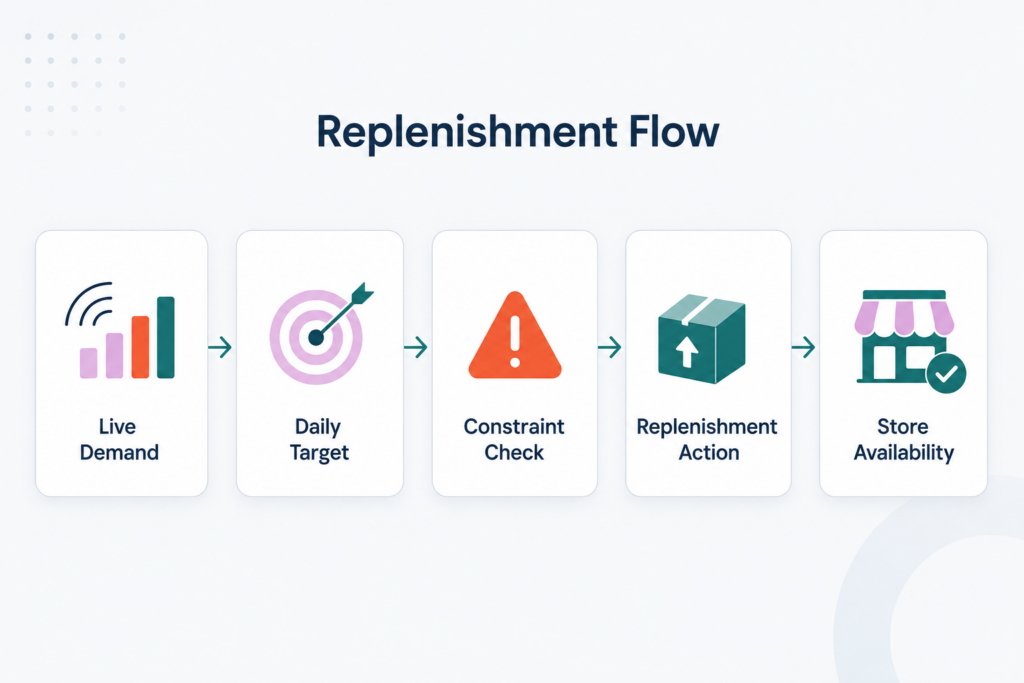
Modern replenishment planning should begin with live demand signals, not fixed averages. That means looking at recent sales velocity, on-hand stock, inventory in transit, lead times, store behavior, and how similar products are moving across the network. The aim is not to replace people with automation. It is to give planners a better daily picture of where inventory can still sell at full price.
Dynamic replenishment needs more than a better reorder rule. It needs retail data infrastructure that connects demand, inventory, constraints, and workflow feedback before it recommends the next SKU-store move.
Dynamic Daily Targets
That is where dynamic daily targets matter. Instead of holding one fixed target for a SKU across the season, retailers should allow targets to change as demand changes. Onebeat describes smart replenishment as setting a unique inventory target for every SKU and store based on demand history, delivery lead time, package constraints, shipment capacity, and store behavior. That is a more realistic operating model for store networks than fixed min/max bands.
Prioritization Over Blanket Automation
Better replenishment planning also uses prioritization, not just automation. A system can generate thousands of recommended moves, but the value comes from ranking those moves well. Which stores are still selling fast at full price? Which locations are running out of core sizes? Which units are better held back because the demand signal is weak or markdown risk is rising? Those are decision-quality questions.
The most useful replenishment model also connects planning to execution. It should not stop at telling planners demand changed. It should translate that change into actions across replenishment, transfers, and inventory flow. This is where Onebeat’s point of view is useful: planning tools plan, but retail value is created when demand signals become executable SKU-store actions.
How Retailers Should Prioritize Replenishment When Inventory Is Limited
Limited inventory exposes the difference between rule-based replenishment and decision-based replenishment. If ten stores want more units and there are only enough units for four, sending the same quantity everywhere usually protects no one. Retailers need a ranking logic.
The first lens is demand quality. Stores with stronger recent sales, cleaner sell-through, and healthier full-price performance should usually rank above stores where the item is already slowing. The second lens is assortment importance. If a missing size or core SKU breaks the offer, availability damage can be larger than the unit count suggests. The third lens is risk. A store with too many weeks of supply should not keep receiving inventory just because a fixed rule says it is time.
This is also where replenishment and transfers start to overlap. Sometimes the next-best move is not shipping from the DC at all. It is rebalancing inventory that is trapped in slower stores while demand is still strong somewhere else. Onebeat’s KAZO case study shows the business value of that approach: by prioritizing replenishment and shifting underperforming stock to stores with greater demand, the brand improved bestseller availability by 28% and store turns by 18% while reducing surplus inventory by 15%.
Pro Tip
Start with one category or region and add a weekly exception review: which stores are still out of stock on top sellers, which stores are building excess weeks of supply, and where are planners overriding the system most often. Those three exceptions usually reveal whether your replenishment logic is learning fast enough.
What KPIs Show Whether Replenishment Is Working
Many retailers measure whether stock moved. That is not enough. The real question is whether the inventory moved to the right place at the right time.
Availability and Stockout Pressure
Start with availability and stockouts. If high-demand stores keep missing sales on core items, replenishment is not doing its job even if total inventory is high. Then look at weeks of supply by store and SKU. This reveals whether inventory is balanced or whether units are piling up where demand is weak.
Network Imbalance and Margin Quality
Next, measure inventory imbalance across the network. A macro number can hide a lot. The US Census Bureau reported a total business inventories/sales ratio of 1.32 in March 2026. That is useful context, but it does not tell a retailer which stores are overfed and which stores are losing sales today. Replenishment teams need store-level visibility, not just enterprise totals.
Finally, use margin-sensitive measures such as full-price sell-through where they fit the category. A replenishment process can look productive if it pushes units out, but if those units land in slow stores and later need discounting, the process did not really improve the business. Good replenishment supports availability where demand is strongest and limits exposure where markdown risk is building.
What to Look For in Replenishment Planning Software
The first test is whether the software treats replenishment as a live store-network decision process or as a faster reorder engine. If it only automates static thresholds, it may save time without improving outcomes.
Look for five capabilities. First, store-level targets that update as demand changes. Second, constraint awareness, including lead times, pack sizes, shipment cadence, and capacity limits. Third, prioritization logic that can rank inventory moves when supply is tight. Fourth, planner control over exceptions and tradeoffs. Fifth, connection to execution so that insights turn into clear actions rather than another layer of reporting.
Buyer Questions to Ask
Ask whether targets update by store and SKU or whether they remain fixed until a planner changes them. Ask whether the system can explain why one replenishment move ranked above another. Ask whether the tool can factor in pack rules, lead times, and shipment limits without pushing planners back into spreadsheet work. Those questions reveal whether the software improves decision quality or just speeds up old logic.
It is also worth asking what the software does not assume. Better replenishment tools should not assume every store is the same, that forecast accuracy alone solves flow problems, or that more automation means less need for human judgment. Strong systems help teams focus on the few decisions that matter most each day.
This is where Onebeat’s Precision Inventory Intelligence framing becomes practical. Replenishment is one part of a broader Inventory Intelligence Loop that connects planning intent to daily actions across replenishment, transfers, and in-season inventory flow. The goal is not to turn replenishment into a black box. It is to help retail teams act on demand faster, with better control over where inventory goes next.
Key Takeaway
Replenishment planning works best when it reflects live demand, real constraints, and store-level tradeoffs. Static min/max rules are easy to run, but in volatile retail they are often too blunt to protect both availability and margin.
See how Onebeat turns live demand and operational constraints into daily smart replenishment decisions.
FAQs
What is replenishment planning in retail?
Replenishment planning is the process of deciding when, where, and how much inventory should flow back into stores or channels after products begin selling.
What is min/max replenishment?
Min/max replenishment uses a minimum inventory threshold to trigger a reorder and a maximum level to define how much stock should be restored.
Why do static replenishment rules fail?
They fail when demand changes faster than the rules do. Fixed thresholds miss store differences, lead-time shifts, and the tradeoff between protecting availability and avoiding excess.
What data should replenishment planning use?
It should use recent sales signals, on-hand inventory, in-transit stock, lead times, store behavior, package constraints, shipment capacity, and item importance within the assortment.
What should retailers look for in replenishment planning software?
They should look for dynamic store-level targets, constraint-aware prioritization, planner control, and a clear link between planning signals and daily execution.


