
Preparing stores for high-demand events is not the same as adding extra stock everywhere and hoping demand sorts itself out. Event demand shifts by product, by store, and by speed. The real question is not whether demand will rise. It is where it will rise first, which SKUs will carry the event, and how quickly the team can respond once the event starts.
That is why blanket uplift creates so much trouble. It feels fast. It feels simple. But it usually pushes too much inventory into some stores and not enough into others. The result is a familiar split: missed sales in hot locations, slow inventory in cooler locations, and margin pressure once the promotion ends.
Store readiness is a better standard. It means translating event expectations into store-level inventory actions before the event begins, then adjusting with discipline as live demand comes in. Retailers need that level of precision because event shopping still concentrates a huge amount of demand into short windows. NRF estimated that 197 million shoppers bought over the Thanksgiving through Cyber Monday weekend.
What You Will Learn
- What store readiness means during a high-demand event
- Why blanket uplift breaks down so quickly
- Which pre-event decisions matter most
- Which KPIs reveal whether the plan worked
- How Onebeat connects event planning to daily action
What Store Readiness Means During a High-Demand Event
Store readiness means more than having extra inventory in the building. In practice, how to prepare stores for high-demand events comes down to setting store-level actions before the event begins and adjusting quickly once demand shows up. That requires planners to make choices at the SKU-store level, not just at the chain level.
This matters because event demand is not uniform. Onebeat’s April 30, 2026 event-planning article notes that promotions, holidays, and tentpole weekends change where demand shows up, which products spike, and how fast stores sell through. A store in a mall, an urban flagship, and a neighborhood strip center can respond very differently to the same offer.
A network-level forecast is useful, but it is not enough. Forecasting tells you what may happen in total. Store readiness turns that estimate into actions: what to place before the event, what to hold back, what to replenish first, and what to stop feeding if demand does not show up. That is the point where planning becomes execution.
Why Blanket Uplift Breaks Down So Quickly
Blanket uplift assumes the event will lift demand in roughly the same way across the network. That is rarely true. Discount depth, offer type, local traffic, store demographics, product relevance, and channel behavior all change the shape of the event.
Onebeat calls this out directly: applying a single lift multiplier across the network is where many event plans start to fall apart. The problem is not only forecast error. It is that the same forecast is being translated into the same action everywhere.
The cost of that shortcut shows up on both sides. Some stores stock out of event drivers early and lose sales they cannot recover. Other stores sit on event inventory that did not earn its keep, forcing markdowns or extra handling later. McKinsey’s work on retail inventory glut is a reminder that excess inventory is not a harmless buffer. It ties up cash, consumes space, and often ends in margin erosion.
Event speed makes the issue worse. If the key sell-through happens in the first two days, a late correction is not much of a correction. By the time a store reorder arrives, the window may already be gone. That is why event readiness depends so heavily on getting the first placement right and knowing what decisions will be triggered once the event starts.
The Four Decisions That Make Stores Event-Ready
1. Define the Event with the Right Comparable History
The team needs more than a calendar date and a target sales number. Define the event by offer type, discount depth, product scope, store participation, timing, and likely traffic pattern. Then find the closest historical analogs. A weekend flash promotion is not the same as a holiday event. A category push is not the same as a storewide markdown.
Comparable history should not be used to force a single uplift number. It should be used to create a range of expectations by category, store cluster, and item type. That gives planners a better starting point and makes it easier to tighten assumptions once early results arrive.
2. Prioritize SKUs and Stores Before Adding Inventory
Not every product deserves the same event treatment. Some SKUs are hero items that will carry the event. Some are traffic drivers that need high availability. Others are attachment or tail items that should be supported more carefully.
The same logic applies to stores. Some locations have the demand pattern, traffic profile, or conversion history to justify more depth. Others may need lighter positioning and a faster response plan instead. The goal is not broad coverage. The goal is to place inventory where it is most likely to earn full-price or near-full-price sales during the event window.
3. Set Store-Level Depth and Trigger Rules
Once priority SKUs and stores are clear, planners can translate the event plan into starting inventory targets. Onebeat’s Special Events page explains the logic well: event planning should predict how the event will change sales for each SKU, category, and location, then keep learning from the results afterward.
The strongest teams also define trigger rules before the event begins. They know what pace-above-plan threshold should trigger replenishment acceleration, what pace-below-plan threshold should pause further feeding, and when a store transfer review should start. That discipline keeps teams from making emotional decisions in the middle of the event.
Pro Tip
Build the trigger rules before launch day. If a hero SKU is running 15 above plan in the first 24 to 48 hours, decide in advance whether that means accelerate replenishment, review transfers from slower stores, or protect remaining stock for the highest-converting locations.
4. Plan the Correction Path, Not Just the Opening Position
Readiness is not only about the inventory that lands before the event. It is also about what the team can do next. That means knowing the replenishment cadence, available transfer paths, pack-size limits, and shipment constraints before demand forces a decision.
It also means planning the return to normal. If the team treats all event inventory as permanent demand, the event ends and the markdown risk begins. Post-event normalization should be part of the original plan, not an afterthought.
The KPIs That Show Whether a Store Was Actually Ready
Revenue is an outcome. It is not a full readiness measure. A high-sales event can still hide bad store preparation if the team sold out too early, overfed the wrong locations, or paid for the event later in markdowns.
The better KPI set is operational. Onebeat recommends watching in-stock rate on top event SKUs, event-window sell-through, estimated lost sales from stockouts, inventory turns or weeks of supply, markdown rate after the event, and forecast error at the SKU-store level.
Each KPI tells a different part of the story. In-stock rate shows whether the event winners stayed available. Event-window sell-through shows whether opening inventory was placed cleanly. Estimated lost sales helps quantify the cost of stockouts. Weeks of supply reveals whether some stores were carrying too much while others ran hot. Markdown rate after the event tells you whether the team overcommitted. Forecast error helps improve the next event.
How Onebeat Connects Planning to Daily Execution
This is where Onebeat’s point of view matters. Planning tools plan. But event readiness lives or dies in execution. A retailer can have a smart forecast and still lose sales if it cannot turn that forecast into store-level actions quickly enough.
Onebeat positions itself as Precision Inventory Intelligence for Retail Planning & Execution. In the event context, that means using expected demand shifts to set more precise inventory targets before the event, then adjusting through replenishment and transfers as real demand comes in. The platform logic is not just prediction. It is prediction tied to action.
That distinction lines up with current retail pressure. Deloitte reported on July 29, 2025 that 78 of surveyed retail buyers were concerned about securing adequate inventory, while 76 expected discretionary purchases to happen around promotional periods. When promotional demand is concentrated and uncertain at the same time, planners need a tighter loop between intent and response.
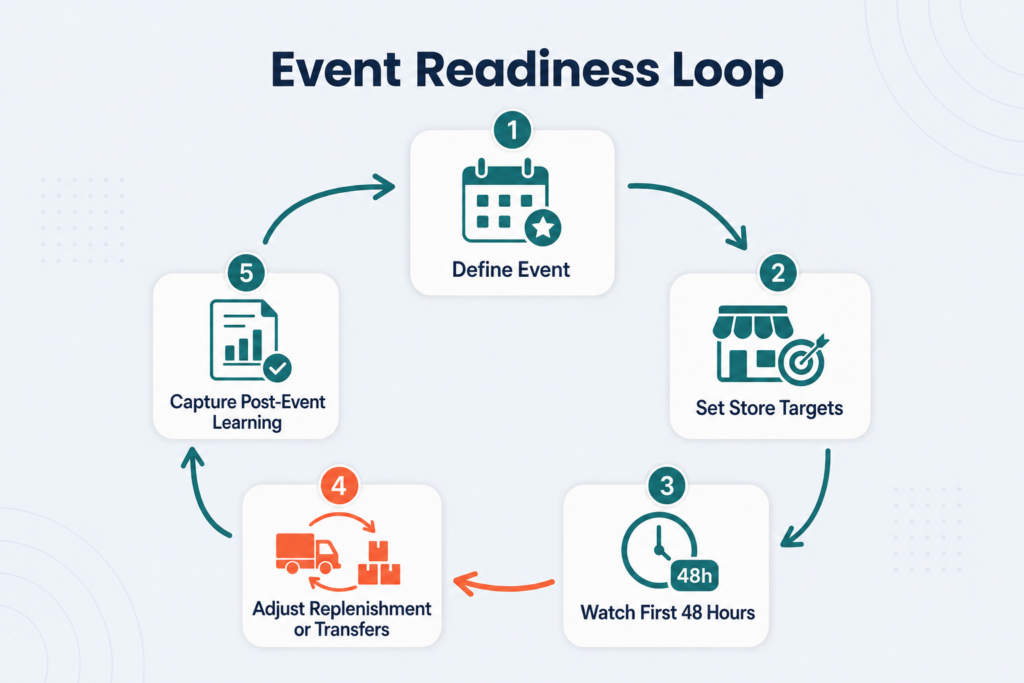
In practical terms, that loop starts with better store targets, then continues through faster replenishment choices, transfer decisions, and post-event learning. The result is a more disciplined way to protect availability on the SKUs that matter without flooding the network with safety stock that will need to be cleared later. Readers who want a deeper event-planning companion can also review Onebeat’s guide to predicting retail event demand.
A Better Standard for Promotion Readiness
The old standard was simple: estimate the lift, push more stock, and hope the event lands close enough to plan. That approach is still common because it feels fast. But it is a weak fit for a retail environment where store demand patterns move quickly and event windows are short.
A better standard is to prepare stores for a range of outcomes, not one average outcome. That means defining the event clearly, prioritizing SKUs and stores, setting store-level targets, establishing response triggers, and learning from the event once it ends. It is more disciplined work up front, but it reduces last-minute firefighting and gives the team a better chance to protect margin as well as sales.
Retailers do not need broader uplift. They need better event decisions. That starts with store readiness, and it gets stronger when retailers treat each event as a continuous loop of planning, response, and learning.
Key Takeaway
Preparing stores for high-demand events means turning event expectations into SKU-store actions before demand hits, then adjusting quickly as demand proves where it is strongest.
FAQs
How do retailers prepare stores for high-demand events?
They define the event clearly, use comparable history to estimate a range of demand, prioritize SKUs and stores, set store-level opening targets, and create trigger rules for replenishment, transfers, and post-event normalization.
How far in advance should teams start planning?
For most events, the groundwork should start several weeks ahead so teams can lock event scope, review comparable periods, and align inventory decisions before the window gets tight. Final trigger rules and store-level checks should happen closer to launch.
What is the biggest mistake in event inventory planning?
The biggest mistake is treating the whole store network the same. Blanket uplift ignores how differently stores and products behave during promotions.
Which KPI is the best early warning sign?
Early pace versus plan on top event SKUs is one of the clearest early warnings because it tells the team whether a store is heading toward a stockout or carrying too much inventory while there is still time to act.
How do retailers avoid markdowns after the event?
They avoid overcommitting opening inventory, pause slow-moving replenishment quickly, rebalance where needed, and plan the return to normal inventory targets before the event begins.


