
Initial allocation often looks simple on paper. A retailer has a buy, a store list, and a standard size run. Ship the first wave, protect presentation, and let replenishment handle the rest.
That logic breaks down fast in fashion retail. One store sells out of medium and large in days. Another store keeps the same sizes on the shelf for weeks. A third store needed less depth overall but a wider opening size mix. Total units may have been “correct” at the chain level, but the first placement was still wrong where it mattered.
That is why initial allocation deserves more precision. Initial allocation is the first shipment decision that determines which stores get which SKUs and sizes before live demand is fully visible. In size-sensitive categories, that decision is not only about how many units to send. It is about which sizes, which stores, and how much flexibility the retailer preserves for the next move.
What You Will Learn
- What initial allocation means in practical retail terms
- Why average size runs fail at store level
- How to build better size curves before inventory ships
- How targeted store allocation improves first placement
- Why fast post-launch adjustment matters
- How Onebeat connects first placement to ongoing execution
What Initial Allocation Means When Size Curves Matter
Initial allocation is the first placement of inventory into stores before enough live selling data exists to guide every decision. In fashion and other size-sensitive categories, it is one of the highest-stakes inventory moves of the season because it sets the opening conditions for availability, sell-through, and markdown risk.
When retailers talk about initial allocation, they sometimes collapse two different questions into one. The first is how much inventory each store should receive. The second is what mix of sizes each store should receive inside that quantity. That second question is where size curves matter most.
Size curves are the working pattern of size demand across a product, category, cluster, or store. They help teams decide whether a store should open with more medium and large, more smaller sizes, more full runs, or a narrower opening mix. In other words, size curves turn a total unit decision into an actual SKU allocation decision.
Onebeat frames initial allocation as a demand-led decision rather than a static push. Its allocation logic uses similar-product behavior, size curve distributions, attribute structure, and consumption patterns to guide where a new item should start when direct history is limited. That is a more useful way to think about first placement than simply dividing the buy into equal store shares.
Why Average Size Runs Fail at Store Level
Average size runs feel safe because they are easy to operationalize. They create a standard opening pack, reduce debate, and make the chain look consistent. The problem is that stores are not average.
Different stores serve different demand pools. Climate, catchment, price sensitivity, mall profile, demographic mix, product role, and store capacity all affect what sells and at what depth. McKinsey notes that retailers should analyze items at the store or store-cluster level instead of applying the same logic across all stores and channels. That principle applies directly to size curves.
The operational failure usually shows up in two ways at once. Winning sizes stock out early in the stores that needed more depth, while slower sizes accumulate in the stores that never needed a full run to begin with. The chain total may still look balanced, but the local outcome is not. That is how retailers end up with both missed sales and excess inventory from the same opening allocation.
Localized assortment logic is becoming more important, not less. Modern Retail reported that Target had opened more than 100 small-format stores with more curated assortments tailored to local demand patterns. If store format and neighborhood demand are already changing assortment choices, they should shape size-run logic too.
Deloitte’s retail planning guidance points to the same pressure from another angle: assortment planning is harder because product variety, data complexity, and rationalization decisions all matter at once. Average runs flatten that complexity at exactly the moment when the business needs more precision.
How to Build Better Size Curves Before Inventory Ships
Better size curves do not start with perfect certainty. They start with better evidence than a chain average.
The first step is store clustering. Stores should be grouped by demand profile, format, capacity, product role, and local selling behavior instead of treated as one population. A flagship that needs full presentation and broad choice should not open the same way as a smaller neighborhood store that needs faster turns and tighter inventory depth.
The second step is to use comparable-product behavior. If a style is new, teams still have clues. Similar silhouettes, fabrication, price point, gender mix, seasonality, and brand role can all help estimate likely size demand. Onebeat describes this as using product attributes and image-based similarity to learn from comparable items when direct history is limited.
The third step is to separate presentation minimums from real demand logic. Some stores need enough depth to make a story visible. That is different from assuming every store deserves the same opening size run. A presentation rule may justify minimum breadth. It should not automatically justify excess depth in sizes that will not move.
The fourth step is to decide what not to ship yet. Holdback inventory is not a sign of hesitation. It is a way to preserve flexibility while demand is still forming. If a retailer sends too much inventory up front, it loses the ability to respond to early signals without resorting to transfers or markdowns. If it keeps a measured reserve, it can follow demand instead of arguing with it.
Pro Tip
If a new style has weak direct history, do not ask for perfect certainty. Ask which comparable products, store clusters, and size-run signals are strong enough to shape a better first move than a chain average.
In size-sensitive categories, the benefit is clear. Onebeat’s platform predicts demand and size curves for every item, style, and store so bestsellers stay available without tying shelves up with what will not move. The objective is clear: leaner size runs, less clutter, and better first placement.
How Targeted Store Allocation Improves First Placement
Targeted store allocation is where the logic becomes executable. Once teams have cluster logic, comparable-product signals, and an opening holdback strategy, they can build a smarter first-placement plan at the SKU-store level.
This is where initial allocation stops being a broad allocation exercise and becomes a set of store-specific decisions. Which stores need full runs? Which need narrower opening packs? Which high-volume locations deserve deeper opening depth in winning sizes? Which stores should receive lighter depth until early demand confirms the shape of the curve?
Onebeat describes strong allocation as recommending the right stores and quantities using sell-through, coverage and assortment gaps, size curves, and store performance. That combination matters because it balances two things retailers often separate: presentation logic and sales potential.
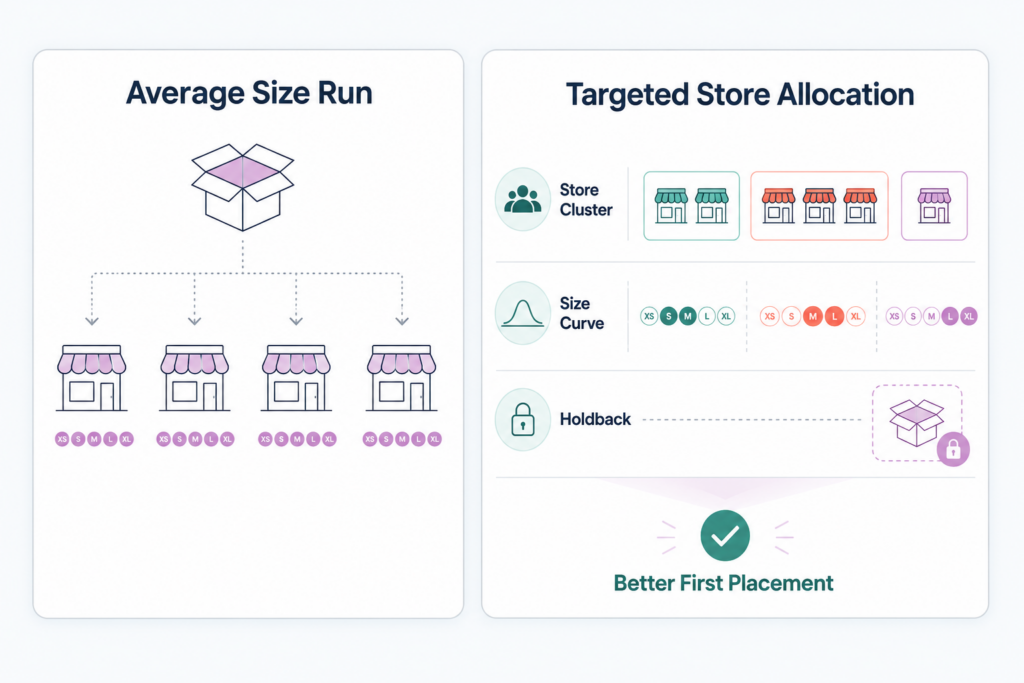
The goal is not to eliminate every stockout or avoid every slow seller. The goal is to improve first placement enough that the next inventory move is a refinement instead of a rescue mission. That is the difference between data-driven allocation and static opening packs.
Retailers can see the value of this approach when they look at inventory productivity instead of only opening completeness. In Onebeat’s Aramis case-study materials, the retailer reduced in-store inventory by 20 percent, increased sales by 12 percent, and improved inventory turns by 60 percent while using smarter demand-led inventory decisions. The lesson is not that every retailer will see the same numbers. The lesson is that smaller, better-placed assortments can outperform broader, less disciplined opening allocations.
Why Initial Allocation Should Adapt Quickly After Launch
The first placement is only the opening move. What happens next matters just as much.
Early demand signals arrive quickly. Stores begin to show whether the size curve was too shallow, too deep, too broad, or directionally correct. At that point, retailers need a fast way to adjust targets without flooding the network with more of the wrong stock.
This is why holdback inventory and replenishment discipline matter. If the first shipment consumed most of the available stock, teams have fewer good choices. They can wait and lose sales, transfer inventory around the network, or ship more without enough confidence. None of those are ideal. A measured reserve gives the retailer room to follow the first real signals with better second moves.
Onebeat’s replenishment article explains the downstream version of this logic well: teams should turn store-level demand signals into clear decisions on what to replenish, how much, and where to send inventory first so fast stores stay in stock without building risk in slow stores. That is exactly why initial allocation should leave room to adapt rather than trying to settle the whole season on day one.
A good rule is simple: use initial allocation to create informed exposure, not final certainty. Once demand appears, let the next move sharpen the size curve instead of defending the original assumption for too long.
Where Onebeat Fits in the Allocation Loop
This is where Onebeat’s point of view becomes useful. The company does not position allocation as a one-time split. It positions allocation as adaptive inventory placement that learns from real demand and improves the next decision.
That matters because the best initial allocation process connects planning logic to in-season execution. Product similarity informs the first move. Store performance and size curves shape targeted store allocation. Early selling data then supports dynamic allocation and replenishment targets. The result is not perfect foresight. It is a tighter feedback loop.
Onebeat describes that broader operating model as Precision Inventory Intelligence for Retail Planning and Execution: planning tools plan, but the loop continues through allocation, replenishment, transfers, and learning. In practical terms, that means allocation teams keep control of the decision while gaining clearer evidence about where inventory should go next.
That planner-control point matters. Better initial allocation does not require replacing the allocation team with a black box. It requires giving the team better inputs, better store logic, and faster evidence once product hits the floor. The value is not automation alone. The value is making first-placement decisions with enough precision that the season starts from a stronger position.
Key Takeaway
Initial allocation works best when retailers treat size curves as store-level demand decisions, not chain-average defaults. Better first placement comes from combining store clusters, comparable-product logic, holdback inventory, and fast post-launch adjustment so inventory starts closer to real demand and stays flexible enough to follow it.
FAQs
What is initial allocation in retail?
Initial allocation is the first placement of inventory into stores before enough live demand data exists to guide every decision. It sets the opening conditions for sell-through, availability, and flexibility.
Why are size curves important in fashion retail?
Size curves determine which sizes and how much depth each store receives. In fashion retail, total units are not enough if the mix of sizes is wrong for local demand.
What is the difference between initial allocation and replenishment?
Initial allocation is the first stock placement. Replenishment is the follow-up flow of inventory after demand begins to reveal itself. Strong retailers connect the two instead of treating them as separate worlds.
How should retailers allocate a new product with little sales history?
They should use comparable-product behavior, product attributes, store clusters, and presentation minimums to make a better first move than a chain average. They should also preserve some holdback inventory for early adjustment.
What is targeted store allocation?
Targeted store allocation is the practice of assigning SKU depth and size mix based on store role, demand profile, and cluster behavior instead of using the same opening run everywhere.


