
Most retailers still treat inventory allocation as a launch distribution step. Decide store quantities. Push inventory into the network. Then hand off the season to replenishment, store teams, and markdown planning.
That model breaks as soon as demand becomes clearer than the original plan. A style can sell through quickly in one region and stall in another. A size curve can work in a cluster on paper, then break once local shoppers respond. A store can miss full-price sales while another holds depth that will need action later.
Inventory allocation in retail is moving from static distribution to adaptive inventory placement. Initial allocation still matters. But the advantage now comes from keeping allocation connected to live demand, product similarity, size curves, store performance, and SKU-store execution while the season is still in motion.
What You Will Learn
- What inventory allocation means in modern retail.
- Why static allocation stops working once demand becomes visible.
- What adaptive inventory placement means and how it differs from basic dynamic allocation.
- How product similarity, size curves, and store performance should inform allocation decisions.
- How allocation connects to replenishment, transfers, lifecycle management, and full-price sell-through.
- How Onebeat’s Inventory Intelligence Loop supports adaptive allocation without positioning Onebeat as a generic forecasting tool.
What Is Inventory Allocation in Retail?
Inventory allocation is the process of deciding how much product to place in each store, channel, or location. In retail, that decision affects availability, sell-through, stockouts, overstock, markdown exposure, and how much of a product’s demand is captured at full price.
In retail inventory allocation, the goal is not just coverage. It is placing inventory where it can convert demand at the best margin.
Traditional retail allocation starts before launch. Merchants and planners define the assortment. Allocation teams decide which stores receive which products and how much depth each location should carry. The logic may use store clusters, past sales, demand forecasts, product roles, presentation minimums, pack rules, and available supply.
That first push is initial allocation. It sets the first inventory position in the network. Store-level allocation decides which locations receive inventory. SKU allocation decides how each item is spread across the network. Size curve allocation decides how size-level inventory should be split, which is especially relevant for apparel, footwear, and other fit-driven categories.
The basic idea is simple. The practical challenge is not. Allocation is a margin decision because the same unit can be productive in one store and unproductive in another. A product that sells at full price in a high-demand location may become excess inventory in a store where demand never appears.
Initial Allocation vs. Replenishment
Allocation decides where inventory should be placed. Replenishment refills inventory as demand materializes. In many retail organizations, those two motions are separated: allocation creates the launch position, replenishment reacts to sales, and transfers or markdowns handle the cleanup later.
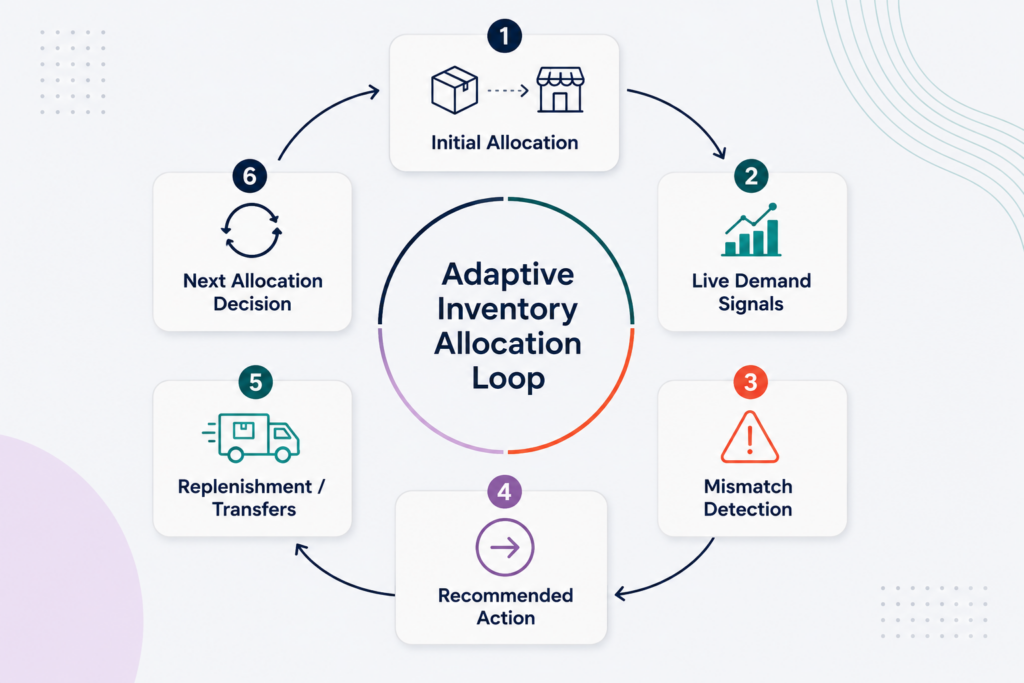
Adaptive retail execution closes that gap. Initial allocation should inform replenishment. Replenishment results should inform future allocation. Transfers should correct placement when demand shifts. Lifecycle decisions should protect winners and resolve laggards before the season loses its margin window.
Why Static Allocation Stops Learning Too Soon
Static allocation stops learning at the moment the plan is pushed. It freezes assumptions before enough real demand is visible. That can be workable when demand is stable, product behavior is known, and stores behave predictably. It becomes risky when demand shifts by SKU, store, size, region, channel, timing, or product role.
The cost shows up on both sides of the inventory problem. IHL Group projects the total global cost of inventory distortion in 2024 at $1.7 trillion, with out-of-stocks accounting for $1.2 trillion and overstocks totaling $554 billion. That imbalance is not only a forecasting issue. It is also a placement and response issue.
McKinsey reported in 2023 that U.S. retailers were sitting on $740 billion in unsold goods, using the figure to frame the need to think beyond markdowns when inventory glut builds across the network. In allocation terms, the problem is often visible too late, after inventory has already spent too much time in the wrong places.
Retailers do not lose sales because allocation happens. They lose sales because allocation stops learning too soon. The launch plan may be reasonable. But if the business cannot respond when a store sells through faster than expected, a size breaks earlier than expected, or a comparable product signals stronger local demand, allocation becomes a fixed answer to a moving problem.
The Cost of Inventory in the Wrong Place
Inventory in the wrong place creates two penalties at once. The first is missed demand. A store can have traffic and intent, but the wrong depth, size, or SKU mix. The second is margin drag. Another store carries the inventory but lacks the local demand to move it at the intended price.
That is why allocation should not be judged only by launch-week sales. A good launch can still create future exposure if depth is left in the wrong locations, while a slow start can hide demand when the right stores or sizes were under-allocated.
Demand does not disappear. It moves. The challenge is moving inventory with it.
– Greg Arthur, VP Retail Strategy | Onebeat
Adaptive Inventory Placement: The New Role of Allocation
Adaptive inventory placement is allocation that keeps learning from live demand, store performance, product similarity, size curves, inventory constraints, and execution results. It treats the initial allocation as the first position, not the final meaningful decision.
Allocation optimization is the process of deciding where inventory should go next based on demand, availability, size needs, store performance, constraints, and expected margin impact.
This is not the same as moving inventory constantly. Constant movement can create noise, cost, and store execution burden. Adaptive allocation means making better decisions when the evidence says the original placement no longer matches demand. Sometimes that means replenishing a selling store. Sometimes it means holding. Sometimes it means transferring units, changing future allocation rules, or protecting a product from unnecessary markdown.
Better forecasting helps, but prediction alone does not create outcomes. Outcomes come from execution. The question is not only, “Where should inventory go before launch?” The better question is, “How should placement change as demand reality becomes clearer?”
| Dimension | Static Allocation | Adaptive Inventory Placement |
|---|---|---|
| Primary role | Create a launch distribution based on preseason assumptions. | Keep inventory placement aligned with demand as the season unfolds. |
| Decision unit | Often store cluster, channel, or rule-based store group. | SKU-store and, where relevant, SKU-size-store. |
| Signals used | Historical sales, forecast, cluster logic, presentation minimums. | Live demand, sell-through, availability, size breaks, product similarity, store performance, constraints. |
| Common failure | Inventory stays where the original plan placed it, even when demand shifts. | Recommendations must still respect cost, capacity, pack rules, and planner judgment. |
| Success measure | Initial launch coverage and plan adherence. | Full-price sell-through, availability, inventory productivity, markdown exposure, and correction speed. |
What Changes After Launch
After launch, allocation has better evidence than it had during planning. Stores reveal demand quality. Sizes reveal local fit patterns. Products reveal whether they behave like the comparable items used in planning. Channels reveal where demand is shifting. Supply constraints reveal which decisions need prioritization.
Adaptive allocation uses that evidence to make inventory more productive. It does not discard the plan. It keeps the plan alive by connecting it to the actions that can still protect sales and margin.
The Signals Adaptive Allocation Should Learn From
Adaptive allocation depends on the quality of the signals behind each decision. More data by itself is not the goal. The goal is better SKU-store action under real constraints.
The strongest allocation signals connect product behavior, local demand, size-level performance, store execution, and inventory position. Together, they show whether the current placement is still the best use of inventory already owned.
Product Similarity for New Products
New products rarely have perfect item history. Product similarity helps bridge that gap. A new sneaker, jacket, or handbag can be compared with similar products by category, price tier, color family, fashion level, seasonality, fit, or store behavior.
Comparable-product behavior is not a replacement for demand sensing. It is a starting point. Once the new product begins selling, live behavior should update the allocation logic. If a new item is outperforming its comparable set in certain stores, that signal should influence replenishment, transfer priority, and future allocation decisions.
Size Curve Allocation
Size curves are often treated as stable planning inputs. In reality, size-level demand can vary sharply by region, store, product type, and customer base. A chain-average curve can create broken sizes in one store and excess depth in another.
For allocation teams, the operational point is clear: size curves should not be frozen if local size demand is telling a different story.
Broken sizes are more than an availability issue. They reduce the chance of full-price sell-through. When high-opportunity stores lose core sizes early, demand can move on before replenishment or transfer decisions catch up.
Store Performance and SKU-Store Precision
Store performance should influence allocation beyond preseason clustering. Two stores in the same cluster can behave differently during the season because of local demand, traffic, weather, events, staff execution, visual merchandising, or competitive context.
That is why SKU-store precision matters. Chain averages can explain the category. Store clusters can guide the plan. But the decision that protects full-price sales often happens at SKU-store or SKU-size-store level.
Constraints matter too. A recommendation should account for available supply, lead times, store capacity, pack rules, allocation policies, presentation standards, and operational feasibility. Allocation that ignores constraints may look smart in a model and fail in execution.
Pro Tip
Do not judge allocation only by launch-week sell-through. Look for SKU-store mismatches that can still be corrected: stores selling through too quickly, stores holding depth without demand, broken sizes in high-opportunity locations, and comparable products showing stronger local behavior than the current allocation assumed.
How Allocation Connects to Replenishment, Transfers, and Lifecycle Management
Allocation is not an isolated decision. It is one action inside a broader retail execution loop. The original placement influences replenishment. Replenishment results reveal where demand is real. Transfers correct inventory trapped in low-opportunity locations. Lifecycle decisions determine whether to protect, reposition, promote, mark down, or exit inventory.
Allocation vs. Replenishment
Allocation sets the position. Replenishment responds to selling. But if replenishment only refills what was originally allocated, it can repeat the original bias. High-demand stores may remain under-supported while low-demand stores retain inventory that should have been redirected.
An adaptive model lets replenishment and allocation inform each other. If a store sells through quickly because the product truly fits local demand, replenishment should prioritize that opportunity under supply constraints. If a store appears slow because it never had enough size coverage, the action may be different.
When Allocation Should Trigger Transfers
Transfers become relevant when inventory is available in the network but not positioned where demand exists. The right transfer is not simply moving overstock away from one store. It is moving inventory to a location where the remaining selling window, demand probability, size need, and margin opportunity justify the cost.
This is where allocation connects to inventory redistribution. A product can be a laggard in one location and a full-price opportunity in another. Adaptive allocation should recognize that difference early enough for the retailer to act before markdown pressure takes over.
Lifecycle Decisions After Demand Becomes Clear
As the season progresses, allocation must connect to lifecycle management. Winners need protection from stockouts and unnecessary discounts. Laggards need diagnosis: is the product weak, under-exposed, in the wrong stores, or broken by size? Tail inventory needs movement, consolidation, promotion, or planned exit.
This is the difference between a launch discipline and an execution discipline. Allocation should keep improving the placement of inventory until the product’s lifecycle tells the business that another action is more profitable.
What Retailers Need to Make Allocation Adaptive
Retailers do not need adaptive allocation because it sounds more modern. They need it because inventory placement now determines whether demand becomes revenue, missed opportunity, or markdown exposure.
The capability model is practical. Retailers need SKU-store demand signals, comparable-product logic, size-level intelligence, store performance learning, constraint-aware recommendations, execution workflow, and feedback loops. Each piece should improve the next decision, not simply add another report.
That shared foundation is AI-native retail infrastructure: the operating layer that turns fragmented retail data into decision-ready SKU-store actions.
KPIs for Allocation Effectiveness
- Full-price sell-through: how much demand is captured before discounts become necessary.
- Availability: whether the right stores have enough inventory to convert demand.
- Stockout rate: where inventory absence is creating missed sales.
- Broken size rate: where size gaps are reducing conversion in fit-driven categories.
- Markdown rate: where poor placement is becoming price pressure.
- Weeks of supply: whether depth matches realistic local demand.
- GMROI: whether inventory is producing enough gross margin relative to its investment.
- Allocation accuracy: whether launch placement matched actual selling behavior.
- Inventory productivity: whether inventory is in locations where it can sell at the best margin.
- Transfer and replenishment effectiveness: whether corrective actions improve sell-through without creating unnecessary cost.
The value of these KPIs is not the report itself. It is the action they trigger: replenishing a winner, correcting a size curve, transferring misplaced inventory, or preparing a lifecycle action before markdown pressure builds.
Why More Data Is Not the Same as Better Allocation
Allocation teams already have data. Sales, inventory, forecasts, purchase orders, store attributes, promotions, size curves, and historical performance are all available in many retail organizations. The gap is often not visibility. It is decision quality.
A useful allocation model should diagnose the mismatch and recommend the next action. Is the store under-allocated? Is the size curve wrong? Is the product similar to a past winner in a specific region? Is inventory better used through replenishment, transfer, or lifecycle action? More data only helps when it leads to a better decision.
How Onebeat Supports Adaptive Allocation Through the Inventory Intelligence Loop
Onebeat is Precision Inventory Intelligence for Retail Planning & Execution. In allocation, that means turning planning intent, demand signals, inventory position, and business constraints into SKU-store actions that can be executed while the season is still active.
Planning creates intent. Execution creates outcomes. The initial allocation expresses the retailer’s plan for where demand should happen. The Inventory Intelligence Loop keeps testing that intent against reality: sense demand, identify SKU-store mismatch, recommend the action, execute through allocation, replenishment, transfer, or lifecycle decisions, measure results, and learn again.
This is not generic forecasting, a dashboard, an ERP replacement, or a promise that every mismatch can be solved. It is an operating model for better inventory decisions. It helps retailers adjust placement as demand becomes clearer, use constrained inventory where it has the best chance to sell, and protect full-price sell-through without treating markdowns as the first response.
For Onebeat, the point is not automation for its own sake. It is helping planning and allocation teams turn demand, inventory, and constraint signals into recommended SKU-store actions while there is still time to protect availability, full-price sell-through, and inventory productivity.
Key Takeaway
Inventory allocation is no longer just the first distribution decision. It is becoming a continuous inventory placement discipline. Retailers still need strong initial allocation, but the advantage comes from keeping allocation aligned with demand as product, size, and store-level reality becomes clearer.
FAQs
What is inventory allocation in retail?
Inventory allocation is the process of deciding how much product to place in each store, channel, or location. Modern allocation also needs to account for live demand, store performance, size curves, product similarity, inventory constraints, and execution capacity.
What is adaptive allocation?
Adaptive allocation keeps learning after launch. It adjusts inventory placement based on live selling behavior, SKU-store signals, product similarity, size-level demand, store performance, and operational constraints.
What is allocation optimization?
Allocation optimization is the process of deciding where inventory should go next based on demand, inventory position, size needs, store performance, constraints, and expected margin impact.
Why is static allocation no longer enough?
Static allocation freezes assumptions before demand is fully visible. When demand shifts by store, size, region, or product role, static rules can create stockouts in high-demand stores and overstock in low-demand stores.
How is allocation different from replenishment?
Allocation decides where inventory should be placed, often at launch or during redistribution. Replenishment refills inventory as demand materializes. In adaptive retail execution, the two should inform each other continuously.
How do product similarity and size curves improve allocation?
Product similarity helps retailers allocate new products using comparable-product behavior when exact history is missing. Size curves help align size-level inventory with local demand instead of relying only on broad averages.
What KPIs show whether allocation is working?
Useful allocation KPIs include full-price sell-through, availability, stockout rate, broken size rate, markdown rate, weeks of supply, inventory turnover, GMROI, allocation accuracy, and inventory productivity.


