
Replenishment planning is the retail process of deciding when, where, and how much inventory to restock across stores and channels based on demand signals, inventory position, lead times, constraints, and store-level performance. Done well, it is not a faster version of static restocking. It is a daily decision discipline that tells teams which SKU-store combinations deserve inventory now.
Retailers already know replenishment matters. The harder problem is that many replenishment processes still rely on blanket min/max logic, historic averages, or manual intervention. That creates a gap between what demand is doing now and what inventory decisions are doing today.
Leaders want stronger availability, but not by sending more inventory everywhere. McKinsey reported that U.S. retailers were sitting on $740 billion in unsold goods in 2023, which is a reminder that availability and excess have to be managed together. The better question is which locations can convert the next unit into demand, full-price sales, and inventory productivity.
This guide explains what retail replenishment planning means, how it differs from basic inventory replenishment and automatic replenishment, why static rules break down, and how dynamic daily replenishment targets turn signals into practical SKU-store actions.
Lo que aprenderás
- What replenishment planning means in retail and how it differs from basic inventory replenishment.
- Why static min/max logic and historic averages can fail when demand shifts by SKU, store, promotion, region, and product lifecycle.
- Which demand signals replenishment teams should use to create better SKU-store decisions.
- How dynamic daily replenishment targets help retailers prioritize inventory when supply is limited.
- Which replenishment KPIs matter for availability, full-price sell-through, store workload, and inventory productivity.
- How Onebeat connects planning intent with daily replenishment execution through the Inventory Intelligence Loop.
What Is Replenishment Planning in Retail?
Replenishment planning is the decision process behind restocking. It determines which products should be replenished, where inventory should go, when action is needed, and how much should be moved or ordered.
In retail, that decision has to happen at the SKU-store level. A product can be a winner in one store, flat in another, constrained by pack size in a third, and blocked by DC availability for an entire region. Looking only at average demand hides the local signal that matters most for the next replenishment decision.
Strong replenishment planning uses demand signals, stock on hand, stock in transit, lead times, supply constraints, store performance, and sales opportunity. It connects the commercial intent of the plan with the operational reality of what can be executed today.
Replenishment planning definition
A practical definition is this: replenishment planning is the process retailers use to decide which inventory should be restocked, where it should go, and when the action should happen. The output should not be a report. It should be a clear SKU-store action.
Why replenishment is a decision discipline, not just a logistics task
Logistics moves inventory. Replenishment planning decides whether that movement is worth doing. A store with low stock may not deserve the next case if sales are weak, the product is near end of life, or the store cannot execute the workload. Another store with slightly more stock may deserve priority because sales velocity, sell-through, and full-price demand are stronger.
That is why replenishment belongs in the same conversation as margin, availability, and working capital. The question is not only whether the shelf can be refilled. The question is whether the next unit is likely to create productive sales.
Replenishment Planning vs. Inventory Replenishment vs. Automatic Replenishment
Retail teams often use replenishment terms interchangeably. That causes confusion because the restocking action, the planning decision, and the automation layer are related but not the same.
Inventory replenishment is the act of restocking inventory. Replenishment planning is the decision logic that determines what should be restocked. An automatic replenishment system can monitor item and location inventory positions and generate orders or recommendations, but the value of automation depends on the quality of the targets and prioritization logic. Oracle describes replenishment in retail systems as monitoring inventory positions down to item and location and generating orders as required.
| Term | What it means | Retail risk if misunderstood |
| Inventory replenishment | The action of restocking products into stores, channels, or DCs. | Teams may focus on movement volume instead of the value of each move. |
| Replenishment planning | The decision process for when, where, and how much inventory to restock. | Teams may rely on old rules that do not reflect current demand or constraints. |
| Automatic replenishment system | Software that monitors inventory positions and can generate orders or recommendations. | Bad targets can be automated faster, which repeats the wrong logic at scale. |
Why automation without prioritization can repeat bad rules faster
Automation is useful when it reduces manual effort and improves decision quality. It is risky when it only accelerates a static rule. If every store is pushed back to the same target without regard for recent demand, lifecycle stage, store capacity, or supply limits, the system can create stockouts and excess at the same time.
The test is simple: does the process explain why this SKU should go to this store today? If the answer is only “because it fell below minimum,” the replenishment logic is incomplete.
Why Static Min/Max Rules Break Down in Modern Retail Replenishment Planning
Static min/max logic was built for a simpler operating rhythm. It assumes the right replenishment range can remain stable long enough to be useful. Modern retail rarely behaves that way.
Demand moves by SKU, store, channel, promotion, weather, region, and lifecycle stage. Supply can be delayed. Pack sizes can make the minimum executable move too large. Store capacity can block a shipment that looks right on paper. A replenishment rule that worked last month can be wrong this week.
Inventory distortion shows why this matters. IHL Group’s 2025 research, reported through EIN Presswire, put global retail inventory distortion from out-of-stocks and overstocks at $1.73 trillion annually. Stockouts and excess are not opposite problems. They are often two symptoms of the same weak decision process.
The stockout and overstock connection
A retailer can be over-inventoried in total and still miss sales in the stores where demand is real. That happens when inventory is placed according to averages, old store rankings, or equal treatment across locations. Winners are starved while slower locations hold stock that will later need markdown attention.
The right replenishment response is not to raise every minimum. That can protect some shelves while creating more inventory drag elsewhere. Better replenishment planning decides where availability matters most and where restraint protects margin.
Why better forecasts alone do not solve execution
Forecasts can improve the planning view, but replenishment still has to make an executable decision. The team must account for current stock, constrained supply, store handling capacity, lead time, pack size, promotion timing, price status, and the cost of sending inventory to the wrong location.
This is where many processes stall. The plan shows intent, but stores need actions. If the replenishment process cannot translate demand reality into a prioritized daily list, planners are forced back into exception reviews, spreadsheets, and store requests.
The Demand Signals Retailers Should Use for SKU-Store Replenishment
SKU-store replenishment works because it treats demand as local and specific. It asks where demand is being proven, where inventory is available, and where the next unit has the best chance to protect a profitable sale.
The signal set should include sell-through, recent sales velocity, stock on hand, stock in transit, lost sales indicators, store performance, promotion calendars, lifecycle stage, price or markdown status, lead times, DC availability, pack sizes, store capacity, and operational workload. None of these signals is enough alone. The value comes from reading them together.
Visibility is still a barrier for many retailers.
Sales velocity, sell-through, and inventory position
Recent sales velocity shows whether demand is still active. Sell-through shows whether inventory is converting at the right pace. Stock on hand and stock in transit show whether the store really needs action or already has supply coming.
Taken together, these signals help avoid two common mistakes: replenishing a low-stock store with weak demand, and ignoring a store that looks covered but is selling through fast enough to create a near-term gap.
Commercial and operational signals
Commercial signals include promotions, lifecycle stage, margin opportunity, and markdown status. Operational signals include DC availability, pack sizes, lead times, store capacity, and store workload. A product on promotion may deserve a higher target, but only if supply exists and the store can execute the replenishment without creating backroom congestion.
This is why demand-driven replenishment is not just demand sensing. It is demand plus constraints. A good decision reflects what the business wants, what the customer is doing, and what the operation can actually handle.
How Dynamic Daily Replenishment Targets Turn Signals into Actions
Dynamic daily replenishment targets are SKU-store goals that adapt based on current demand, inventory position, lead times, constraints, and store opportunity. They replace the idea that every product should return to a fixed min/max range with a more practical question: what target makes sense today?
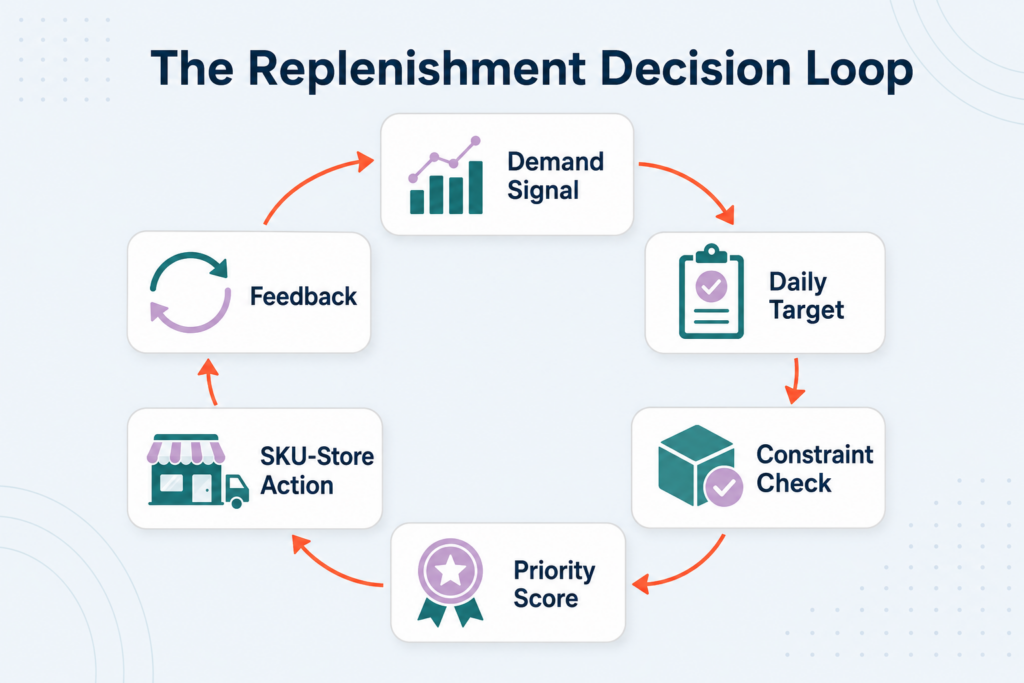
A useful operating model is signal, target, constraint, priority, action, feedback. First, the process reads demand and inventory signals. Then it sets a target for the SKU-store combination. It checks constraints such as available supply, pack size, lead time, and capacity. It prioritizes the best opportunities. It produces a replenishment action. Then the result feeds the next decision cycle.
The signal-to-action replenishment loop
- Signal: read recent demand, sell-through, stock position, in-transit inventory, lost sales indicators, promotions, lifecycle stage, and store performance.
- Target: set a daily SKU-store replenishment goal based on current demand and business priority, not a fixed historical range.
- Constraint: check supply, lead time, pack size, store capacity, workload, and execution timing before recommending the action.
- Priority: rank the SKU-store combinations where the next unit is most likely to protect demand, full-price sales, and inventory productivity.
- Action: generate a practical replenishment, transfer, or hold decision that teams can execute.
- Feedback: compare the action against sales, availability, execution, and exception outcomes so the next cycle learns from what happened.
Prioritization when supply is limited
This loop matters most when supply is limited. If there is not enough inventory for every store, equal treatment is rarely the best answer. The team should protect the SKU-store combinations where the next unit has the strongest chance to meet real demand, protect full-price sales, and improve inventory productivity.
For example, a size run may be shallow across the network. One store is out of a core size but has weak recent velocity. Another store still has a few units but is selling through quickly at full price. A demand-driven replenishment process should not simply refill the empty store first. It should compare opportunity, constraint, timing, and business value before assigning the next unit.
How the Inventory Intelligence Loop adapts as demand changes
Onebeat’s Inventory Intelligence Loop is built around this idea: planning intent, daily execution, feedback, and adaptation. Planning tools create intent. Onebeat runs the loop by turning signals, constraints, and opportunity into prioritized daily replenishment actions.
Consejo profesional
Do not prioritize replenishment only by which store has the lowest stock. Prioritize by the SKU-store combinations where the next unit has the highest chance to protect demand, full-price sales, and inventory productivity within real supply and operational constraints.
The Replenishment KPIs That Matter Most
Replenishment KPIs should measure more than whether inventory moved. They should show whether replenishment improved availability, protected margin, reduced wasted effort, and improved inventory productivity.
Availability, or in-stock rate, is a core service measure. APQC defines retail shelf or in-stock availability rate as the percentage of time a product is available on the shelf for customers to purchase. FMI has also reported improvements in food retail supply chain service levels, connecting progress to better supply chain performance, data analytics, and inventory management practices.
The strongest KPI set connects service, margin, working capital, and execution. Availability can rise while inventory productivity falls if the retailer pushes inventory too broadly. Inventory can fall while availability suffers if winners are starved. The goal is balance.
“Retailers often measure inventory value. The real question is inventory productivity.”
— Greg Arthur, VP of Retail Strategy at Onebeat
Availability and service KPIs
Availability or in-stock rate shows whether customers can buy the product when demand exists. Stockout rate shows how often demand is blocked by missing inventory. Fill rate measures how much requested or required inventory was supplied. Service level shows how reliably the replenishment process meets demand or store need within the expected time window.
These measures should be read together. A retailer can improve fill rate by sending more inventory broadly, but that may raise excess risk. A retailer can reduce inventory by cutting replenishment too tightly, but that may raise stockouts in high-performing stores. Service KPIs are useful only when they are paired with productivity measures.
Full-price and inventory productivity KPIs
Full-price sell-through shows whether inventory is converting before markdown pressure rises. Inventory turnover shows how efficiently inventory moves through the business. Weeks of supply shows how long current stock will last at the current rate of demand. Excess inventory risk highlights where replenishment may be building future markdown exposure.
These KPIs help leaders avoid the classic replenishment trap: celebrating higher availability while quietly lowering margin quality. The right measure is not just whether a shelf was filled. It is whether that inventory was placed where it could sell productively.
Execution workload KPIs
Store request volume, transfer execution rate, replenishment execution rate, exception volume, and action completion rate matter because they reveal whether the process is practical. A technically correct recommendation that stores cannot execute is not a good replenishment action.
Retail leaders should look for a reduction in noise. When the replenishment process is working, teams spend less time arguing over exceptions and more time managing the highest-value decisions.
| KPI | What it tells you | Why it matters |
| Availability or in-stock rate | Whether products are available for customers to buy. | Connects replenishment to customer demand capture. |
| Stockout rate | How often a product is unavailable when demand exists. | Shows missed sales risk and service gaps. |
| Fill rate and service level | How reliably demand or store needs are fulfilled. | Links supply performance to replenishment execution. |
| Full-price sell-through | Whether inventory is converting before markdown pressure rises. | Connects replenishment to margin quality. |
| Inventory turnover and weeks of supply | How productively inventory is moving through the business. | Shows working capital discipline and excess risk. |
| Replenishment success rate | Whether recommended actions were executed and improved position. | Measures the quality of actions, not just planning intent. |
| Store request volume | How much stores need to ask for manual replenishment support. | Signals whether the process is anticipating demand well. |
| Transfer or replenishment execution rate | How often approved actions are completed in the field. | Connects planning quality to store execution reality. |
| Excess inventory risk | Where replenishment may be creating future markdown exposure. | Keeps availability from becoming an overstock strategy. |
How Onebeat Connects Replenishment Plans to Daily Execution
Onebeat is Precision Inventory Intelligence for Retail Planning & Execution. In replenishment, that means connecting planning intent to daily SKU-store decisions that reflect demand, constraints, lead times, store performance, and full-price sales opportunity.
The distinction matters. Onebeat should not be thought of as a generic forecasting tool, dashboard, ERP replacement, or broad inventory management system. The value is in the loop: turning signals into prioritized actions, learning from execution, and adapting as demand changes.
For replenishment teams, this helps move the operating rhythm from static restocking to daily decision quality. The process can identify which SKU-store combinations need action, which should wait, and which are lower priority because the next unit is unlikely to create productive sales.
For executives, the outcome is clearer governance. Replenishment is no longer measured only by whether shelves were refilled. It is measured by whether the right inventory moved to the right place for the right commercial reason.
That is the planning-to-execution gap Onebeat is built to close. Planning creates the intent. The Inventory Intelligence Loop turns that intent into prioritized replenishment, transfer, promotion, in-season purchasing, and lifecycle actions, then uses execution feedback to improve the next decision.
Key Takeaway
Replenishment planning is not a speed contest. It is a daily decision loop. Retailers protect availability and margin when they use demand signals, constraints, and SKU-store priorities to decide where inventory should go now, then adapt again as demand changes.
Preguntas frecuentes
What is replenishment planning in retail?
Replenishment planning is the retail process of deciding when, where, and how much inventory to restock across stores and channels. Strong replenishment planning uses demand signals, inventory position, lead times, constraints, and store performance to create daily SKU-store actions.
How is replenishment planning different from inventory replenishment?
Inventory replenishment is the action of restocking products. Replenishment planning is the decision process that determines which products should be restocked, where they should go, when action is needed, and how much should be replenished.
What is an automatic replenishment system?
An automatic replenishment system monitors inventory positions and can generate replenishment orders or recommendations. Its value depends on whether its targets, constraints, and prioritization logic reflect actual demand and business priorities.
What are dynamic daily replenishment targets?
Dynamic daily replenishment targets are SKU-store replenishment goals that update frequently based on demand signals, inventory availability, lead times, constraints, and sales opportunity. They help retailers avoid treating every store and SKU the same.
Which replenishment KPIs should retailers track?
Retailers should track availability or in-stock rate, stockout rate, fill rate, service level, full-price sell-through, inventory turnover, weeks of supply, replenishment success rate, store request volume, transfer or replenishment execution rate, and excess inventory risk.
What is demand-driven replenishment?
Demand-driven replenishment uses current demand signals, store performance, and constraints to shape replenishment actions. It is different from static restocking because the target changes as demand, supply, and product lifecycle conditions change.
What is the difference between replenishment and allocation?
Allocation usually decides the initial placement of inventory across stores or channels. Replenishment decides how inventory should be restocked after demand begins to appear. Both should use SKU-store demand signals, constraints, and business priorities.
What is the risk of replenishing every store equally?
Equal replenishment can send scarce inventory to stores with weak demand while stronger stores run out. That creates the stockout and overstock pattern retailers are trying to prevent.


