
Demand-triggered replenishment starts with a simple truth: when inventory is limited, the next unit is not equally valuable in every store. Some locations are about to miss a full-price sale. Others are already carrying enough stock, or more than enough. The job of replenishment is not to refill every gap the same way. It is to decide where the next unit will do the most good.
In practice, demand-triggered replenishment is the daily discipline of ranking SKU-store needs by live sales opportunity instead of refilling every store equally. It is a replenishment method that reacts to real demand and current store conditions, then prioritizes inventory to the SKU-store combinations with the strongest selling opportunity. Instead of treating replenishment as a routine refill, it treats replenishment as a daily ranking problem.
This matters because static logic breaks fastest when supply gets tight. If every store gets an equal share, high-velocity stores stock out anyway while slower stores build weeks of supply they do not need. That is how retailers end up losing sales in one part of the network while quietly creating markdown risk in another.
McKinsey’s work on in-stock performance makes the stakes clear. The firm notes that out-of-stock issues are rarely caused by one thing alone, and that the drivers can stretch from store inventory accuracy and shelf execution to store ordering, DC fill issues, and vendor problems. It also notes that a one-percentage-point improvement in presubstitution in-stock rates can boost sales by 20 to 35 basis points.
Lo que aprenderás
- What demand-triggered replenishment actually means
- Why static min/max logic breaks down when stock is limited
- Which signals matter most when ranking SKU-store demand
- How to decide which store should get the next unit
- Which KPIs show whether constrained replenishment is working
- How Onebeat connects replenishment planning to daily execution
What Demand-Triggered Replenishment Actually Means
Demand-triggered replenishment is a decision method, not just an automation feature. It asks a harder question than “is the store below target?” It asks whether sending inventory to this store, for this SKU, right now is the best use of the next available unit.
That is a different mindset from classic restocking. Classic replenishment often assumes the network should be restored to a preset buffer. Demand-triggered replenishment assumes the value of the next unit depends on what is happening in that store right now: current selling pace, remaining stock, nearby receipts, lead time, and the likelihood that the unit will sell at full price.
Onebeat’s smart replenishment page describes the same shift in plain terms. Instead of sending an equal share of stock to every store, the platform sets dynamic inventory targets for every SKU and store, adapting to demand, delivery constraints, and store behavior. That is the core logic this article is focused on.
In practice, demand-triggered replenishment does not mean planners surrender control. It means planners stop managing the network with one-size-fits-all refill rules and start judging the next move by sales opportunity and constraint reality.
Why Static Replenishment Rules Fail Fast When Inventory Is Limited
Static min/max rules can look reasonable when supply is plentiful and store patterns are stable. But they flatten important differences. They assume that if two stores have the same planogram, category role, or facing count, they can be replenished with roughly the same logic. Real demand rarely behaves that neatly.
Limited inventory exposes the weakness immediately. If a retailer only has enough stock to cover part of the network, equal-share replenishment feels fair but performs badly. It sends too much inventory into lower-velocity stores and not enough into the stores where demand is already proving itself.
This is why the problem is not only forecast error. It is translation error. A chain-level view might say the item is healthy overall. A store-level view might show that one cluster is already on the edge of stockout while another cluster is carrying slow units that are heading toward markdown risk. The same average hides two very different realities.
Onebeat’s recent real-time replenishment article explains this clearly. Traditional replenishment relies on static min/max levels, reorder points, or periodic planning cycles, while real-time replenishment optimization keeps recalculating what to send, where to send it, and when, so fast-selling stores stay in stock and slow stores avoid excess.
For a broader view of why static rules fail, Onebeat also covers the issue directly here: https://onebeat.co/blog/replenishment-planning-in-retail-why-static-min-max-rules-fail/
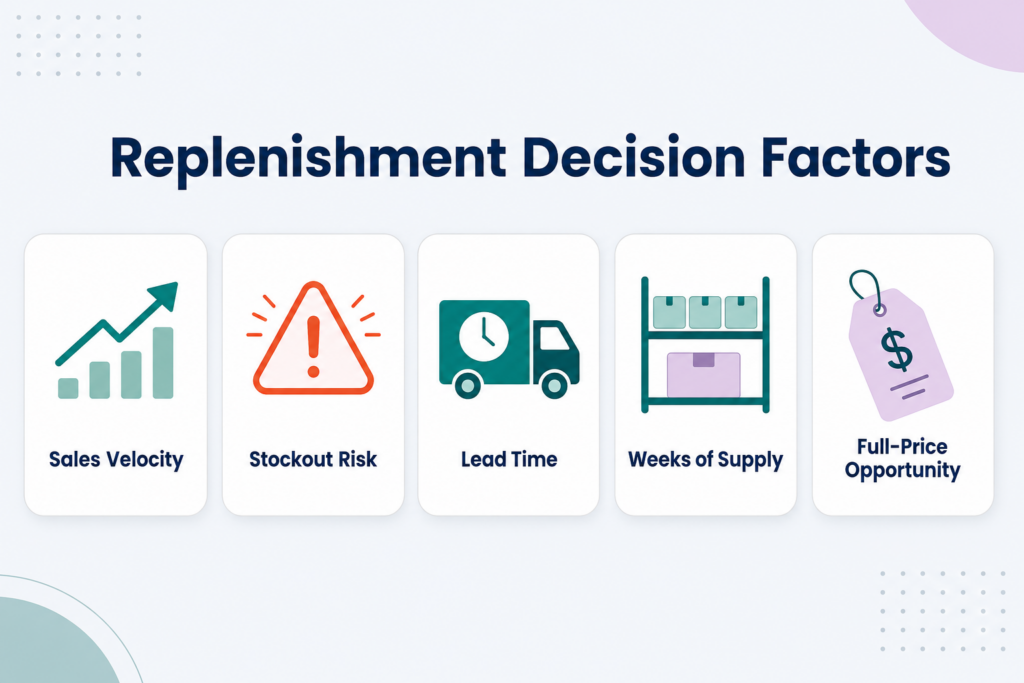
The Five Signals That Should Drive Replenishment Priority
Retailers do not need dozens of disconnected metrics to decide who gets the next unit. They need a short signal set that reveals demand quality, constraint pressure, and inventory risk.
1. POS Sales Velocity by SKU and Store
The first signal is how fast the item is actually selling in that location. Not chain average. Not category average. Real SKU-store velocity. If one store is selling through at a much faster rate than another, that store is telling you more about the next unit’s likely value than any static buffer ever could.
2. On-Hand Inventory and In-Transit Inventory
Current stock matters, but so does what is already on the way. A store with low on-hand units and no inbound coverage is in a different position from a store with the same on-hand count and a shipment arriving tomorrow. Good prioritization treats these as different needs.
3. Lead Time and Shipment Constraints
Not every urgent need can be solved quickly. Lead time, pack-size rules, shipping cutoffs, warehouse capacity, and route limits all affect whether a replenishment move can still protect demand in time. Onebeat’s smart replenishment logic makes this explicit by including demand history, delivery lead time, package constraints, and shipment capacity in the target-setting process.
4. Store-Specific Selling Profile
Some stores are high-velocity locations. Some are steady repeat sellers. Some are long-tail stores that need tighter feeding rules. Onebeat’s real-time replenishment framework recommends store segmentation because optimizing to patterns is more scalable than chasing one-off exceptions.
5. Full-Price Opportunity
This is where replenishment stops being a service-level-only exercise. A unit is worth more in a store where it is still likely to sell at full price than in a store where the SKU is already slowing down and inventory is aging. Prioritization should protect availability, but it should also protect margin.
The signals above work together. Onebeat’s public replenishment guidance lists the most important in-store inputs as POS sales velocity by SKU-store-day, on-hand inventory, recent receipts and transfers, lead times and in-transit inventory, returns, and store-specific constraints such as shelf capacity and backroom space. That is a strong signal map for smart replenishment and everyday event-based inventory decisions alike.
How To Decide Which Store Gets the Next Unit
Once the signals are clear, replenishment becomes a ranking exercise. Which store has the strongest demand? Which store has the highest stockout risk? Which store still has a strong chance to sell the unit at full price? Which store can be reached in time? Which store should be paused because the risk has already shifted from lost sales to future markdowns?
The first step is to separate must-win needs from nice-to-have needs. A top-selling store with low cover, clean full-price sell-through, and no inbound shipment should rise to the top. A slower store with acceptable cover and weak recent pace should not get the same treatment just because it is technically below a static target.
The second step is to compare stockout risk against markdown risk. Replenishment often goes wrong when teams see only the service problem and ignore the margin problem. Feeding every store that looks short can protect near-term availability in the wrong places while creating slow inventory that has to be cleared later.
The third step is to keep transfers in the decision set. If one store is over-covered and another is about to lose sales, the answer may not be another DC shipment. It may be to rebalance inventory already in the network while the product can still sell cleanly. That is especially important when DC inventory is tight or lead times are too long to rescue the sale.
The fourth step is to manage exceptions instead of manually replanning every SKU. A good replenishment process surfaces the few moves that matter most today: where stockout risk is rising, where excess is building, and where a transfer can protect demand faster than a new order. That keeps planners in control without trapping them in busywork.
Consejo profesional
Set a no-feed rule before the rush starts. If a store still has high weeks of supply, slowing sell-through, or low full-price conversion on a SKU, do not keep feeding it just because another store with the same planogram is short. Protect the next unit for the store where the demand is cleaner and the selling window is still open.
The KPIs That Show Whether Prioritization Is Working
Revenue alone does not tell you whether constrained replenishment is healthy. A retailer can still post sales while missing higher-margin demand in fast stores and accumulating future markdown risk in slow stores.
The better KPI set is more operational. Onebeat recommends tracking in-stock rate or on-shelf availability proxy, stockout rate, weeks of supply, full-price sell-through, markdown penetration, and inventory imbalance across stores.
Each metric shows a different part of the story. In-stock rate shows whether shoppers can actually buy the item. Stockout rate shows lost selling time in high-demand locations. Weeks of supply shows whether some stores are overfed while others are starved. Full-price sell-through shows whether inventory is flowing to the places where it can still generate strong margin. Inventory imbalance reveals whether stock is stuck in the wrong stores.
Public customer proof helps show what better prioritization looks like in practice. In Onebeat’s Sport Zone case study, availability increased by 25% to 97.5%, average stock in stores fell by 40%, and store special requests were reduced by 90% after the retailer moved from push replenishment toward more target-driven pull logic.
How Onebeat Connects Replenishment Planning to Daily Execution
This is where Onebeat’s point of view matters. Planning tools plan. But once supply tightens and store demand separates, the business needs a daily execution layer that can translate intent into action.
Onebeat positions this as Precision Inventory Intelligence for Retail Planning & Execution. In replenishment terms, that means setting dynamic targets by SKU and store, then adjusting those targets with live demand, lead times, shipment constraints, and store behavior in view. The goal is not to automate movement for its own sake. The goal is to direct inventory where it is most likely to protect sales and margin.
That logic also fits the broader replenishment reality described outside Onebeat. IBM Research’s omnichannel replenishment work frames the problem as one of maximizing system-wide profit margins while incorporating operations constraints, not simply chasing unit movement or generic forecast accuracy. That is a useful way to describe what smarter replenishment should aim for.
When Onebeat is working well, replenishment becomes a continuous loop: set the target, prioritize the next move, execute through replenishment or transfer, learn from the result, and tighten tomorrow’s decision. That is the operational meaning behind Precision Inventory Intelligence in a replenishment context.
A Better Standard for Replenishment Teams
The old standard was simple: keep stores above a fixed threshold and reorder when they fall below it. That still feels manageable because it is easy to explain and easy to audit. But it is a weak standard when demand shifts quickly and inventory is limited.
A better standard is to judge every next unit by likely value. Which store is closest to a stockout on a real seller? Which store is still converting at full price? Which store already has enough cover? Which move is still feasible within lead-time and shipment limits? That is what turns replenishment from mechanical restocking into a profit-protecting retail discipline.
If replenishment teams want a quick self-check, they should ask one question: when supply is tight, do we know exactly why one store gets the next unit before another does? If the answer is no, the process is probably still being managed by static rules instead of demand-triggered logic. Better replenishment is not only faster movement. It is Precision Inventory Intelligence applied to daily SKU-store decisions.
Key Takeaway
Demand-triggered replenishment means the next unit goes to the store where it is most likely to protect real demand and full-price sales, not simply to the store that happens to be below a static threshold.
Preguntas frecuentes
What is demand-triggered replenishment?
Demand-triggered replenishment is a replenishment method that prioritizes inventory using live demand signals, stock position, and operational constraints at SKU-store level instead of relying only on static min/max or reorder rules.
How is demand-triggered replenishment different from replenishment planning?
Replenishment planning sets the overall logic and targets. Demand-triggered replenishment is the daily execution layer that decides where limited stock should go next as demand and constraints change.
Which data matters most for replenishment priority?
The most important inputs are SKU-store sales velocity, on-hand and in-transit inventory, lead time, store selling profile, and the likelihood the next unit will still sell at full price.
How often should replenishment priorities update?
Priorities should update as often as the business can act on them. In many retail environments that means daily, with exception reviews during faster-moving periods.
How can retailers reduce stockouts without overfeeding the network?
They can rank stores by demand quality and stockout risk, tighten no-feed rules for slower stores, use transfers when appropriate, and track weeks of supply and full-price sell-through instead of chasing availability alone.


