
Excess inventory is one of retail’s most expensive problems. It ties up working capital, increases carrying costs, and often ends with margin-eroding markdowns. Yet excess inventory rarely appears overnight. In most cases, it develops gradually as demand changes while inventory decisions remain unchanged.
Retailers do not lose margin because demand changes. They lose margin because their decisions do not change with it. The best way to reduce excess inventory is not to become better at liquidation. It is to identify risk earlier and take action before products become clearance candidates.
Direct Answer: How Do Retailers Reduce Excess Inventory?
Retailers reduce excess inventory by identifying slow-moving products early, separating true excess from misplaced inventory, transferring stock to locations with demand, using phased markdowns instead of blanket discounts, tracking markdown effectiveness, and feeding those learnings back into allocation, replenishment, purchasing, and lifecycle decisions.
Lo que aprenderás
- Why excess inventory happens
- How to identify inventory risk earlier
- The difference between true excess and misplaced inventory
- How phased liquidation works
- Which KPIs reduce markdown dependency
- Why lifecycle management outperforms reactive clearance
What Causes Excess Inventory in Retail?
Excess inventory is usually the result of demand volatility colliding with slow decision-making. Forecast error matters, but allocation mismatches, delayed reactions, changing consumer preferences, and inventory distortion often play a larger role.
Research on inventory distortion shows that overstocks and out-of-stocks are often connected symptoms of the same decision problem. A retailer can be overstocked at chain level while still missing sales in specific stores or sizes.
McKinsey notes that many retailers continue to struggle with inventory gluts that cannot be solved by markdowns alone.
How to Reduce Excess Inventory in Retail
1. Detect risk early.
2. Separate true excess from misplaced inventory.
3. Rotate tail inventory to stores with stronger demand.
4. Protect winning products from unnecessary markdowns.
5. Phase markdowns by SKU-store demand.
6. Track markdown effectiveness.
7. Feed learnings into future purchasing and allocation.
8. Use continuous execution loops rather than periodic reviews.
These actions reduce markdown dependency because they intervene while options still exist.
True Excess vs. Inventory in the Wrong Place
A product that is underperforming in one store may still be a full-price opportunity somewhere else. Without SKU-store visibility, retailers often assume demand has disappeared everywhere.
Inventory productivity improves when retailers distinguish between true excess inventory and inventory that is simply misplaced. Transfers, allocation changes, and replenishment decisions frequently recover value without reducing price.
Consejo profesional
Treat excess inventory as an early-warning signal. Products usually become liquidation candidates long before they reach the clearance rack.
What Is Phased Liquidation?
Phased liquidation uses a sequence of measured markdowns rather than an immediate deep discount. Retailers introduce smaller price reductions, evaluate demand response, and only increase discount depth when necessary.
This approach protects margin while generating additional insight into customer price sensitivity and product demand.
Lifecycle Management vs Reactive Clearance
Reactive clearance treats liquidation as a clean-up exercise. Lifecycle management treats excess inventory as an early-warning signal.
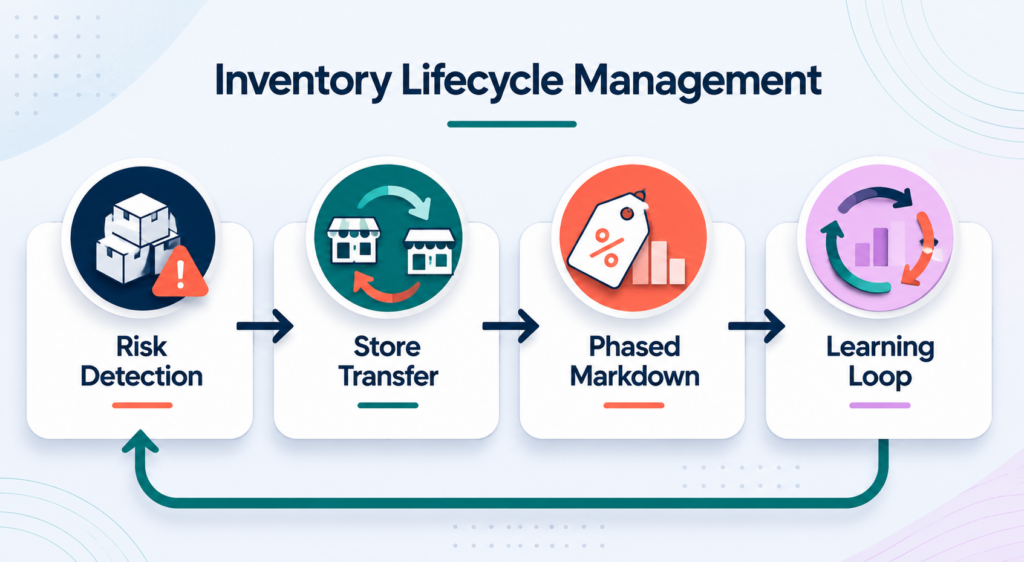
A lifecycle approach connects risk detection, transfers, allocation, replenishment, promotions, and markdowns into a continuous process. This aligns with Onebeat’s Inventory Intelligence Loop, which connects planning intent to executable inventory actions. Planning tools plan. Onebeat runs the loop.
KPIs That Help Reduce Markdown Dependency
Track sell-through, aged inventory, full-price sell-through, markdown effectiveness, and inventory productivity.
These metrics help retailers understand not only how much inventory they own, but how effectively inventory generates revenue and margin.
Building a Retail Operating Model That Prevents Excess Inventory
The strongest retailers connect planning and execution through continuous feedback loops. Demand signals influence allocation. Allocation affects replenishment. Replenishment shapes purchasing decisions. Markdown outcomes improve future planning.
This planning-to-execution cycle creates faster responses to demand shifts and reduces the number of products that become liquidation problems in the first place.
Key Takeaway
Retailers reduce excess inventory most effectively when they act before deep discounts become necessary, using lifecycle management, SKU-store visibility, and continuous inventory execution.
Preguntas frecuentes
What causes excess inventory in retail?
Forecast errors, allocation mismatches, demand shifts, delayed decisions, and inventory distortion.
How can retailers reduce excess inventory without deep discounts?
Act early through transfers, targeted markdowns, tail inventory rotation, and lifecycle management.
When should retailers begin markdowns?
When demand risk becomes visible and other inventory actions have been evaluated.
What is the difference between liquidation and lifecycle management?
Liquidation clears inventory. Lifecycle management aims to prevent inventory from reaching liquidation status.
Which KPIs help reduce markdown dependency?
Sell-through, aged inventory, full-price sell-through, markdown effectiveness, and inventory productivity.


