
Special events can create the best kind of retail demand: concentrated, urgent, and highly visible. A holiday weekend, product launch, sports event, tourism spike, local festival, or chainwide campaign can move shoppers faster than the regular demand curve. That is why retailers invest so much in the event calendar, campaign plan, and store presentation.
The inventory risk lasts longer than the event itself. A retailer can plan the campaign well and still end up with stockouts in high-response stores, excess inventory in low-response stores, broken size runs, and markdown pressure after demand returns to normal.
The better answer is not more safety stock everywhere. Retailers need a practical way to manage inventory for special events before, during, and after the spike. That means using event-aware demand factors, SKU-store signals, allocation, replenishment, transfers, and post-event normalization as one execution loop.
Lo que aprenderás
- Why special event inventory planning is different from regular planning.
- Why blanket uplift assumptions can create stockouts and overstock at the same time.
- How to position inventory before a special event using event-aware demand factors.
- What teams should monitor while the event is live.
- How allocation, replenishment, transfers, and promotions should work together.
- How post-event normalization prevents event-driven inventory from becoming markdown risk.
- How Onebeat’s Inventory Intelligence Loop supports more profitable special event execution.
How to Manage Inventory for Special Events Before, During, and After the Spike
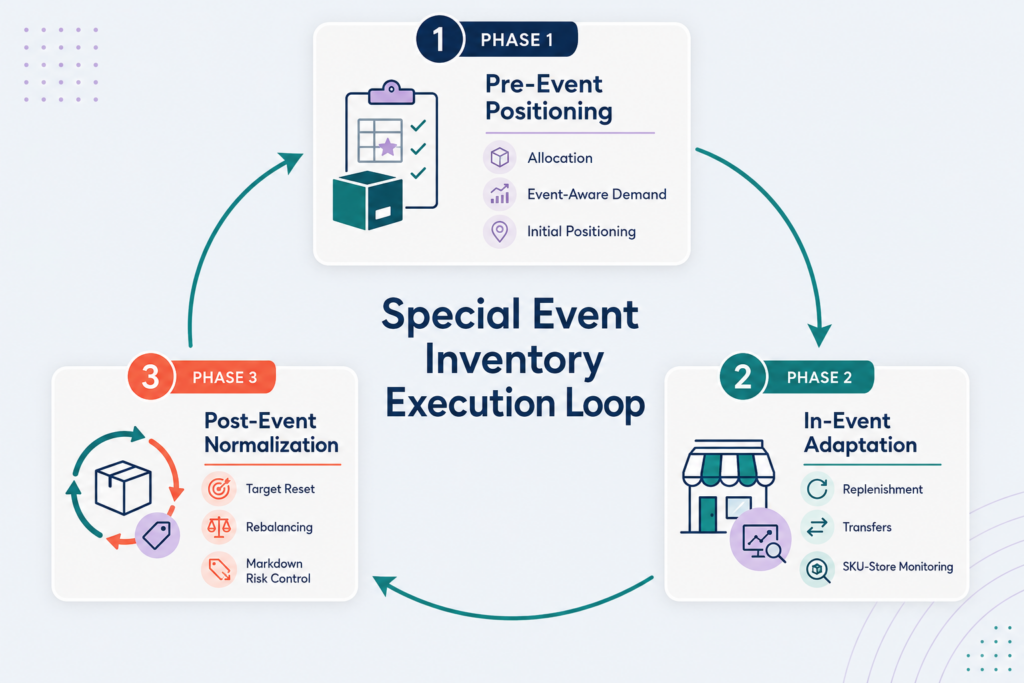
Retailers should manage inventory for special events as a three-phase execution loop: position inventory before the spike, adapt while demand is live, and normalize inventory after the event. The plan should use event-aware demand factors by SKU, store, region, product role, supply constraint, and remaining demand window instead of relying on a single chainwide uplift assumption.
This three-phase model matters because events compress the decision window. The retailer has to place inventory before demand appears, adjust while the signal is still useful, and reset targets before event inventory becomes post-event exposure. In practical terms, the question is not only how much demand the event will create. It is which SKU-store combinations need action now.
What Makes Special Event Inventory Planning Different?
Special event inventory planning is the process of preparing, adjusting, and normalizing inventory around temporary demand shifts caused by events, promotions, launches, holidays, or local demand spikes. It is not regular replenishment with a louder campaign attached. The demand pattern is compressed, local, and time-sensitive.
In regular replenishment, a retailer can often recover from a slow correction. If one store is understocked this week, next week’s replenishment may still catch demand. During a special event, the window is shorter. If the right SKU, size, or color is missing on the event weekend, the sale may be lost and the demand signal may never show up as observed sales.
Peak periods also carry large commercial stakes. NRF forecasted 2025 U.S. holiday retail sales to exceed $1 trillion for the first time, with November and December sales expected to grow 3.7% to 4.2% over 2024. That kind of demand concentration raises the cost of both missed availability and poorly placed stock.
Special events vs. regular replenishment
Regular replenishment tends to work from recent sales, target levels, lead times, and service goals. Special events require an added layer: event-aware demand factors. Those factors can include event type, promotion depth, product role, historical event response, store cluster, region, channel behavior, available supply, display capacity, and the remaining demand window.
A back-to-school push, a marathon weekend, a beauty launch, and a regional sports win do not create the same demand shape. Even inside one event, one store may need depth in core sizes while another needs breadth across related products. Treating these situations as the same chainwide lift creates weak decisions.
The inventory risk before, during, and after the event
The first risk is going into the event with inventory in the wrong locations. The second risk is failing to adapt while demand is happening. The third risk is letting event inventory sit after demand normalizes. The third risk is often underestimated because the event team has moved on, but the inventory remains.
This is why special events retail planning should not end when the campaign launches. It should run as a loop that positions inventory, reads demand, adjusts execution, and then resets inventory before event-specific stock becomes a markdown problem.
Why Blanket Uplift Assumptions Create Inventory Chaos
A blanket uplift assumption can be a useful starting input. It becomes dangerous when it turns into the operating plan. A single percentage does not tell the retailer which stores need more depth, which SKUs will lead demand, which sizes may break first, which stores are constrained by capacity, or where leftover inventory will become a margin risk.
This is how retailers create two opposite problems at the same time. High-response stores stock out early and understate true demand. Low-response stores look well supplied during the event but carry too much exposure after the spike. The chain-level plan may look mathematically reasonable while the store-level outcome is messy.
The problem with chain-level lift
Chain-level lift hides variation. A 20% expected lift may include stores that need 60% more depth, stores that need no added units, and stores that need a different mix altogether. It may also hide product-level differences. A promoted jacket may lift strongly in one climate zone, but the matching accessory may be the item that sells fastest in another.
The risk is more than lost sales. When the event ends, the retailer may still be holding units in the wrong stores. Those units tie up working capital, crowd the sales floor, and push teams toward broader markdowns later.
What event-aware demand factors should include
Event-aware demand factors translate a broad event plan into executable inventory decisions. Useful factors include SKU, store, category, region, product role, lifecycle stage, promotion depth, timing, local demand context, supply availability, lead time, store capacity, and post-event sell-through risk.
The best signal set combines planning intent with execution reality. Marketing may know the campaign objective. Merchandising may know the product story. Allocation may know the launch position. Replenishment sees velocity. Store operations sees capacity and presentation. Promotional inventory optimization works when those inputs turn into specific SKU-store actions, not when each team works from a separate view.
Phase 1: Position Inventory Before the Demand Spike
Pre-event positioning is the first decision point. The objective is not to push more inventory into every store. It is to place constrained inventory where it has the best chance to convert into full-price sales during the event window.
A practical pre-event plan starts with historical event response, but it should not stop there. The team should ask which products are most relevant to the event, which stores have responded to similar events, which store clusters share behavior, which locations have enough space to carry depth, and which supply constraints limit the plan.
Deloitte’s 2025 holiday research describes a shopping environment shaped by omnichannel behavior, digital discovery, and AI-influenced shopping journeys. That makes pre-event planning more demanding because demand may form earlier, move across channels, or shift toward products that gain sudden visibility.
Pre-event allocation
Allocation sets the initial event position. For a launch, it decides which stores receive the product and how deep the opening quantity should be. For a promotion, it decides where added depth should sit before demand peaks. For a holiday or local event, it decides which locations need a different mix than their regular replenishment pattern would suggest.
The better allocation question is not, “How much inventory does the chain need?” It is, “Where does each unit have the best chance to sell within the event window?” That pushes the team toward SKU-store demand shifts, store clusters, size curves, display needs, and timing.
Peak demand planning under supply constraints
Most retailers do not have unlimited supply, unlimited labor, or unlimited shelf space. Peak demand planning has to decide what to protect when everything cannot be protected equally. That may mean prioritizing lead items in high-response stores, protecting size curves on hero products, or holding back some inventory for quick replenishment once demand is visible.
The mistake is treating pre-event positioning as a static shipment plan. It should create the strongest starting point and leave room for adaptation. A good event plan makes it easier to move fast once the event begins.
Phase 2: Adapt While the Event Is Live
Once the event is live, the plan meets reality. Sell-through may beat the plan in a cluster of stores. A featured SKU may lag while a related item accelerates. A weather shift may move demand from one region to another. Store capacity may limit how much inventory can be presented, even when warehouse stock is available.
Retailers should monitor sell-through, availability, stockouts, size breaks, replenishment velocity, local demand deviation, store capacity, and event response by SKU-store. The goal is to see where inventory can still convert into profitable demand while the window is open.
A 2025 fresh retail dataset paper highlights a core measurement problem: stockouts censor true demand, which can bias future inventory and pricing decisions. This matters during events because a store that stocked out early may look like an average performer in the sales data, even though demand was stronger than sales reveal.
In-event replenishment priorities
Replenishment should prioritize locations where demand is materializing, inventory can still arrive in time, and the product still has enough event window left to sell at the intended margin. That requires more than replenishing every store back to the same target.
A store with fast sell-through and three days left in the event may deserve priority over a slower store with the same on-hand level. A store with a broken size run may need a targeted replenishment, not a full-size shipment. A store with limited backroom capacity may need smaller, faster moves.
When transfers make sense during an event
Transfers can help when inventory is trapped in low-response stores and another store still has enough demand window to sell the product at a better margin. They do not make sense for every event or every SKU. The transfer should be justified by the expected full-price sell-through opportunity, the cost of the move, the remaining time, and the risk of creating a new gap at the sending store.
This is where event execution becomes operational, not theoretical. The question is not simply whether one store has too much and another has too little. The question is whether moving units now improves margin and availability before the event demand fades.
Why promotions cannot run separately from inventory availability
Retail promotion planning often focuses on campaign mechanics: price, creative, offer, audience, and timing. Those choices matter, but they cannot sit apart from inventory availability. A promotion that drives demand to unavailable SKUs trains customers to leave disappointed. A promotion that pushes products already overexposed in the wrong stores may delay the markdown problem rather than fix it.
Promotion teams and inventory teams should share one event view: what the campaign is trying to sell, where inventory is available, which products are at risk of stockout, and which products may need help before they drift into excess.
Consejo profesional
Do not judge event performance only by sales lift. A store can look like it underperformed because it stocked out early, while another can look healthy during the event and still create post-event excess. Measure event performance with availability, sell-through, stockout signals, leftover exposure, and post-event markdown risk together.
Phase 3: Normalize Inventory After the Event
Post-event normalization is the process of resetting inventory targets, identifying leftover exposure, rebalancing inventory, protecting continuing winners, and preventing event-driven stock from becoming markdown risk. It starts as soon as the demand spike begins to fade.
This phase matters because event inventory rarely disappears cleanly. Some products keep selling after the event. Some need to be rotated to stores where demand remains. Some should stop receiving replenishment. Some need lifecycle action before they become a larger end-of-season liability.
McKinsey reported that U.S. retailers were sitting on $740 billion in unsold goods in 2023 and argued that clearing inventory requires action beyond markdowns. For special events, that means the post-event plan should not default to discounting. It should first ask where inventory can still sell, what targets should change, and which actions can protect margin.
Reset targets after demand normalizes
Targets that made sense during the event may be wrong the week after. A store that needed depth for a holiday weekend may need a lower target once traffic returns to normal. A product that became an event winner may deserve continued protection, while a product tied tightly to the event may need a faster exit path.
The planning team should reset targets by SKU-store, not by broad category alone. This protects the products that still have demand and stops automatic replenishment from feeding products whose event window has closed.
Rebalance before markdown is the only lever
Rebalancing after the event can include store transfers, replenishment pauses, allocation changes, display adjustments, or lifecycle actions. The right move depends on remaining demand, transfer cost, seasonality, inventory age, and margin exposure.
Feed learning into the next event
Every event should improve the next event library. Which stores responded above plan? Which SKUs created size breaks? Which products sold only because of discount depth? Which locations needed transfers? Which leftover inventory created margin risk? Those answers should feed future event-aware demand factors.
The learning matters only if it changes the next decision. A post-event report that does not alter allocation, replenishment, transfer, or lifecycle rules becomes another retrospective deck. The value is in better action the next time the demand spike appears.
How Allocation, Replenishment, Transfers, and Promotions Work Together
The event loop works because each inventory lever has a different job. Allocation sets the starting position. Replenishment responds to live demand. Transfers move inventory only when the margin opportunity and remaining demand window justify the move. Promotions connect campaign intent to product availability and lifecycle risk. Lifecycle management prevents event-driven excess from becoming end-of-season liability.
These levers often fail when they are managed in sequence but not in connection. Marketing launches the event. Merchandising chooses the product. Allocation ships the inventory. Replenishment reacts. Stores request help. Markdown teams inherit the leftover exposure. The retailer may have capable teams, but the operating model creates lag.
Decision map: which lever to use when
| Lever | Best timing | Use it when |
| Asignación | Before the event | The main question is where event inventory should start by SKU-store, store cluster, size curve, and available supply. |
| Reabastecimiento | During the event | Demand is visible, stock can still arrive in time, and inventory can still convert into full-price sales. |
| Transfers | During or soon after the event | Inventory is trapped in low-response locations and the receiving store still has enough demand window to justify the move. |
| Promotion changes | During or after the event | Demand needs to be redirected toward available inventory or controlled sell-through is needed before exposure grows. |
| Lifecycle action | After the event | The event window has closed and the product needs a margin-aware exit, target reset, rotation, or markdown path. |
The best event teams do not ask which function owns the problem. They ask which decision will protect sales, margin, and inventory productivity now.
What KPIs show whether the event plan worked?
Sales lift is not enough. Retailers should measure availability, sell-through, stockout signals, size breaks, replenishment success, transfer conversion, leftover exposure, full-price sell-through, markdown risk, and post-event inventory productivity.
The strongest KPI set looks across the full loop. Pre-event metrics show whether inventory was positioned well. In-event metrics show whether the team responded fast enough. Post-event metrics show whether the retailer protected margin after demand normalized.
How Onebeat Turns Special Event Planning Into an Inventory Intelligence Loop
Onebeat’s point of view is simple: planning tools plan. Onebeat runs the loop. For special events, that means planning intent must become SKU-store action before, during, and after the demand spike.
Onebeat is Precision Inventory Intelligence for Retail Planning & Execution. In an event context, that means detecting event-aware demand factors, setting SKU-store targets, guiding allocation and replenishment, monitoring live performance, identifying transfer priorities, and normalizing inventory after the event.
In Onebeat’s model, event demand signals should adjust dynamic daily targets so planners can prioritize allocation, replenishment, transfers, promotions, in-season purchasing, and lifecycle actions while the decision still affects margin.
The value is not another dashboard. Retailers already have reports showing that events are volatile. The value is turning the signals into daily inventory decisions: which store needs depth, which SKU needs replenishment, which location should stop receiving stock, which transfer is worth doing, and which leftover exposure needs action before markdowns become the main lever.
“Technology creates value only when it helps retailers respond faster to reality,”
– Yishai Alshag, Cofounder & CEO | Onebeat
From event forecast to executable SKU-store action
A forecast can suggest demand. Execution decides whether the retailer captures it. The Inventory Intelligence Loop connects the event plan to action: detect demand shifts, set targets, execute allocation and replenishment, monitor performance, adjust transfers and priorities, normalize after the event, and feed learning into the next event.
That loop is especially useful when demand does not follow the plan. A local event, social signal, weather shift, or product substitution can change the demand pattern quickly. The retailer needs a way to adjust decisions while the opportunity still exists.
Planning tools plan. Onebeat runs the loop.
This distinction matters. Special event planning is not only about predicting the spike. It is about managing the inventory consequences of the spike. Better planning helps, but better execution protects margin.
Retailers that treat events as execution loops can make sharper SKU-store decisions, reduce manual firefighting, and improve the odds that event demand becomes profitable demand rather than post-event exposure. That is the role of Precision Inventory Intelligence: connect planning to execution and keep the loop moving until inventory is back in balance.
Key Takeaway
Special events should not be managed as one-time planning moments. They should be managed as inventory execution loops. Retailers protect margin when they position inventory before the spike, adapt while demand is live, and normalize inventory after the spike before event-driven exposure becomes markdown pressure.
Preguntas frecuentes
How should retailers manage inventory for special events?
Retailers should manage special events in three phases: pre-event positioning, in-event adaptation, and post-event normalization. The work should use event-aware demand factors and SKU-store decisions rather than a single chainwide uplift assumption.
What makes special event inventory planning different from regular planning?
Special events compress demand into a short window and create localized shifts by SKU, store, region, channel, product role, and timing. Regular replenishment routines may be too slow or too broad for that kind of demand pattern.
Why are blanket uplift assumptions risky?
Blanket uplift assumptions are risky when used alone because they hide local variation, size or SKU exposure, store constraints, and post-event sell-through risk. They can be useful inputs, but they should not become the full execution plan.
What should retailers monitor during a special event?
Retailers should monitor sell-through, inventory availability, stockouts, size breaks, replenishment velocity, local demand deviation, transfer opportunities, store capacity, and leftover exposure.
When should retailers transfer inventory during a special event?
Retailers should consider transfers when the expected full-price sell-through opportunity exceeds transfer cost, the receiving store still has demand window left, and the sending store is unlikely to need the units. Transfers should be selective, not automatic.
What is post-event normalization in retail inventory planning?
Post-event normalization is the process of resetting targets, rebalancing leftover inventory, protecting continuing winners, and preventing event-driven stock from becoming markdown exposure.
How can retailers prevent post-event overstock?
Retailers can prevent post-event overstock through post-event normalization: reset targets, rebalance inventory, adjust replenishment priorities, rotate stock when the economics make sense, and avoid letting event inventory drift into end-of-season markdown risk.


