What You Will Learn
- What sell-through rate and full-price sell-through really measure, and why both matter
- How real-time retail replenishment improves availability without increasing markdown risk
- The key demand signals that power real-time inventory replenishment decisions
- A practical, store-ready framework to increase full-price sell-through
- Which KPIs prove replenishment is working, and where teams see impact first
What Is Sell-Through Rate in Retail? (Definition + Formula)
Sell-Through Rate Definition
Sell-through rate is the percentage of inventory sold compared to the inventory available (or received) during a specific time period. Retailers use it to measure how quickly products are moving and whether inventory levels match customer demand. A higher sell-through usually means stronger demand and better inventory efficiency.
Sell-Through Rate Formula (with a quick example)
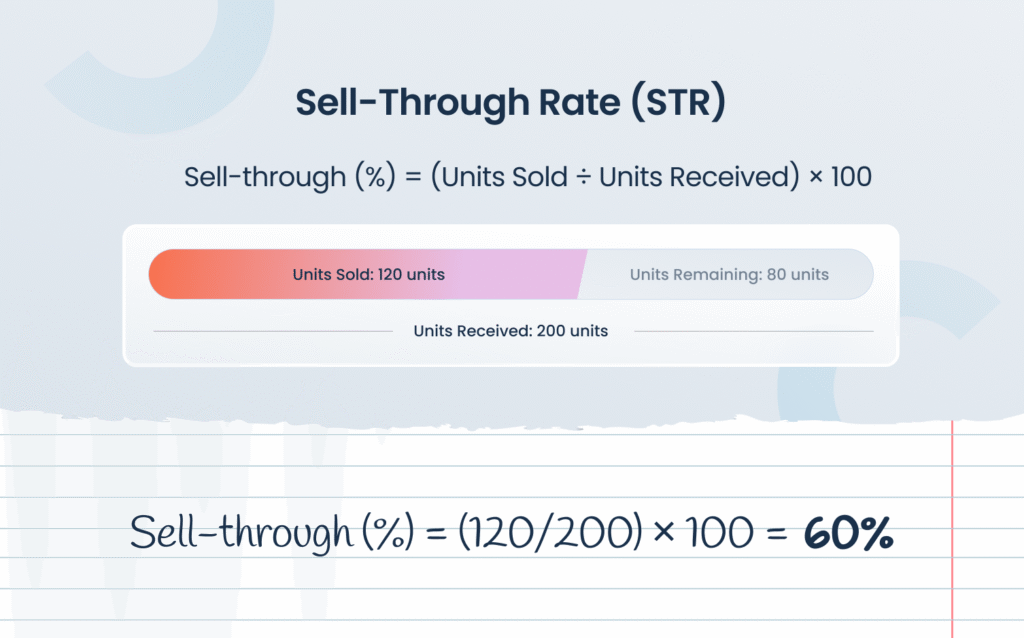
Sell-through rate (%) = (Units Sold ÷ Units Received or Units Available) × 100
Example: If a store received 200 units of a SKU and sold 120 units in four weeks:
Sell-through = (120 ÷ 200) × 100 = 60%
What’s a “Good” Sell-Through Rate by Category?
A “good” sell-through rate depends on the category, seasonality, and replenishment speed. Fast-moving categories (like essentials) typically need higher sell-through to avoid overstock, while seasonal or fashion categories may start lower early in the season and rise as demand peaks. The best benchmark is your own historical performance by category and time-in-season, then improve by reducing stockouts in high-demand stores and avoiding excess in slower stores.
What Is Full-Price Sell-Through (and Why It Matters More Than Overall Sell-Through)?
Full-Price Sell-Through Definition
Full-price sell-through is the percentage of inventory sold at regular price (no markdowns, no promotions) within a given time period or season. It measures how well you convert inventory into full-margin sales before discounts are applied.
Full-Price Sell-Through vs Sell-Through Rate
- Sell-through rate = how much you sold, regardless of price. It can look great even if you relied on markdowns.
- Full-price sell-through = how much you sold at full price. It’s stricter and more closely tied to profitability.
In practice, overall sell-through tells you “did it sell,” while full-price sell-through tells you “did it sell well.”
Why Full-Price Sell-Through Protects Margin
Markdowns don’t just reduce revenue; they compound costs (lost margin, heavier labor, weaker cash flow, and poorer future buying power). Improving full-price sell-through means you’re keeping the right stores stocked with the right items before demand peaks and before inventory turns into a markdown problem.
What Is Real-Time Replenishment? (And How It Changes Sell-Through)
Real-time replenishment is a retail replenishment approach that updates inventory decisions as new store demand data comes in, instead of waiting for weekly or fixed review cycles. Compared to traditional replenishment—which relies on static min/max levels, reorder points, or periodic planning—real-time inventory replenishment continually recalculates what to send, where to send it, and when, so fast-selling stores stay in stock and sell-through improves while slow stores avoid excess that leads to markdowns. In practice, “real-time” doesn’t just mean fresh data; it means decisions can change quickly enough to prevent stockouts and overstock before they happen. The most important in-store signals powering these decisions include POS sales velocity by SKU-store-day, on-hand inventory, recent receipts and transfers, lead times and in-transit inventory, returns, and store-specific constraints like shelf capacity and backroom space.
How Real-Time Replenishment Increases Sell-Through Rate (and Reduces Markdowns)
Real-time replenishment improves full-price sell-through by solving the three inventory problems that drive markdowns: stockouts, overstocks, and imbalances across stores. First, it prevents stockouts in the locations where items sell at regular price by prioritizing replenishment to high-velocity stores before demand is lost. This also prevents customer dissatisfaction.
An elevated shopping experience also means consistently finding the products you want and need every time you shop.
– Michael Fiddelke, COO, Target
Second, it reduces overstocks that create markdown pressure by limiting reorders to stores where sell-through is slowing and excess inventory is building. Third, it balances inventory across the network early, moving units from low-demand stores to high-demand stores while the product can still sell at full price. This way, retailers capture demand before the markdown window and protect margin.
Pro Tip
Add a “full-price guardrail” to every replenishment rule: replenish (or transfer) only into stores where the SKU is still selling above a minimum full-price rate (e.g., 70–80% of units at regular price) and WOS is below target. This keeps you from “feeding” slow stores, protects margin, and shifts inventory to the highest full-price demand before the markdown window opens
A Practical Real-Time Retail Replenishment Framework (Store-Ready)
Set Full-Price Guardrails (Don’t Replenish Into Markdown Risk)
Start with profitability rules, not volume. Prioritize replenishment to stores where the item is still selling at full price and block or limit replenishment where the SKU is already trending toward markdown (slow velocity, high weeks of supply, aged inventory). This keeps inventory moving where demand is strongest and prevents “feeding” slow stores that will discount later.
Segment Stores by Demand Profile
Not every store should be replenished the same way. Group stores by selling behavior: high-velocity, steady performers, and long-tail locations. Then, set different targets and priorities for each group. Store segmentation makes replenishment decisions more accurate and easier to scale because you’re optimizing to patterns, not one-off exceptions.
Use Dynamic Targets Instead of Static Min/Max
Static min/max levels don’t adapt to real demand. Replace them with dynamic targets that update based on current sales velocity, seasonality, and lead times. When demand rises, targets increase to prevent stockouts. When demand softens, targets tighten to reduce overstock and markdown exposure.
Execute via Exceptions, Not Manual Replanning
Real-time replenishment works best when planners manage exceptions, not every SKU. The system should surface only the actions that matter: stockout risk in fast stores, excess inventory building in slow stores, and transfer opportunities that protect full-price sell-through. This reduces manual work while improving speed and consistency.
Weekly Calibration: Learn, Adjust, Improve
Daily decisions need a weekly feedback loop. Review what changed in sell-through, full-price sell-through, stockouts, and weeks of supply, then tune rules, store groups, and targets. This calibration step turns replenishment into a continuous improvement cycle that gets more accurate over time.
See how KAZO improved sell-through with Onebeat now
KPIs That Prove Replenishment Is Working
Sell-Through Rate KPI
- Sell-through rate (%): Measures how much of the received/available inventory is actually sold in a set period.
- Sell-through by time-in-season: Shows whether products are selling early enough to avoid late markdowns.
- Sell-through by store cluster: Confirms replenishment is improving performance in the stores that matter most.
Full-Price Sell-Through KPIs
- Full-price sell-through (%): Tracks what portion of inventory sold at regular price, before discounting.
- Full-price sales share (%): Shows how much volume is protected from promotions and markdowns.
- Markdown penetration (%): Measures how dependent sales are on markdowns to move inventory.
Availability, Stockouts, and Inventory Health KPIs
- In-stock rate / on-shelf availability proxy (%): Indicates whether shoppers can actually buy the item when they want it when they want it.
- Stockout rate (days OOS): Quantifies lost selling time, especially in high-demand stores.
- Weeks of supply (WOS): Flags understock (lost sales) or overstock (markdown risk) by store and SKU.
- Aged inventory exposure: Highlights inventory at higher risk of being discounted due to time-in-store.
- Inventory imbalance (WOS variance): Reveals whether stock is stuck in slow stores instead of flowing to fast stores.
Real-Time Replenishment Examples in Stores
New Product Launch Replenishment
During a launch, demand is volatile, and store performance separates quickly. Real-time replenishment improves sell-through by detecting early winners at the store level and prioritizing fast replenishment to those locations, while limiting exposure in slower stores. This keeps high-demand stores in stock at the moment shoppers are willing to pay full price and reduces the need to “blanket” the network with excess inventory that later turns into markdowns.
Regional Demand Spikes
Regional spikes happen when local events, weather, tourism, or foot traffic shifts create sudden demand in specific areas. Real-time replenishment responds by reallocating inventory and accelerating replenishment to the impacted stores before the spike fades, protecting full-price sell-through. Instead of averaging demand across the chain, it uses store-level signals to move units where they will sell now and avoids sending more inventory to stores where demand hasn’t changed.
Size/Variant Gaps
Size and variant gaps quietly destroy sell-through because shoppers abandon purchases when their preferred option is missing, even if the style is “in stock.” Real-time replenishment identifies which sizes or variants are selling fastest in each store and replenishes the exact gaps, not just total units. This improves full-price conversion, reduces broken assortments, and prevents the common scenario where slow sizes pile up while top sizes stock out and force markdowns later.
Real-Time Retail Replenishment With Onebeat
Onebeat automates the daily actions required for real-time retail replenishment by turning store-level demand signals into clear decisions on what to replenish, how much, and where to send inventory first: so high-velocity stores stay in stock, and slow stores don’t accumulate markdown risk. Teams typically see impact first through fast wins like fewer stockouts on key sellers, better inventory balance across stores, higher full-price sell-through, and less time spent manually chasing transfers and replenishment exceptions.
Implementation Checklist: How to Roll Out Real-Time Inventory Replenishment
Key Takeaways
- Real-time replenishment increases sell-through rate by keeping high-demand stores in stock and preventing lost full-price sales.
- Full-price sell-through is more profitability-focused than overall sell-through because it measures what sells before markdowns.
- Traditional replenishment often reacts too slowly, creating stockouts in winner stores and overstocks in slower stores.
- A store-ready framework needs full-price guardrails, store segmentation, dynamic targets, and exception-based execution.
- Proving impact requires tracking sell-through, full-price sell-through, stockouts, weeks of supply, and markdown exposure together.
Turn real-time replenishment into real results.
FAQs: Sell-Through Rate, Full-Price Sell-Through, and Real-Time Replenishment
What is real-time inventory replenishment in retail?
Real-time inventory replenishment is an automated, demand-driven approach that continuously updates replenishment decisions based on live store-level sales and inventory data. Unlike traditional retail replenishment, it reacts fast enough to prevent stockouts in high-demand stores and reduce excess inventory that leads to markdowns. This makes it especially effective for improving the sell-through rate and full-price sell-through.
How does real-time replenishment improve full-price sell-through?
Real-time replenishment improves full-price sell-through by keeping the right products in stock where customers are still buying at regular price. It prioritizes replenishment to high-velocity stores, limits replenishment into slow-moving locations, and balances inventory across stores before the markdown window opens. The result is more sales captured at full margin and fewer forced discounts.
What’s the difference between traditional retail replenishment and AI-driven replenishment?
Traditional retail replenishment relies on static min/max levels, reorder points, and weekly planning cycles, which often react too late to demand changes. AI-driven replenishment uses real-time demand signals to automatically adjust targets and recommend actions daily. This helps retailers reduce stockouts, avoid overstock, and improve sell-through without manual replanning.
Which KPIs should retailers track to measure replenishment success?
To measure replenishment performance, retailers should track sell-through rate, full-price sell-through, stockout rate, weeks of supply, and markdown penetration. Together, these KPIs show whether inventory is selling quickly, selling at full price, and flowing to the right stores before markdown risk increases.

Onebeat