
Retailers rarely lose margin because they have no inventory at all. More often, they lose margin because the inventory they do have is sitting in the wrong store.
That is what makes store transfers so important. A transfer is not just a way to clean up slow stock. It is a decision about whether inventory has a better chance to sell at full price somewhere else in the network before it becomes a markdown problem.
The hard part is timing. Move too early and you create unnecessary cost and disruption. Move too late and the item may already have lost its full-price selling window. That tension matters more now because retailers are still managing margin pressure, uneven consumer demand, and the operational cost of serving shoppers across channels. Deloitte notes that retail margins remain squeezed and that retailers continue investing in better real-time inventory visibility and more profitable omnichannel execution.
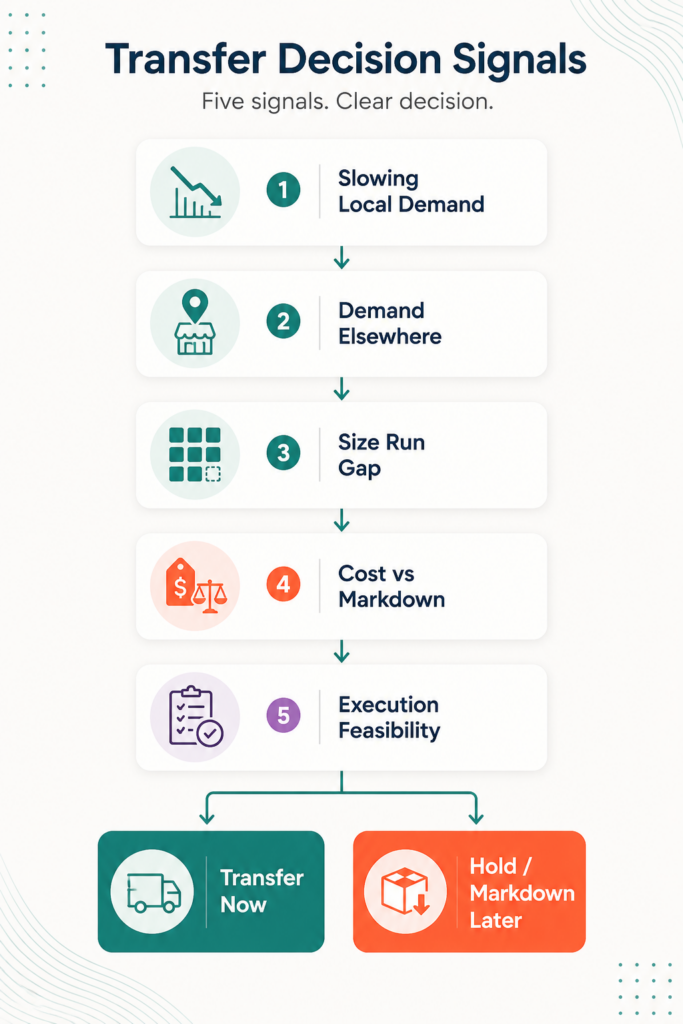
So when should retailers transfer inventory between stores? Transfer when local demand is weakening, demand is stronger elsewhere, the destination store has a real selling opportunity, and the expected upside is greater than the transfer cost and execution burden.
What You Will Learn
- When a store transfer is worth doing
- Why timing matters more than transfer volume
- The five signals that should trigger action before markdown
- When not to transfer inventory
- Which store transfer KPIs show whether transfers are working
When to Transfer Inventory Between Stores
Retailers should transfer inventory when a product has a stronger probability of selling in another store than in its current location, and when that probability creates more value than the cost of moving it.
That forces a better question than many teams ask. The question is not, “Which stores have extra units?” The better question is, “Which units are losing value where they are, and where could they still convert at a healthier rate?”
Yes. A retail system can identify transfer opportunities by comparing demand, sell-through, availability, markdown risk, transfer cost, and store capacity across locations. The goal is not to move inventory more often; it is to move the units with the clearest margin and availability upside.
That is AI-native inventory execution: a shared decision layer that connects the data, business rules, constraints, and workflow behind each move.
This is why store transfers sit between merchandising, planning, and execution. A good transfer decision takes signals from demand, assortment, store performance, and local inventory health, then turns them into a practical move that store teams can actually carry out. The move only matters if it improves a real retail outcome such as full-price sell-through, size availability, or margin protection.
The U.S. Census Bureau defines the inventories-to-sales ratio as the relationship between end-of-month inventory and monthly sales, which can be read as how many months of inventory are on hand relative to current sales. That is useful context, but chain-level inventory ratios do not tell you which specific stores are over-covered and which are under-covered. Transfer decisions happen below that level.
Why Store Transfer Timing Matters More Than Most Retailers Think
Retailers often treat transfers as a late-stage reaction. By the time the move is approved, the source store has already proven the item is not moving, the destination store may have already missed demand, and the markdown clock is getting louder.
That delay is expensive. McKinsey has written about the cost of inventory gluts and the pressure retailers face when bloated stock positions force them toward discounting rather than healthier actions earlier in the lifecycle. Once a product has lost too much time, the transfer is no longer a margin-preserving decision. It becomes a salvage decision.
Timing matters even more because retail demand is not moving evenly. Bain projects 4.0% nominal US retail sales growth in 2025, but in the same breath points to shifting consumer behavior, economic volatility, and trade complexity as ongoing realities for retailers. In practice, that means one store can feel slow while another is short on the very same item.
The network can look healthy while individual stores stay out of balance. The U.S. Census Bureau’s March 2026 report showed a total business inventories-to-sales ratio of 1.32, down from 1.38 a year earlier. That may suggest broad improvement, but it does not mean inventory is positioned correctly at the store level. Retailers still need a way to decide when local imbalance has become valuable enough to act on.
The 5 Signals That a Transfer Is Worth Doing Now
1. Demand Is Slowing in One Store and Accelerating in Another
The clearest signal is a widening sell-through gap between locations. If one store is holding weeks of cover on an item while another is short and still converting, the issue is not total inventory. The issue is placement.
This is where many teams wait too long. They keep hoping local demand will recover in the weak store instead of recognizing that demand may already have shifted elsewhere. A transfer is most valuable when it happens while the item still has full-price energy in the destination store.
2. The Destination Store Can Complete a Broken Size Run or Assortment
Sometimes the value of a transfer is not in adding one more unit. It is in making the assortment sellable again.
If a store has demand but is missing a key size or a missing style-color-size combination, a small transfer can unlock disproportionate value. McKinsey’s State of Fashion notes that inaccurate stock buying across sizes can create profit loss of up to 20% on average, which reinforces how much damage incomplete size availability can do.
For many apparel and footwear retailers, this is one of the strongest transfer signals because it connects inventory movement directly to conversion probability.
3. Markdown Risk Is Rising Faster Than Transfer Cost
Retailers should compare the cost of moving the item with the cost of leaving it in place. If the likely next step in the source store is a markdown, then the real comparison is not transfer cost versus zero. It is transfer cost versus margin erosion.
This is the practical difference between a transfer-first decision and a markdown-first decision. A transfer-first decision asks whether the item can still win elsewhere at a healthier price. A markdown-first decision assumes that the current store is the last realistic selling option.
That does not mean transfers always beat markdowns. It means the retailer should decide earlier, when both options are still available.
4. The Item Still Has Full-Price Selling Potential Elsewhere
Not every slow seller deserves to move. The best transfer candidates are products that are soft in one location but still relevant in another because of customer profile, climate, store format, local trend, or selling momentum.
This is where tail rotation matters. A product may be nearing the end of its local life in one store but still have a healthy full-price window in another. The goal is not to move inventory for the sake of movement. The goal is to relocate selling potential before it disappears.
Onebeat’s Grupo Nomura case study shows the business value of this approach. The company used strategic store-to-store transfers to turn stock imbalance into a revenue lever, generating $1.2 million in incremental revenue in the first six months, reallocating 47,380 units, and converting 39% of transferred inventory into sales. Those results are case-specific, but they illustrate why transfer timing matters.
5. The Move Is Operationally Feasible and Worth Prioritizing
A good transfer on paper can still be a bad transfer in practice.
The destination store needs capacity. The route needs to make sense. Labor has to be available. The item has to arrive with enough selling time left. If those conditions are missing, the transfer may create activity without creating value.
This is why strong retailers do not evaluate transfers one request at a time. They prioritize the moves with the best combination of expected margin protected, likelihood of near-term sell-through, and ease of execution.
Pro Tip
Rank transfer opportunities by three things at once: expected margin protected, speed to likely sell-through, and operational simplicity. The best moves are often not the biggest ones. They are the ones that are easiest to execute while the selling window is still open.
When Retailers Should Not Transfer Inventory
Transfers should not become a reflex. If demand is weak across the network, moving the item may only spread the problem.
Retailers also should not transfer when the cost of movement is too high relative to the likely upside. That includes labor-heavy moves, long routes, low-value items, or products so late in their lifecycle that no store has a credible full-price opportunity left.
Another red flag is operational friction. If store teams are already overloaded, the transfer process is inconsistent, or the receiving location cannot absorb the goods cleanly, the move may create more noise than value. In those cases, a faster markdown or a different lifecycle action may be the better decision.
The point is discipline. A transfer is only smart when it improves the next best outcome.
Which KPIs Show Whether Store Transfers Are Actually Working
Retailers should measure transfers the same way they measure any inventory action: by business impact, not by activity volume. That is what makes store transfer KPIs useful. They show whether movement improved the economic result.
The first KPI is sell-through uplift on transferred units. Did the receiving store actually sell the product faster or at a healthier rate than the source store was likely to?
The second is margin preserved versus the likely markdown path. If a transferred item sold at or near full price in the destination store, that matters more than the fact that it moved.
The third is transfer cost per unit or per move. Teams need to know whether the economics hold up at scale.
The fourth is conversion on transferred inventory. This is one reason the Nomura case is useful. A reported 39% sales conversion on transferred inventory gives a more practical view of success than transfer count alone.
The fifth is reduction in stranded or tail inventory. If the same stores continue to accumulate the same kinds of slow stock, the issue may not be transfer execution alone. It may point back to allocation, replenishment, or assortment decisions upstream.
How Onebeat Turns Transfer Decisions Into Executable Inventory Actions
Many retailers already have reports that show imbalance. The bigger challenge is deciding which moves are worth making now, in what order, and with what expected return.
That is the difference between seeing imbalance and knowing which move is worth making first. Planning tools plan. Onebeat runs the loop by helping retailers turn demand signals into executable inventory decisions across allocation, replenishment, transfers, and lifecycle management.
In store transfers, that means evaluating whether inventory can sell better elsewhere, weighing local demand signals, assortment gaps, transfer cost, and execution feasibility, then prioritizing the moves with the strongest expected value. This is what separates strategic transfer action from ad hoc store requests.
The Grupo Nomura case is a strong example of this logic in practice, where transfers shifted from reactive requests to strategic decisions with clearer criteria and expected ROI before execution.
The value is not that inventory moves. The value is that the right inventory moves early enough to protect margin and improve availability.
Key Takeaway
Retailers should transfer inventory when a product is losing value in one store and still has a stronger selling opportunity in another, provided the upside is greater than the cost and complexity of the move. The best transfer programs are built on timing, prioritization, and SKU-store decision quality.
See how Onebeat turns store-level demand and inventory constraints into daily transfer decisions.
FAQs
What is the difference between a store transfer and a markdown decision?
A store transfer tries to preserve value by moving inventory to a location where it can still sell better. A markdown accepts lower margin in order to clear stock where it sits.
How do retailers know if a transfer is worth the cost?
They compare expected sell-through and margin upside in the destination store with transfer cost, labor effort, timing, and the alternative path if the item stays put.
Should slow-moving inventory always be transferred?
No. If demand is weak everywhere, the item is too late in lifecycle, or the move is too expensive or difficult to execute, a transfer may not be the best choice.
What KPIs matter most for store transfers?
Sell-through uplift, margin preserved, transfer cost, conversion on transferred inventory, and reduction in stranded inventory are the most useful measures.
How are store transfers different from replenishment?
Replenishment pushes inventory into ongoing demand based on expected need. Store transfers reallocate existing stock that is already in the network but positioned in the wrong place.


