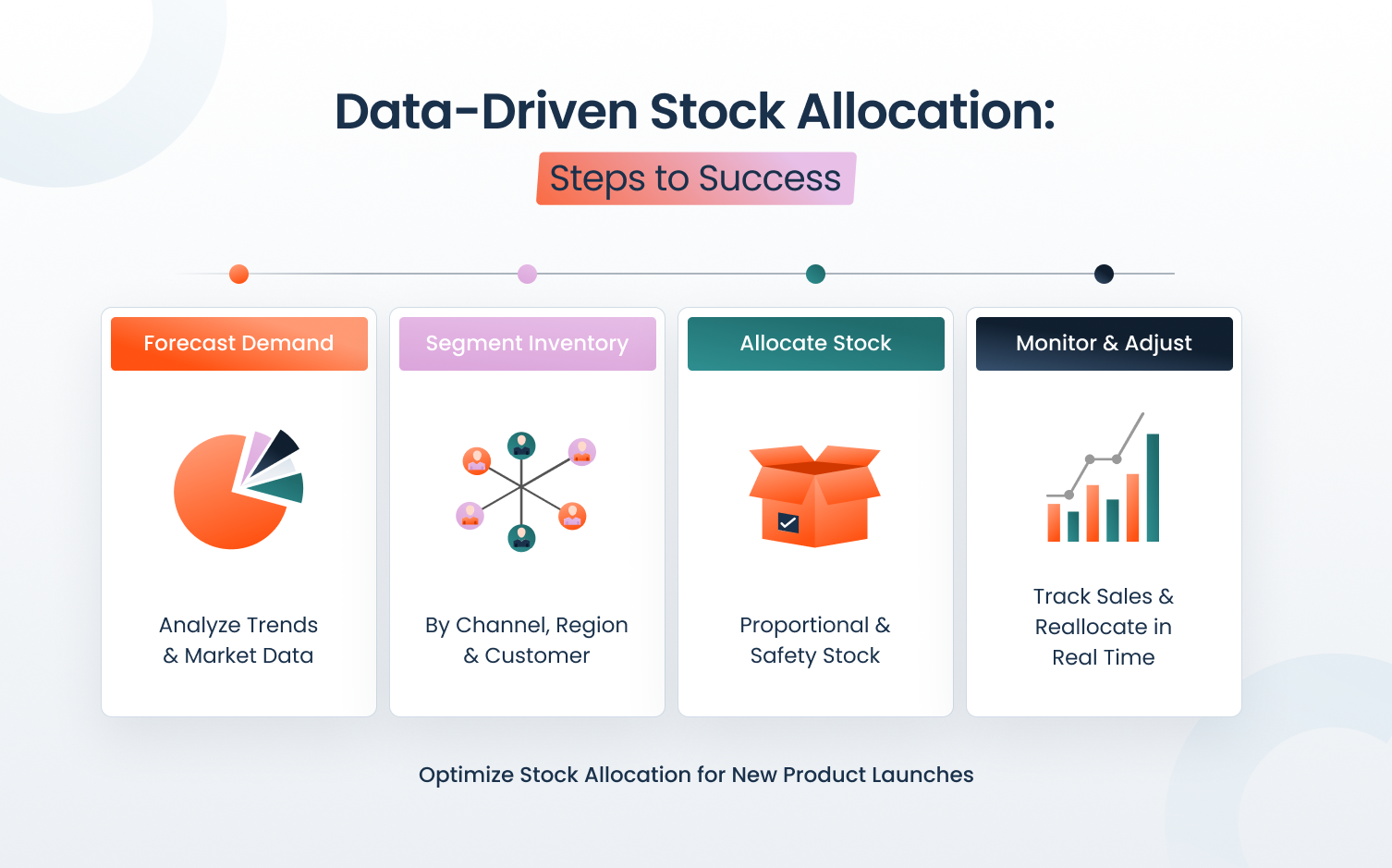
Store transfers shouldn’t be a late-season panic move for slow sellers. When done right, they’re a profit lever: shift inventory to the exact stores where it’s most likely to sell at (or near) full price, before you’re forced into markdowns. The difference comes down to timing, data, and discipline. When retailers move the right SKUs, and only when the economics make sense, store transfers stop being expensive. Rather, they become a repeatable strategy for protecting margins, reducing reliance on markdowns, and getting value from inventory you already own.
In this guide, we’ll break down why most store transfer programs fall short and how leading retailers use demand signals, ROI math, and execution to turn transfers into full-price sales engines.
What will you learn?
In this article, you’ll learn:
- How to turn future markdown inventory into full-price sales
- The three main reasons store transfers fail
- Step-by-step playbook to identify and refine sales
- Metrics and KPIs that prove ROI
Why are store transfers the overlooked key to boosting margins?
Markdowns feel like the fastest way to clear stock, but they permanently give away margin. Transfers are different: you’re not discounting demand, you’re matching supply to it. When you move the right units early enough, you convert “future markdown inventory” into full-price sales.
Think of transfers as preemptive margin protection. Rather than waiting for a product to underperform and then cutting its price, you proactively move it to a store where it has a higher likelihood of selling at full price. Transfers are powerful for several reasons:
- They support both rebalancing and consolidation strategies
- They convert future markdown inventory into full-price sales items
- They maximize network-level performance, not just individual stores
- Frequent markdowns can condition customers to wait for sales, eroding brand perception and pricing power.
- Beyond lost margin, unsold inventory often incurs additional costs, including storage, handling, and eventual liquidation.
Why Do Most Store Transfers Fail?
The hidden cost of guesswork
Guesswork happens when transfers are based on partial visibility and stale forecasts, so teams move inventory that looks slow instead of what will actually sell. When inventory is out of sync (in transit, reserved, backroom-only) and demand signals lag, retailers ship the wrong SKUs or variants to the wrong stores. The result is costly inventory churn, missed sales, and more markdown pressure, not less.
When transfers stay one-to-one
Transfers stay one-to-one when systems only identify single moves, sending one SKU from one store to another without evaluating the full network impact. But store inventory is not a series of isolated decisions. Every transfer affects availability, store workload, and downstream demand across multiple locations. Without network-wide optimization, teams miss better transfer paths, overload certain stores, and move inventory in ways that solve one problem while creating another. The result is more effort, more churn, and less full-price sales recovery.
What happens when speed fails?
Speed fails when transfer decisions happen after the selling window has already narrowed. By the time the team identifies excess stock, approves the move, and the product arrives, demand has shifted, or the destination store is already in markdown mode. Late transfers turn into expensive reshuffling instead of full-price sales recovery.
What does ROI math mean?
No ROI math occurs when transfers get approved without calculating whether the move will actually yield a return on investment. Once you factor in labor, shipping, receiving time, and the risk of lost sales at the origin store, many obvious transfers are margin-negative. Without true-cost ROI, retailers end up moving inventory more than they’re improving sell-through
The secret formula: Demand signal + true cost + speedy execution
The best operators treat transfers like an investment decision, not a logistics task.
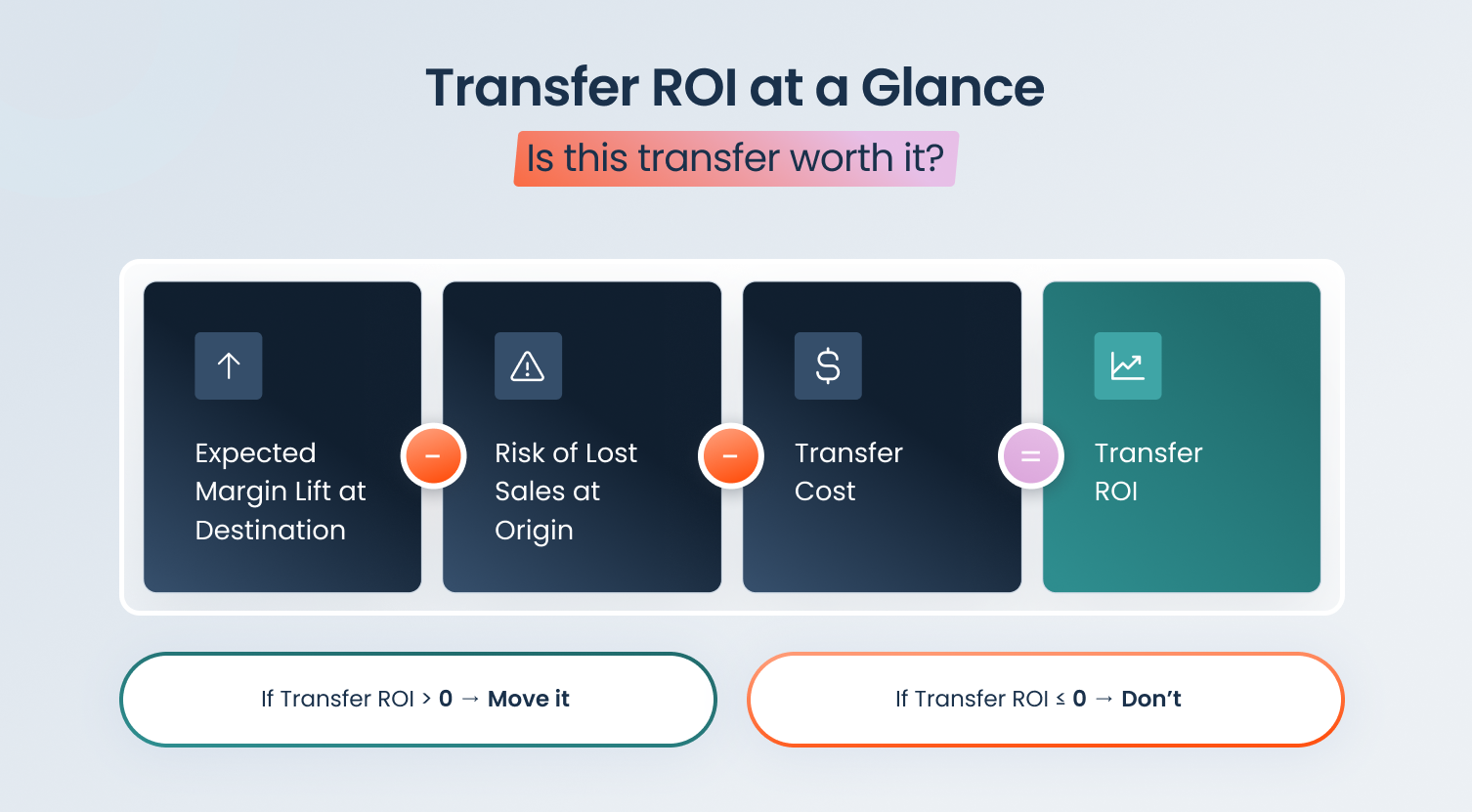
Transfer ROI formula (simple rule):
(Expected Margin Lift at Destination – Risk of Lost Sales at Origin) – Transfer Cost
If the cost is positive, move it. If not, don’t. This is the shift from moving what’s overstocked to moving what will sell better elsewhere.
A practical 3-step transfer playbook: Identify, Evaluate, Refine
Start with a ranked list of misplaced inventory: items that are underperforming in Store A but have clear demand signals in Store B (sell-through gaps, repeated stockouts, strong category velocity, local size/color preferences). The same logic applies when the destination is an outlet or liquidation channel. Many retailers consolidate inventory based mostly on geography, but the best results come from matching products to the locations or channels where that category and customer profile actually perform. Onebeat describes this as analyzing demand, inventory, and sales data to pinpoint SKUs likely to perform better in other locations.
- Clear sell-through gaps between stores
- Repeated stockouts or being low on hand in specific locations
- Strong category or style velocity in certain regions
- Local size or colour preferences that don’t match the origin store
Step 2: Evaluate the true cost (so you only do ROI-positive moves)
A transfer isn’t free inventory. You’re paying for handling, shipping, labor, time, and risk. Build a true-cost model that includes: pick/pack time, freight, receiving workload, and, most importantly, opportunity cost (what if the origin store suddenly sells?). Just as important, evaluate whether the destination store can actually sell the product at full price. Many retailers have merchandising requirements like completing a size curve, making sure the full collection is represented, or maintaining the right assortment mix on the floor. If the transfer does not support those presentation needs, even a high-demand store may not be able to sell it effectively. Onebeat explicitly frames this step as calculating the true cost of each transfer to ensure ROI-positive moves.
Step 3: Refine the rules so each cycle gets smarter
The first month is about learning. Add guardrails based on what you see: minimum expected sell-through window, max distance, pack-size constraints, and exceptions for hero items. Onebeat positions this as fine-tuning transfer settings to business needs, improving each cycle over time.
What Should Be Measured?
Store transfers can only work at a scale when everyone decides what “success” looks like. If you’re only tracking how much inventory is moved, you’re missing the point. The goal with store transfers isn’t movement; it’s selling faster, better, and at full price. To keep store transfers focused on margin, you should review the following metrics weekly, bi-weekly, or monthly:
Speed to scale:
What percentage of transferred units sold within 30 days?
This will tell you whether you’re hitting the selling window or arriving too late.
Transfer ROI:
If the ROI isn’t positive, the transfer may have added more work without any profit. A question to ask is: did the margin gained at the destination store outweigh the all-in cost of the move?
Markdown avoidance:
How many transferred units are sold at full price, and would they have been discounted otherwise?
Pro Tip
Markdown avoidance is one of the clearest signals that transfers are doing their job. When a transferred item sells at full price in its new location, that’s proof that demand wasn’t created with a discount. You simply moved the product to where demand already existed.
What Are The Common Pitfalls and How Can They Be Avoided?
One of the biggest mistakes in store transfers is moving stock too late. Waiting until a problem is obvious usually means that markdowns become unavoidable. The solution is to monitor demand signals early and act proactively, moving inventory before it loses its full value. By responding to demand signals instead of chasing stock levels, retailers can make smarter transfer decisions, protect margins, and boost sales.
How Does Onebeat Deliver Value in Store Transfers?
Onebeat approaches store transfers as a strategic tool, not just a fallback. Aligning inventory with demand across stores ensures transfers are smart and cost-effective. The platform focuses on making decisions at the SKU level, and continuously refines recommendations, helping retailers sell more products at full price without overstocking or relying on clearance sales.
Key Takeaways
- Store transfers protect margin by moving inventory to where it’s most likely to sell at full price, instead of relying on markdowns to create demand.
- Most transfer programs fail for three reasons: guesswork, late execution, and missing ROI math. Fixing these turns transfers into a repeatable profit lever.
- The best transfers start with SKU-level demand signals (not “overstock intuition”) and prioritize units with the highest probability of selling quickly in the destination store.
- Always calculate true transfer cost (labor, shipping, handling, receiving capacity, and opportunity cost) and only execute ROI-positive moves.
- Make transfers faster and smarter over time by refining rules, tracking outcomes (speed-to-sale, ROI, markdown avoidance), and continuously tuning your transfer strategy.
FAQs
What is a store-to-store transfer in retail?
A store-to-store transfer is moving inventory from one location to another to better match demand, improve availability, and reduce the risk of markdowns.
When should you transfer inventory rather than mark it down?
Transfer when another store has a higher probability of selling the item fast at a better price, and the margin lift exceeds the all-in transfer cost.
How do you calculate whether a transfer is worth it?
Estimate incremental margin at the destination, subtract transfer costs (labor + shipping + handling), and account for the risk of lost sales at the origin. Transfer only if ROI is positive.

Onebeat