
Retailers rarely have the luxury of perfect demand data when inventory has to move. Allocation teams must decide which stores get which products, which sizes, and how much depth before shoppers have fully shown where demand will land.
That is where dynamic allocation matters. Dynamic allocation in retail is adaptive inventory placement across stores, channels, sizes, and SKUs based on demand signals, product behavior, store performance, and operational constraints. It gives retailers a way to move beyond a one-time launch push and keep improving SKU-store placement while the season is still alive.
The stakes are real. IHL Group estimates that retailers lose a meaningful share of sales to out-of-stocks and overstocks, with its 2025 inventory distortion report page citing 6.5% of all sales lost to those issues.
Better allocation will not solve every inventory problem by itself. But it can improve one of retail’s most valuable decisions: where inventory should go now, given what the retailer knows today.
Lo que aprenderás
- What dynamic allocation means in retail.
- How dynamic allocation differs from static initial allocation and replenishment.
- Which signals improve SKU-store allocation decisions.
- Why product similarity and size curves matter for new and seasonal products.
- Which KPIs show whether allocation is improving availability and inventory productivity.
- How Onebeat frames allocation inside the Inventory Intelligence Loop.
What Is Dynamic Allocation in Retail?
Dynamic allocation is adaptive inventory placement. It helps retailers decide which stores, channels, sizes, and SKUs should receive inventory based on demand signals, product behavior, store performance, and operational constraints.
Traditional allocation often starts with fixed rules. A retailer might allocate by store tier, region, sales history, channel, or broad cluster. Those rules are useful as a starting point, especially when the product has not launched yet. The problem is that demand rarely follows the launch plan perfectly.
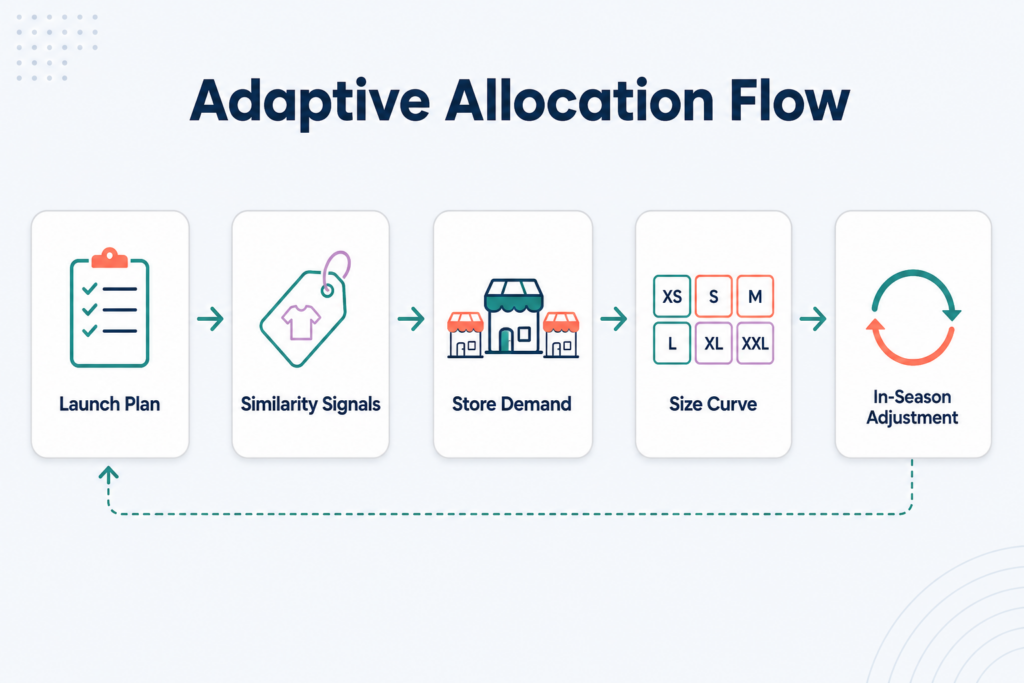
Dynamic allocation treats the first allocation as a hypothesis. Once products reach the market, the retailer watches what happens: which stores sell through, which sizes break first, which locations lag, which comparable products behave similarly, and where inventory is likely to produce full-price sales.
In practice, this means allocation does not stop when inventory leaves the warehouse. It becomes part of a living retail execution process. The goal is not to spread product evenly. The goal is to place the right depth in the right stores while there is still time to affect sales and margin.
Why Static Initial Allocation Breaks Down After Launch
Initial allocation is hard because it asks teams to make decisions before the market has fully spoken. A planner may know the assortment, the store groups, the intended buys, and the expected curve. But shoppers decide in the real world, store by store.
Static allocation breaks down when it assumes that past averages are enough. A top store in one category may not be a top store for a new silhouette. A warm-weather region may not behave the same way during an unusual season. A store with strong overall sales may still underperform on a specific size range. A product that looks like a prior winner may behave differently because of color, fit, price, or timing.
That mismatch creates two problems at once. Some stores lose sales because they do not have the right item or size. Other stores carry inventory that does not move, tying up cash and increasing markdown exposure. IHL’s 2026 inventory distortion analysis frames the problem as both stockouts and overstocks, not one or the other.
The issue is not that allocation teams are careless. It is that static rules cannot keep up with changing demand. Retailers need allocation decisions that respond to evidence as it appears.
The Signals That Make Dynamic Allocation Smarter
Dynamic allocation works when it uses the right signals. More data is not the point. Better allocation comes from turning the right data into a better decision.
The most useful signals include sell-through, coverage, assortment gaps, store clusters, store performance, current availability, product attributes, comparable-product behavior, and size curves. In fashion, footwear, and other size-sensitive categories, size curves are especially important because a store can look stocked while still missing the sizes that actually sell.
Product similarity matters when the item is new or has limited history. If a retailer has never sold a specific style before, it can still learn from products with similar attributes, images, prices, categories, customer groups, or historical behavior. This is where allocation becomes more intelligent than a simple historic-sales rule.
Store-level demand is another critical signal. A retailer may know that a product is selling well overall, but allocation value comes from knowing where it is selling, where it is likely to keep selling, and which stores need more depth or a different size mix.
A useful allocation signal checklist should include:
- Current sell-through by SKU, store, color, and size.
- Coverage by store and size curve.
- Store cluster performance and local demand patterns.
- Product similarity and comparable-product behavior.
- Assortment gaps and broken size runs.
- Warehouse, shipping, minimum quantity, and timing constraints.
Consejo profesional
Do not evaluate allocation only by whether the launch looked balanced on paper. Track early sell-through, size availability, coverage, and stranded units by store cluster. The first allocation is a hypothesis. Dynamic allocation is how retailers test and improve it.
Dynamic Allocation vs Replenishment: Where Each Decision Fits
Allocation and replenishment are connected, but they are not the same decision.
Allocation decides where inventory should go. It often happens when product is first received, when a launch is being prepared, when stores need a placement plan, or when available supply must be distributed across locations. Oracle’s retail allocation documentation describes allocation as placing inbound, warehouse, or store inventory across stores or warehouses, which is a useful baseline for the mechanics of the process.
Replenishment keeps inventory flowing against ongoing demand. Once a product is in market, replenishment decisions decide how stores should be refilled, when supply should move, and which locations should be prioritized when inventory is limited.
The mistake is treating these as disconnected workflows. A strong retail operating model connects them. Allocation sets the first placement. Replenishment, transfers, promotions, and in-season purchasing then respond as demand becomes clearer. When those decisions share the same demand signals, retailers can avoid the common trap of overcorrecting in one store while under-serving another.
How Dynamic Allocation Improves Sell-Through and Inventory Productivity
The business value of dynamic allocation comes from better inventory productivity. That means inventory is not just lower or higher. It is working harder in the stores where it has the best chance to sell.
For allocation teams, this changes the KPI conversation. A launch can look efficient because units were distributed according to plan, yet still perform poorly if core sizes break in high-demand stores or slow stores receive too much depth. The better question is whether the allocation improved availability where demand existed and reduced inventory trapped where demand was weaker.
Useful KPIs include full-price sell-through, size availability, rate of broken size runs, store-level coverage, lost sales risk, stranded units, transfer need, markdown exposure, and replenishment exceptions. These measures show whether allocation is helping inventory turn into revenue, not merely whether units were pushed out.
Onebeat’s Initial Allocation uses historical sales behavior and similar styles to guide placement.
How to Move From Rule-Based Allocation to Adaptive Allocation
Retailers do not need to throw away every allocation rule. Rules are useful when they capture known constraints, store roles, presentation minimums, or service expectations. The shift is to stop treating rules as the final answer.
A practical transition starts with product and store segmentation. Which products need size precision? Which stores have distinct local demand? Which categories are seasonal, trend-driven, or low-history? Which products should be allocated by cluster, and which need SKU-store precision?
Next, define the signals that should change the decision. For a footwear retailer, that may include size curve, comparable style behavior, launch sell-through, local climate, and current coverage. For a specialty retailer, it may include store role, assortment depth, sell-through rate, and supply constraints.
Then connect allocation to the decisions that follow. If a product sells faster than expected in one store cluster, replenishment should know. If inventory becomes stranded, transfers should know. If demand spikes during an event, promotion and replenishment decisions should know. Adaptive allocation is most valuable when it is part of a connected execution process, not a separate planning exercise.
A simple operating question helps: what would make us change the original allocation decision? If the answer is not clear, the process is probably still too static.
Where Onebeat Fits in the Inventory Intelligence Loop
Onebeat’s point of view is that planning tools plan, but retailers need a way to run the loop between planning intent and store-level execution. That matters in allocation because the first plan is never the whole truth. Demand changes, stores behave differently, sizes break unevenly, and supply constraints force tradeoffs.
Precision Inventory Intelligence for Retail Planning & Execution means turning those signals into executable inventory actions. In Smart Allocation, that means using live demand, product similarity, size curves, store performance, and comparable-product behavior to recommend SKU-store placement with better timing and better context.
The same loop should connect allocation with replenishment, store transfers, promotions, in-season purchasing, and lifecycle management. If allocation reveals that a product is winning in a store cluster, that signal should inform replenishment or repeat-buy decisions. If a product is weak in specific stores, that signal should inform transfers or lifecycle action before markdown pressure grows.
This is the difference between a dashboard and a decision. A dashboard can show that demand changed. The Inventory Intelligence Loop helps retailers decide what to do about it.
Key Takeaway
Dynamic allocation helps retailers stop treating allocation as a one-time push. The stronger model is adaptive: use live demand, product similarity, size curves, store performance, and constraints to keep improving SKU-store placement after the product reaches the market.
Preguntas frecuentes
What is dynamic allocation in retail?
Dynamic allocation is adaptive inventory placement. It helps retailers decide which stores, channels, sizes, and SKUs should receive inventory based on live demand signals, product behavior, store performance, and supply constraints.
How is dynamic allocation different from initial allocation?
Initial allocation is the first placement of inventory, often before full demand is known. Dynamic allocation keeps learning after launch and adjusts placement decisions as sell-through, coverage, size availability, and store demand become clearer.
How is allocation different from replenishment?
Allocation decides where inventory should go, especially at launch or when available supply needs to be placed. Replenishment keeps inventory flowing against ongoing demand after products are already in market. They are different decisions, but they should share demand signals.
What data is used for dynamic allocation?
Useful data includes sell-through, coverage, size curves, store performance, product attributes, product similarity, comparable-product behavior, assortment gaps, and warehouse or shipping constraints.
Can dynamic allocation help reduce markdowns?
It can reduce markdown exposure when it helps retailers place inventory closer to real demand and avoid stranded units. It should not be framed as a guarantee. Markdown risk also depends on buying, pricing, replenishment, transfers, promotions, and lifecycle decisions.


